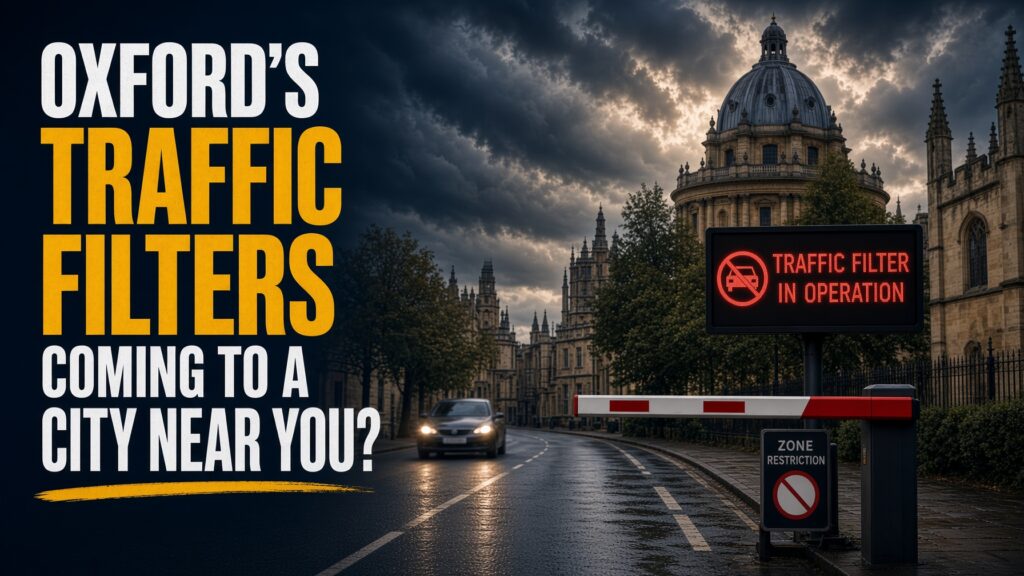
Are Oxford’s Traffic Filters Coming to a City Near You?
A British city just started fining drivers by camera for using their own streets — and the real rules raise nearly as many questions as the viral rumors do.
Six cameras just started writing tickets in Oxford, England. On September 28, 2026, Oxfordshire County Council switched on a trial of six “traffic filters” — number-plate cameras that fine drivers who pass through certain roads without a permit. Within days, a viral clip claimed residents now pay $93 a day to leave a government-drawn “15-minute city,” tracked entirely by AI. The real policy is different, and in some ways more troubling than the exaggerated version, because it’s real, it’s already live, and almost nobody outside Oxfordshire has read the actual rules.
What Are Oxford’s Traffic Filters, Exactly?
The scheme places automatic number-plate recognition cameras on six specific roads across Oxford. Between 7 a.m. and 7 p.m., any car passing through one of those points without a valid permit or exemption gets a fine in the mail [Oxfordshire County Council]. Buses, taxis, bikes, and pedestrians pass through freely at all hours. Residents can still drive anywhere in the city — they may simply need to use a different route, such as the ring road, once their permits run out [Oxfordshire County Council joint statement].
Support Independent Local Journalism
TheTownHall.News is a non-profit reader-supported journalism. Just $5 helps us hire local reporters, investigate important issues, and hold public officials accountable across Alameda County. If you believe our community deserves strong, independent journalism, please consider donating $5 today to support our work.That distinction matters. This is not a wall around a “15-minute city.” It’s a camera-enforced restriction on six roads, tied to a household permit system that resets every calendar year.
Is the Viral $93-a-Day Fine Real?
No. The actual fine for passing through a filter without a permit is £70, cut to £35 if paid within 21 days — roughly $45 to $90, and it’s a one-time traffic penalty, not a daily toll for leaving the city [Oxfordshire County Council]. Oxford-area residents receive 100 free permit days a year; residents elsewhere in Oxfordshire get 25 [Full Fact, AAP FactCheck]. Both fact-checking organizations independently confirmed the “confined to a zone” framing distorts the council’s own trial.
If a policy is controversial enough to need a government fact-check within days of launching, shouldn’t that alone tell you something about how it was sold to the public?
- That’s how many free driving days Oxford-area residents get before a permit is required — the question nobody’s asking is why a city needs a permit system for its own roads at all.
How Is It Actually Being Enforced?
There’s no officer at a checkpoint and no physical gate. The system runs entirely on automatic number-plate recognition cameras that read a car’s plate, check it against the permit database, and mail a fine to registered vehicles with no valid pass [Oxfordshire County Council]. That’s a meaningfully different reality than “AI hunting you down” — but it’s still a fully automated enforcement pipeline, issuing financial penalties with no human review before the fine is generated.

That’s worth sitting with on its own terms. Automated systems don’t get tired, don’t get distracted, and don’t use discretion — which is either the strongest argument for them or the strongest argument against handing government fines over to a machine, depending on who you ask.
Why Should Americans Care About a British Traffic Scheme?
Because the technology isn’t staying in Oxford. Automatic license-plate readers already blanket thousands of American communities, and companies like Flock Safety have built networks that let police departments search plate data across state lines. Separately, federal agencies have expanded use of Palantir’s data-integration software to link records across government systems. Neither of those U.S. programs is the same as Oxford’s traffic filters, and none of them currently charges drivers a daily fee to leave a neighborhood.
But the underlying infrastructure — cameras that read every plate, databases that store the results, and fines with no human review — is exactly what a future policymaker could repurpose.
What Do Supporters of Oxford’s Traffic Filters Actually Believe?
Supporters make a real argument worth engaging honestly. They say Oxford’s roads are congested, that filtering through-traffic on a handful of streets encourages walking, cycling, and bus use, and that 100 free driving days a year covers the overwhelming majority of residents’ actual car trips. They point out that no one is fined for walking, biking, or taking a bus anywhere in the city, at any hour.
That argument isn’t baseless — congestion is a genuine problem, and the permit allowance is generous enough that most casual drivers may never hit the cap. But convenience for most residents doesn’t answer the harder question: who decided six specific roads should require government permission to drive on, and what accountability exists if that number of restricted roads quietly grows next year, or the year after?
Support Independent Local Journalism
TheTownHall.News is a non-profit reader-supported journalism. Just $5 helps us hire local reporters, investigate important issues, and hold public officials accountable across Alameda County. If you believe our community deserves strong, independent journalism, please consider donating $5 today to support our work.Is it really “free movement” when the government is the one deciding how many free days you get?
Who’s Really Accountable When a Camera Writes the Ticket?
Oxfordshire County Council approved the trial, and it can be expanded, narrowed, or made permanent based on results the council itself will evaluate. That’s a normal function of local government — but it also means the body that designed the cameras is the same body judging whether the cameras worked. There is no independent audit built into the trial’s design that’s been made public.
For residents who never asked for a permit system on roads they’ve driven for free their whole lives, that’s a legitimate accountability gap, not a conspiracy. The infrastructure works exactly as described. What’s missing is a clear, independent answer to who watches the watchers once the trial period ends.
Key Questions This Story Raises:
- If Oxford’s traffic filters expand beyond six roads, what independent body would review that decision — and would residents get a vote?
- Should any government be allowed to fine drivers using a fully automated system with no human review before the ticket is issued?
- As U.S. cities expand license-plate camera networks for other purposes, what stops that infrastructure from being repurposed for road-use fees like Oxford’s?
Is This Where American Roads Are Headed?
Oxford’s traffic filters are not a “15-minute city” prison, and the $93-a-day figure racing around social media is false. But the real policy — automated cameras, permit caps, fines with no human review, and a council that grades its own homework — is a genuine test case for how much authority citizens are willing to hand to a camera network before anyone asks who’s accountable for what it does next.
The technology behind Oxford’s cameras already exists on American streets. The only open question is what it gets used for once it’s there. The real question isn’t whether Oxford’s rules are as extreme as the viral version claims — it’s whether Americans will demand accountability for similar systems before they’re fully built out at home.
Still have questions about how camera enforcement works where you live? Stay informed — subscribe for daily coverage of government accountability and surveillance policy. Think your neighbors need the real numbers instead of the viral version? Share this article. Want your voice to count? Contact your city council or state representative and ask whether local automatic license-plate camera data is shared with third parties like Flock Safety or federal agencies — most city council websites list direct contact information for members.