
Are DOJ Election Monitors in Alameda a Real Safeguard or Overreach?
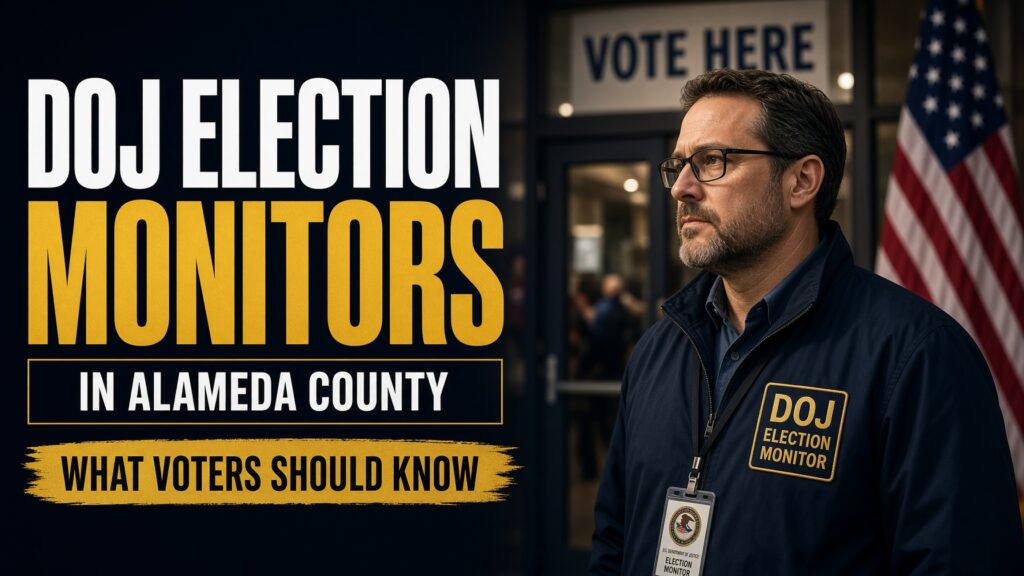
As roughly 1,000 federal monitors spread across all 50 states for the first time, one question follows them into Alameda County: who is watching the watchers, and what are they allowed to do?
One thousand federal monitors just spread across all 50 states.
The Justice Department announced Tuesday, on Election Day, that Alameda County is one of four California counties receiving DOJ election monitors, alongside Los Angeles, Sacramento and San Diego [local TV report]. The department calls it the largest monitoring operation in its history and the first to reach every state. With California’s ballots still being counted, the question is no longer whether monitors showed up. It is what they are there to do. ktvuktvu
Support Independent Local Journalism
TheTownHall.News is a non-profit reader-supported journalism. Just $5 helps us hire local reporters, investigate important issues, and hold public officials accountable across Alameda County. If you believe our community deserves strong, independent journalism, please consider donating $5 today to support our work.Is This Really Business as Usual in Alameda County?
In part, yes. Alameda County has hosted federal monitors many times, usually in federal election years, and Registrar of Voters Cynthia Cornejo said the county still has not been told why it was chosen this time [local TV report]. Earlier CBS San Francisco coverage shows a 2011 court order requiring the county to keep enough Spanish- and Chinese-speaking poll workers, with federal observers checking compliance [local TV archive]. CBS NewsCBS News
That is federal oversight at its most conventional: making sure a voter can read a ballot and be understood at the counter. The personnel mix is familiar too. This year’s monitors come from across the Justice Department, U.S. Attorney’s Offices and the Office of Personnel Management [Fox News]. So the sight of a federal monitor is not new. The scale is. Fox News
What Is Different About This Year’s Deployment?
The numbers tell the story. DOJ sent 289 monitors for the 2022 midterms and 714 for the 2024 presidential election [Newsweek]. This year’s operation follows more than 80 monitors sent to primaries in seven states, according to Assistant Attorney General Harmeet Dhillon, who leads the Civil Rights Division [Fox News]. NewsweekFox News
1,000 monitors. More than triple the 2022 total. The question worth asking: what does this many monitors catch that 289 did not?

DOJ’s stated mission is modest. It says every monitor will only observe and report potential violations of federal law, which the department will review after Election Day [CBS San Francisco]. It also says monitors will check that polling places are accessible to voters with disabilities. [Fox News] Dhillon has described the job as watching election practices and pursuing any suspected fraud afterward, not stepping into the voting line [Fox News]. Federal election monitors deploy to Alameda County +2
Federal monitors can watch an election. They cannot run one. The gap between those two verbs is the entire case for keeping the line where state law draws it.
Where Does Washington’s Role End and the States’ Begin?
American elections are run by states and counties, not by Washington. That is not a technicality. It is the design. Federal law gives DOJ a defined job: enforcing federal voting-rights statutes, not supervising the ballot box.
Dhillon has said monitors will follow state law, including state-set buffer zones, offering a 150-yard perimeter as an example, and many states bar monitors from entering polling places at all [Fox News, citing Bloomberg interview]. That is federalism working in practice: Washington watches from the line state law draws. Fox News
There is history behind that restraint. After the Supreme Court’s 2013 Shelby County decision, observers became restricted, so the department used more monitors, who are not allowed to enter polling stations uninvited [BuzzFeed News, 2016 reporting; Christian Science Monitor]. The monitor’s role was built around invitation and consent, not command. buzzfeednews
Support Independent Local Journalism
TheTownHall.News is a non-profit reader-supported journalism. Just $5 helps us hire local reporters, investigate important issues, and hold public officials accountable across Alameda County. If you believe our community deserves strong, independent journalism, please consider donating $5 today to support our work.Courts have reinforced the line. District Judge Reggie Walton declined to block the deployment but ordered DOJ to ensure its monitors are not law enforcement officers with arrest authority [AURN, court order]. DOJ told the court in an October 28 declaration that it was not using sworn officers with arrest powers as monitors in a law enforcement capacity [Newsweek]. Separately, on Monday the Supreme Court rejected the administration’s bid to make California segregate ballots from 20,000 voters DOJ believes are noncitizens [Fox News]. Limited government means limits that hold when someone tests them. Court Limits DOJ Poll Monitors After Civil Rights Challenge +2
If a federal monitor stands where state law allows and reports only what federal law covers, is that a threat to local control or the system working as designed?
What Do Critics of the Monitor Plan Actually Believe?
Critics are not making a frivolous argument. California Attorney General Rob Bonta and other critics contend that an unusually large federal presence could spook voters or discourage some from casting ballots [Fox News]. The NAACP went to court to try to stop the plan [Fox News]. Bonta said his office is sending state observers alongside the federal monitors, as California did in the previous two elections [Fox News]. Bonta says he’ll counter DOJ election monitors with observers of his own +2
That concern deserves a real answer, and the record offers part of one. Perception matters in a democracy. But the safeguards now in place are built for exactly this worry: state-law perimeters, a court order against armed or arrest-empowered monitors, and state observers watching the federal ones. As of Tuesday afternoon, no significant confrontations involving federal monitors had been publicly reported [Fox News]. That covers only part of Election Day, and it should be updated. Critics are right that this scale invites scrutiny. They overreach if they treat observation as interference. Fox News
Is a watchdog still a watchdog if the public never sees what it reports?
What Happens After the Polls Close?
The real accountability test comes later. Monitor reports are reviewed after Election Day, and any suspected fraud becomes a matter for investigation after the fact [CBS San Francisco; Fox News]. That is where transparency matters most. CBS NewsFox News
Taxpayers are funding a 1,000-person deployment. They are entitled to know what it found, county by county, and whether any finding in Alameda County changes anything. A monitoring program that reports only to itself is not oversight. It is activity.
Voters have a part to play as well. Anyone who sees a problem at a polling place or drop box can report it to the county registrar of voters, and should. Personal responsibility is the other half of election integrity: federal monitors can only observe what neighbors and poll workers are willing to document honestly.
Key Questions This Story Raises:
- What specific violations, if any, will DOJ say its monitors found in Alameda County, and when will it say so?
- Will the department publish county-by-county findings, or review them behind closed doors?
- Why were Alameda, Los Angeles, Sacramento and San Diego chosen out of California’s 58 counties?
The Question That Outlasts Election Night
So are DOJ election monitors a safeguard or an overreach? The honest answer depends on what happens next: whether monitors stay inside the lines of state law, whether the courts’ limits hold, and whether the public ever sees what the monitors reported. Both things can be true at once. Federal voting-rights law deserves enforcement, and the people enforcing it deserve scrutiny.
The real question isn’t whether Washington is watching the vote. It’s whether anyone will watch the watchers once election night is over.
Still have questions? Stay informed: subscribe for daily coverage of elections and accountability. Think others need to see this? Share the article. What do you think, is this a safeguard or overreach? Share this and let us know. Want your voice to count? Contact your member of Congress and your county registrar of voters and ask the Justice Department to publish its monitor findings, county by county.