Aisha Wahab Special Election: Outside Spending, By the Numbers
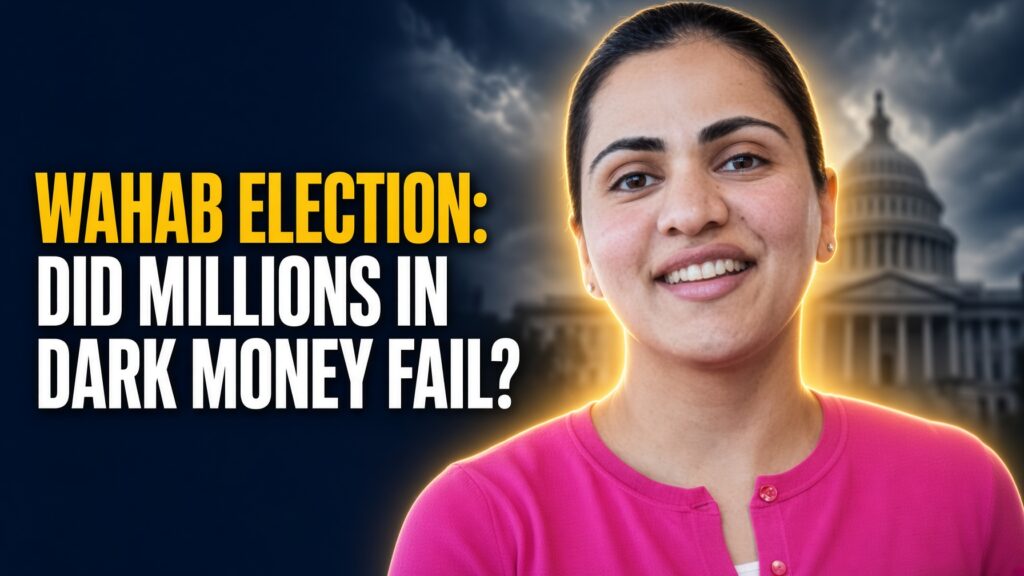
Aisha Wahab called her win proof that “our district cannot be bought.” The final vote margin tells a more complicated story — one every California voter should be asking about.
Millions of dollars couldn’t buy this election.
That is the claim California state Sen. Aisha Wahab made after winning a bruising special election this week to fill the East Bay’s 14th Congressional District seat, vacated in April after former Rep. Eric Swalwell resigned amid misconduct allegations. Wahab’s win makes her the first Afghan American ever elected to Congress. But the bigger accountability story may be what almost happened before voters had their say: a flood of untraceable outside spending that nearly erased a 20-point lead in a matter of weeks.
What Actually Happened in This Race?
Wahab, a progressive Democrat and Hayward resident, entered the special election as the clear frontrunner. She won the June 2 primary by more than 20 points and the June 16 special primary by an even wider 26-point margin over fellow Democrat Melissa Hernandez, a Bay Area Rapid Transit board president. By the time Tuesday’s runoff arrived, however, the race had tightened to a near coin flip, with Wahab ultimately prevailing by roughly two percentage points, according to Associated Press projections. Something changed in those final weeks, and it wasn’t Wahab’s message.
Support Independent Local Journalism
TheTownHall.News is a non-profit reader-supported journalism. Just $5 helps us hire local reporters, investigate important issues, and hold public officials accountable across Alameda County. If you believe our community deserves strong, independent journalism, please consider donating $5 today to support our work.Who Actually Funded This Flood of Spending?
Federal Election Commission filings show the two campaigns themselves raised nowhere near the sums that decided this race. Wahab’s campaign raised about $632,000 and spent about $485,000 through late July [FEC data]. Hernandez raised roughly $1.5 million and spent about $1.4 million over the same period [FEC data]. Neither figure explains the flood of advertising that suddenly reshaped the contest. That came from outside groups. The United Democracy Project, a super PAC aligned with the American Israel Public Affairs Committee, spent more than $2.4 million opposing Wahab and boosting Hernandez, according to FEC filings reviewed by The Hill and NBC News. A second group, Bold America, added roughly $1.8 million. Multiple outlets, including the San Francisco Chronicle and Politico, reported additional spending pushed the total opposing Wahab as high as $5 million to $6 million in the race’s final weeks.
$4 Million. That is the low-end estimate, reported by Al Jazeera and 270toWin, of what outside groups spent on this single low-turnout special election since mid-July alone. The question voters in Alameda County deserve answered: why does electing a temporary representative attract more outside cash than most full congressional campaigns?
Who Is the Woman at the Center of This Story?
Wahab’s own biography is part of what made this race resonate nationally. Born in New York to Afghan refugee parents who fled the Soviet-Afghan war, she lost both her father and mother while still a child. She and her sister entered foster care before being adopted by an Afghan American family and raised in Fremont. She went on to become the first Afghan American elected to public office in the United States when she won a Hayward City Council seat in 2018, and the first Afghan American elected to the California State Senate in 2022. Her win this week extends that pattern to the U.S. House. Whatever side of the outside-spending debate a reader falls on, that trajectory is a genuine, hard-earned American success story, and it deserves to be recognized on its own terms, separate from the financial battle waged around it.
Why Does Outside Spending in Local Races Matter?
Special elections draw a fraction of the turnout of a general election, which means a relatively small pool of late-deciding voters can be moved by a concentrated ad blitz. That is precisely what happened here. Independent expenditure committees can spend unlimited sums as long as they don’t formally coordinate with a campaign, a loophole that has turned low-turnout special elections into inviting targets for national interest groups with no direct stake in Alameda County. Voters rarely know who is funding the mailers landing in their inbox until after the ballots are counted. In this race, at least one mailer sent to district households cited a Republican primary candidate’s endorsement of Hernandez, an apparent attempt by outside groups to pull crossover votes from voters who might otherwise sit out a Democrat-on-Democrat contest entirely. That is not illegal. But it is exactly the kind of tactic that becomes possible only when spending is large enough, and anonymous enough, to reshape a race’s turnout math in the final stretch, regardless of what either candidate actually campaigned on.

Is This Really About Local Representation Anymore?
The spending in this race wasn’t primarily about East Bay issues like housing or transit. Multiple outlets, including KQED and the Times of Israel, reported the money was driven substantially by the candidates’ differing positions on U.S. policy toward Israel and Gaza. Whatever one thinks of that debate, it illustrates the underlying problem: national advocacy groups with no accountability to Alameda County residents were able to pour millions into deciding who represents them, on issues largely separate from the ones voters actually raised on the doorstep.
What Do Supporters of Unlimited Outside Spending Actually Believe?
Defenders of the current campaign finance system make a genuine First Amendment argument. Independent expenditure spending is protected political speech, they argue, and voters remain free to evaluate and reject messages they find misleading, regardless of who paid for them. Restricting that spending, the argument goes, risks restricting speech itself, and incumbents already benefit from enormous structural advantages that outside money can help offset. That argument deserves real weight; free speech protections exist precisely to prevent the government from picking which voices get heard. But it doesn’t fully answer the deeper question raised by this race: whether ordinary voters can meaningfully evaluate a $6 million ad campaign funded by out-of-state groups in the handful of weeks a special election allows, or whether the sheer scale of spending itself functions as a thumb on the scale that no amount of “buyer beware” can offset.
Millions of dollars in outside spending nearly overturned a 20-point lead in three weeks — is that democracy working, or something else?
A California special election just drew more outside cash than some full congressional campaigns. What does that say about who our elections actually serve?
Wahab said her district “cannot be bought.” The final vote margin suggests it came close.
Support Independent Local Journalism
TheTownHall.News is a non-profit reader-supported journalism. Just $5 helps us hire local reporters, investigate important issues, and hold public officials accountable across Alameda County. If you believe our community deserves strong, independent journalism, please consider donating $5 today to support our work.When a handful of national donors can spend more on a local special election than either candidate raised themselves, whose election is it really?
Key Questions This Race Raises:
- Should independent expenditure committees be required to disclose funding sources in real time during a live campaign, rather than after Election Day?
- Why did a temporary, interim congressional seat attract more outside spending than many full two-year campaigns?
- What obligation, if any, do national advocacy groups have to the voters of a district they don’t live in and won’t answer to?
Wahab’s victory is a genuine milestone, and her personal story, from foster care to the U.S. Senate chamber in Sacramento to Congress, is the kind of American success story worth celebrating regardless of party. But the flood of money that nearly swept her opponent past her raises a question that outlasts any single election: if millions of untraceable dollars can turn a 20-point landslide into a coin flip in three weeks, how much longer can any voter honestly say their district can’t be bought?
Both candidates are already back on the ballot. Wahab and Hernandez face each other again in November for the district’s full two-year term, and there is little reason to expect outside spending to slow down. Still have questions about who’s funding the ads flooding your mailbox this fall? Stay informed — subscribe for daily coverage of the money shaping Bay Area elections. Think your neighbors deserve to know who’s paying for this? Share the article. Want your voice to count before November? Look up your district’s independent expenditure filings at the FEC’s website and see exactly who is trying to influence your vote.