
Girls’ Sports Ruling: What the Supreme Court Decided and What’s Next
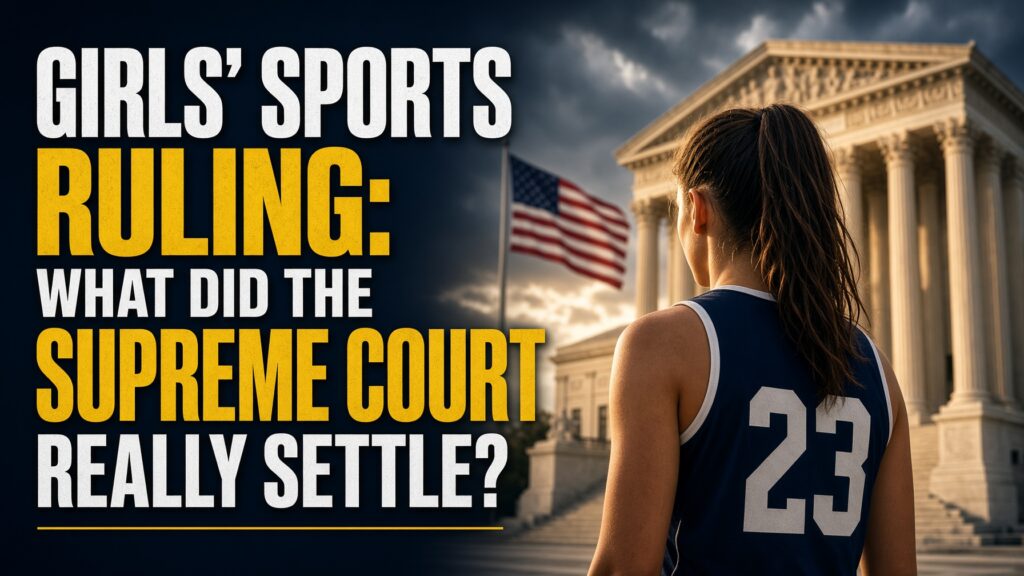
Four months after the justices sided with West Virginia and Idaho, a federal court has already drawn a line around the decision — and parents everywhere are asking what it actually guarantees. States may protect girls’ sports. They are not required to. That gap between “may” and “must” is where the fight stands today. On June 30, 2026, the Supreme Court upheld West Virginia and Idaho laws limiting girls’ teams to biological females, in a 6-3 decision written by Justice Brett Kavanaugh [Supreme Court opinion, reported by Jurist and SCOTUSblog]. Since then, a federal judge has confirmed the ruling protects the states that passed those laws, not a national standard, and the Justice Department’s push for one is still tied up in court.
What Did the Supreme Court Actually Decide?
In West Virginia v. B.P.J. and Little v. Hecox, the Court held that neither Title IX nor the Equal Protection Clause stops a state from reserving girls’ and women’s teams for biological females [SCOTUSblog; Stateline]. On Title IX, the justices were unanimous. On equal protection, the vote was 6-3. The Court reversed the appeals-court rulings that had blocked both laws and sent the cases back for further proceedings [Jurist]. Idaho passed the first such law in 2020, and West Virginia followed in 2021. Twenty-seven states now restrict girls’ sports this way, all enacted since 2020 [advocacy-group tracker, via Bloomberg Law]. The Supreme Court did not invent a new rule for girls’ sports. It confirmed that the states that wrote one had the authority to do so.
Why Did the Court Rule This Way?
Justice Kavanaugh reasoned that West Virginia’s law was at least reasonable, noting that 26 other states, the NCAA and the International Olympic Committee use similar sex-based rules [Stateline]. He also wrote that judging each athlete’s physical capabilities individually would be nearly impossible for a court to do fairly [Jurist]. That is a practical argument as much as a legal one. A sports category only works if its edges are clear, and a category that must be re-argued for every athlete stops being a category at all. The opinion also cautioned that no student-athlete, on either side of the issue, deserves to be ostracized or vilified [AP, via WTTW]. Is that too much to ask of a debate this heated?
Support Independent Local Journalism
TheTownHall.News is a non-profit reader-supported journalism. Just $5 helps us hire local reporters, investigate important issues, and hold public officials accountable across Alameda County. If you believe our community deserves strong, independent journalism, please consider donating $5 today to support our work.What Did the Court Leave Unresolved?
Quite a lot. The Court did not decide whether Title IX permits transgender girls to compete on girls’ teams, a “distinct question” the opinion expressly left alone [as described by U.S. District Judge Cynthia Valenzuela, EdSource]. The ruling also does not affect states that allow transgender participation, and challenges to policies in Connecticut and California remain unresolved [Bloomberg Law; AP]. Connecticut’s case, first filed in 2020, was still at the district-court stage after more than six years of litigation when the Court ruled, with no hearings scheduled [ESPN]. 27 states. All have laws like West Virginia’s and Idaho’s, and the Court’s reasoning favors them [advocacy-group tracker, via Bloomberg Law]. The question still open: what happens in the states that chose a different path?
Is California the Test of “May” Versus “Must”?
It has become one. On August 31, 2026, Judge Valenzuela dismissed the Justice Department’s Title IX lawsuit against California’s education department and its interscholastic athletic federation, a suit that had threatened $44.3 billion in federal education funding [EdSource; Los Angeles Times via Education Week]. Her reasoning was narrow. She found California lacked clear notice that excluding transgender athletes was a condition of its federal money, and that the Supreme Court’s decision did not supply that clarity [EdSource]. A Justice Department spokesperson said the agency was “evaluating our options for appeal.” Public reporting is inconsistent on whether an appeal has since been filed.
Who Should Write the Rules, Washington or the States?
For readers who value limited government, the answer in this ruling is encouraging: the Court left the decision with states, which are closer to parents, coaches and school boards than any federal agency. The California decision shows the other side of that principle. Washington cannot impose a rule through a funding condition it never clearly stated. Washington can’t regulate girls’ sports by implication. If a national standard is worth having, it should be written down, voted on and signed, not inferred from a funding letter. If Congress wants a uniform rule, shouldn’t it write one? Until then, parents have the most influence where the rules are actually made: in statehouses, school boards and state athletic associations.
If states may protect girls’ sports but nothing requires them to, whose daughters get the protection, and whose don’t?
What Do Opponents of These Laws Actually Believe?
Opponents, including the ACLU lawyers who represented the athletes, make a serious argument. They say the laws exclude a very small number of students based on who they are. NCAA president Charlie Baker told Congress in 2024 he knew of about 10 transgender athletes among more than half a million college athletes [AP, via ESPN]. Justice Sonia Sotomayor, dissenting in part, argued the equal protection question turned on unresolved facts that should have been sorted out in the lower courts [Stateline]. Critics also note that Lindsay Hecox had asked to drop her case, yet the Court ruled on it [Bloomberg Law]. Each point deserves an answer. Small numbers cut both ways: if few students are affected, a clear rule costs schools little, while what it protects, a podium spot, a roster place, a scholarship, is concrete for the girls competing. A bright-line rule also spares individual teenagers from athlete-by-athlete scrutiny. On Sotomayor, even the three dissenting justices agreed Title IX did not bar these laws [Stateline]. And the Hecox procedural objection is fair, but the West Virginia case stood on its own and produced the same holding.

Why Does This Still Matter to Parents and Girls?
Title IX, passed in 1972, is the reason girls’ teams exist as a protected opportunity. The ruling confirms states can keep that category defined by sex. What it does not do is make that protection uniform. Today, a girl in Charleston and a girl in Sacramento compete under different rules, and both sets of rules have survived in court. Two girls, two states, two rulebooks. Is that what the Supreme Court settled, or what it left behind? That patchwork will not last forever. Appeals, new lawsuits and state legislation will keep testing the boundary between what states may do and what they must. Key Questions This Story Raises:
- If the Supreme Court says states may protect girls’ sports, should Congress decide whether every state must?
- Will the Justice Department’s California case, or the long-running Connecticut case, produce the “must” ruling the Supreme Court declined to give?
- Who in your state decides the eligibility rules for girls’ teams, and when did they last ask parents? So what did the Supreme Court really settle? It settled that states have the power to protect girls’ sports. It did not settle whether they all will. The real question isn’t whether a state may draw the line. It’s whether the girls who compete will find the same line wherever they live. What do you think: should girls’ sports rules be set state by state, or nationwide? Share this article and tell us where you stand. Still have questions? Stay informed: subscribe for daily coverage of the courts, schools and government. Think others need to hear this? Share the article. Want your voice to count? Contact your state legislator and your state athletic association, ask for their written eligibility policy for girls’ teams, and bring the same question to your next school board meeting.