Russell City Redress Fund: Alameda County Approves $1.4M Payout
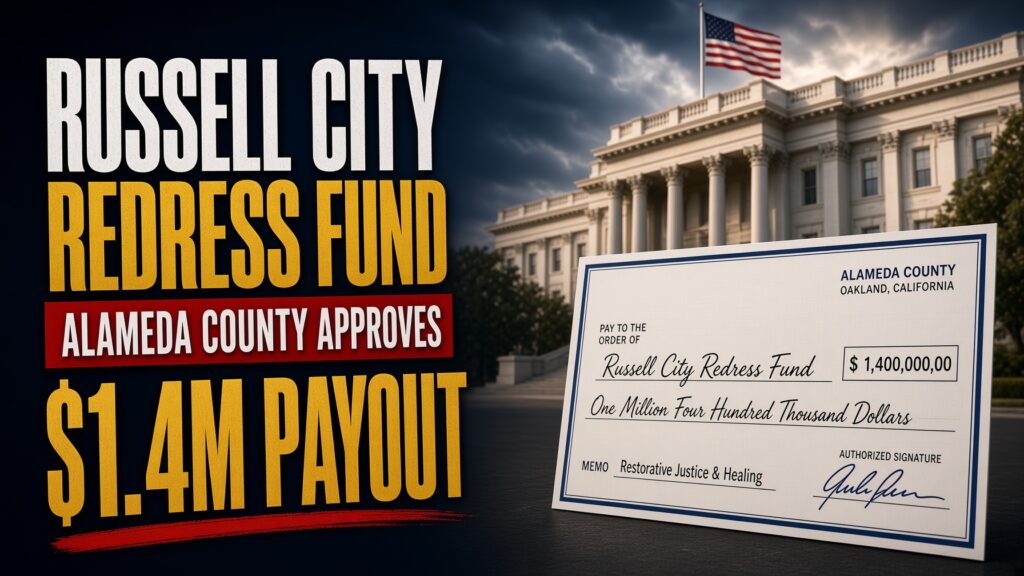
As Alameda County finalizes a $1.4 million payout six decades after Russell City was bulldozed, residents across the region are asking a harder question: does government ever actually pay for its own mistakes, or does the public quietly pick up the tab?
Sixty years is a long time to wait for an apology to become a check.
That is exactly what happened this month, when the Alameda County Board of Supervisors voted unanimously to finalize how the Russell City Redress Fund will be jointly administered with the City of Hayward. The vote matters right now because it moves a decades-old government failure out of the realm of symbolic resolutions and into the realm of real dollars, real eligibility rules, and real oversight questions that taxpayers deserve answered.
What Happened This Week in Alameda County?
On August 4, the Board of Supervisors voted unanimously to approve a plan for distributing $1.4 million to former residents, codifying a formal agreement between the county and Hayward on how the redress fund will be administered. The vote follows more than a year of incremental commitments from individual supervisors’ discretionary budgets rather than a single line item in the general county budget. That distinction matters, because it means the fund grew piecemeal, office by office, before landing on a unified administrative structure.
Support Independent Local Journalism
TheTownHall.News is a non-profit reader-supported journalism. Just $5 helps us hire local reporters, investigate important issues, and hold public officials accountable across Alameda County. If you believe our community deserves strong, independent journalism, please consider donating $5 today to support our work.How Did Russell City Come to Be Destroyed?
Russell City was a working-class, multi-racial community that sat as unincorporated Alameda County land until it was annexed into Hayward in 1964. During the 1960s, government-driven redevelopment displaced roughly 1,400 residents and resulted in the acquisition of approximately 700 parcels, clearing land for commercial and industrial use. Hayward’s City Council formally apologized in 2021, and the county’s Board of Supervisors followed with its own apology resolution in 2023. A community steering committee then spent a year developing recommendations, presented to Hayward’s City Council in March 2024.
Who Is Actually Paying for This Redress Fund?
This is where the limited-government lens becomes essential. The fund was not built through a single, transparent appropriation voted on by the full board as a standalone expenditure. Instead, it was assembled from individual supervisors pledging money out of their own discretionary office budgets, alongside a matching contribution from Hayward. Supervisors Elisa Márquez and Nate Miley led the effort, and Supervisors Nikki Fortunato Bas and David Haubert later added their own pledges to push the total toward $1.4 million. Discretionary spending gives individual officials wide latitude, and wide latitude is exactly what fiscal watchdogs are trained to scrutinize, regardless of how sympathetic the cause.
Sixty years passed between the wrong and the check — should government ever get to decide on its own timeline when accountability is due?
Is This the Accountability Moment We Have Been Waiting For?
For former residents and their families, the answer is a cautious yes. Officials have been careful not to overstate what the fund accomplishes. Supervisor David Haubert, who contributed $100,000 from his own office, said the money does not fully address the long-lasting harm but is symbolic progress beyond a written apology. That candor is worth crediting. It also raises an obvious follow-up: symbolic progress is not the same thing as a defined, auditable process, and residents deserve to know exactly how eligibility will be determined and how funds will be tracked once they leave government hands.

“This doesn’t completely address and redress all of the harms which are long-lasting, which are traumatic, and yet at the same time, I think it is very symbolic in terms of going beyond the apology.”
What Do the Numbers Actually Tell Us?
A 2023 survey conducted by the Russell City Reparative Justice Project Steering Committee, which polled 377 respondents connected to the community, found that 78 percent said the forced relocation caused major financial hardship for their families. Eighty-four percent said they had never received any relocation assistance from the county at the time of the displacement, and the same share said the loss of property and businesses limited their ability to pass wealth to the next generation. [Russell City Reparative Justice Project survey]
$1.4 million. Divided among an estimated 1,400 displaced residents and their surviving families, the question no government official has fully answered is this: what does a fair number even look like, and who decided this one?
If your family’s home was seized by your own local government and it took sixty years to see a dollar in return, would you call that justice — or just the bare minimum?
Does This Program Come With Real Oversight?
This is the piece of the story that deserves more scrutiny. Reporting confirms that eligibility requirements, identification of qualifying former residents, and the disbursement process were still being finalized even after the fund’s initial creation. That is reasonable for a new program, but it is also exactly the kind of gap where public money can drift without clear guardrails. Taxpayers and former residents alike share an interest in a published, auditable disbursement process — not a fund that exists in principle while who-qualifies decisions happen behind closed doors.
Could This Fund Set a Costly Precedent for Other Governments?
Alameda County is not the only local government with a redevelopment-era displacement in its history. If this fund becomes a template, other counties may face pressure to build similar programs the same way — through discretionary pledges rather than voter-approved appropriations. That is not necessarily bad policy, but it deserves public debate before it becomes the default playbook. Accountability should not depend on which supervisors happen to hold office when a historical wrong finally gets attention.
Support Independent Local Journalism
TheTownHall.News is a non-profit reader-supported journalism. Just $5 helps us hire local reporters, investigate important issues, and hold public officials accountable across Alameda County. If you believe our community deserves strong, independent journalism, please consider donating $5 today to support our work.What Do Supporters of This Policy Actually Believe?
Supporters of the redress fund make a straightforward case worth taking seriously: government caused direct, documented harm to a specific, identifiable group of people, and a formal apology without any financial component is words without weight. They point to the survey data showing most affected families experienced real financial hardship and received no assistance at the time, and they argue that elected officials who caused the harm — or their institutional successors — bear a direct responsibility to correct it, especially while original residents are still alive to receive it.
That argument has real merit, and a fair accounting of the historical record supports the premise that Russell City residents were displaced through a government-driven process with lasting financial consequences. Where accountability-minded readers can reasonably push back is not on the premise but on the process: even righteous causes deserve transparent budgeting, competitive bidding for third-party fund administration where applicable, and public reporting on how every dollar is ultimately distributed. Good intentions do not exempt public spending from public scrutiny.
KEY QUESTIONS
- Who ultimately decided the $1.4 million figure, and was that number based on any independent valuation?
- What specific eligibility criteria will determine which former residents and descendants qualify for payment?
- Will the fund’s disbursement process be subject to the same public auditing standards as other county expenditures?
So Where Does This Leave Alameda County?
The redress fund answers a moral question that took sixty years to reach the county’s official ledger. It does not yet answer the practical one: will this program run with the same transparency and accountability that taxpayers expect from every other line of government spending, or will “symbolic” become an excuse for skipping the oversight that public money always deserves? That is the question worth watching as the fund moves from vote to disbursement in the months ahead. The real question isn’t whether Russell City’s former residents deserved acknowledgment — it’s whether the government now writing the checks will hold itself to the same standard it’s asking taxpayers to trust.
What do you think — does this program set the right example for government accountability, or does it raise more questions than it answers? Share this article and let us know.
Still have questions about how your local government spends discretionary funds? Stay informed — subscribe to The Town Hall News for daily accountability coverage. Think former Russell City residents and Alameda County taxpayers both deserve a transparent process? Share this article. Want your voice to count? Alameda County Board of Supervisors meetings are open to public comment — contact the Clerk of the Board or attend a session to ask directly how the Russell City Redress Fund will be audited and disbursed.