Operation Disarm Oakland: 76 Guns Seized, 51 Charged, Questions Remain
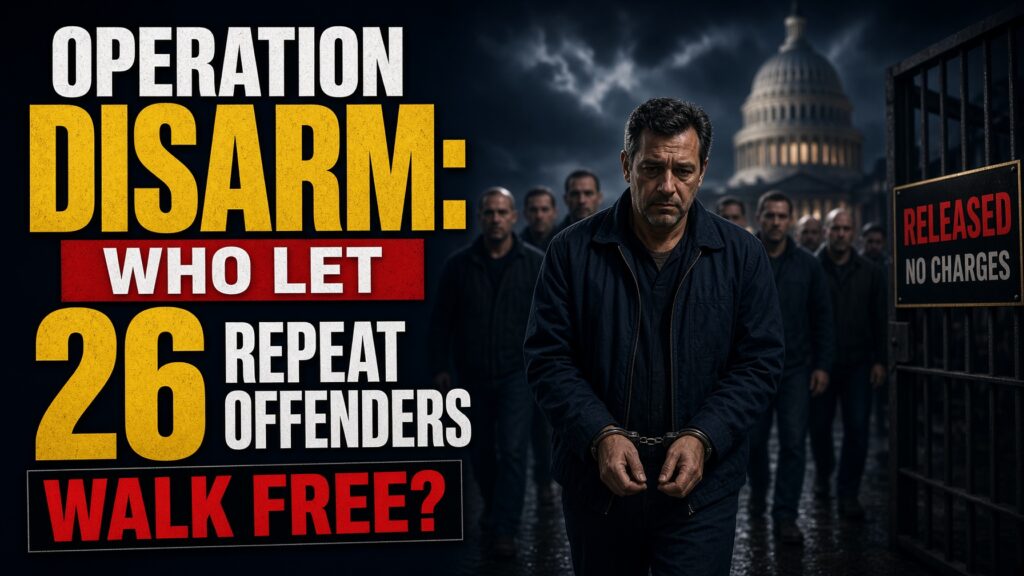
Federal agents seized 76 guns and charged 51 people in a 90-day Oakland crackdown. As the operation wraps up, one uncomfortable question remains: why did it take the federal government to do the job local supervision was already supposed to be doing?
A 90-day federal operation just did what Oakland’s own system could not.
That is the blunt takeaway from Operation Disarm, the joint federal-local enforcement effort that wrapped up this month with 76 illegally possessed firearms seized and 51 people federally charged. The results were announced this week at a press conference inside the Ronald V. Dellums Federal Building in downtown Oakland, and they matter right now because they arrive amid a broader debate over whether California’s courts, probation offices, and parole system are actually holding repeat offenders accountable, or simply cycling them back onto the same streets.
What Did Operation Disarm Actually Accomplish?
Between March and July 2026, the U.S. Attorney’s Office, the ATF, the Oakland Police Department, the FBI, the DEA, the U.S. Marshals Service, the Oakland Housing Authority, and the California Highway Patrol combined intelligence, shooting data, and cross-jurisdictional case screening to identify the individuals driving Oakland’s gun violence. U.S. Attorney Craig H. Missakian said the operation’s targets were “part of that small group of individuals who simply refuse to play by the rules and who are responsible for much of the violent crime we see in Oakland and in the area.” Seventy-six illegal guns off the street and 51 violent repeat offenders federally charged in 90 days — why did it take a federal surge to do this?
Support Independent Local Journalism
TheTownHall.News is a non-profit reader-supported journalism. Just $5 helps us hire local reporters, investigate important issues, and hold public officials accountable across Alameda County. If you believe our community deserves strong, independent journalism, please consider donating $5 today to support our work.Who Are the 51 People Federal Prosecutors Charged?
Officials say the defendants were not random arrests. Investigators used shooting data and intelligence-sharing to identify more than 100 “high-priority violent” targets before narrowing enforcement to the individuals prosecutors believed were doing the most damage. Charges connected to the operation include gun cases tied to the deadly March shooting at EZ’s Lounge, which killed two people and wounded five others, and a separate shooting near two Oakland schools. FBI Special Agent in Charge Scott Schelble credited the operation’s results to shared intelligence and coordinated targeting across every level of law enforcement.
That level of coordination is notable in itself. Seven separate agencies — federal, state, and local — had to combine resources to accomplish what any one of them, working alone, apparently could not. Oakland Police Assistant Chief Casey Johnson framed it as a partnership success, thanking federal and state agencies for “providing the resources and intelligence needed” to hold offenders accountable. That gratitude is a tacit admission worth noting: local law enforcement needed outside help to do this work at scale.
Why Were 26 Repeat Offenders Still on the Streets?
Here is the detail that deserves the most scrutiny. Of the 51 people federally charged, 26 were already on probation, parole, or federal supervised release at the time they allegedly committed the new offenses. That is roughly half. These were not first-time offenders slipping through the cracks unnoticed; they were individuals the system had already identified, already sentenced, and already placed under active supervision. Half of the people charged in Operation Disarm were already under government supervision when they allegedly reoffended — so who was actually supervising them?
Is Local Supervision Failing Oakland Residents?
This is where the limited-government, personal-responsibility lens becomes unavoidable. Probation and parole exist to monitor exactly the population Operation Disarm ultimately had to chase down again with federal resources. When roughly half of a federal firearms surge’s defendants were already supposed to be under active supervision, the fair question is not whether federal agents did their job. They clearly did. The fair question is why county and state supervision structures did not catch these individuals first, before a 90-day multi-agency federal operation had to do it for them.
“These 51 individuals are part of that small group of individuals who simply refuse to play by the rules and who are responsible for much of the violent crime we see in Oakland and in the area.”
What Do the Numbers Actually Tell Us?
18 percent. That is how much violent crime — homicides, rapes, assaults, and robberies — has dropped in Oakland year-to-date compared with the same period last year, according to OPD’s own data [OPD crime data]. The question no press release fully answers: how much of that drop belongs to Operation Disarm specifically, and how much reflects a broader national decline that experts are still debating the causes of? Crime is falling in many cities that ran no comparable surge at all, which means Oakland officials owe residents a clearer accounting of what actually moved the needle.
If half the people driving Oakland’s gun violence were already under court supervision, is early crime-drop credit-taking premature — or earned?

What Do Supporters of This Policy Actually Believe?
Supporters of Operation Disarm make a reasonable case. Violent crime imposes real, immediate costs on Oakland families, and waiting for slow-moving reforms to fix supervision gaps means more preventable shootings in the meantime. They point to 76 guns off the street, 51 dangerous individuals facing federal charges instead of state charges with lighter sentencing exposure, and officials’ promise that more surges are coming. OPD Assistant Chief Casey Johnson credited the partnership for helping “hold 51 violent offenders accountable,” and that is a legitimate, defensible outcome worth crediting.
Where accountability-minded readers can reasonably push back is not on the results but on the reliance. A federal surge is, by definition, temporary. It cannot be Oakland’s permanent substitute for a probation and parole system that actually tracks the people it is assigned to supervise. Good intentions and real arrests do not exempt local government from explaining why its own systems needed federal rescue in the first place.
KEY QUESTIONS
- Why were 26 of the 51 federally charged defendants already on probation, parole, or supervised release when they allegedly reoffended?
- What specific reforms, if any, will Alameda County and Oakland pursue to close the supervision gap Operation Disarm exposed?
- Will future federal surges be necessary every year, or is this the last time local agencies get to lean on Washington to do their job?
So Where Does Oakland Go From Here?
Officials have already signaled that more enforcement operations are planned for the coming months, which suggests this will not be the last federal intervention Oakland needs. That is worth watching closely. A federal surge that recovers guns and charges dangerous offenders deserves credit. But a city that needs repeated federal rescue missions to manage a supervision population it already controls has a structural problem no press conference can fully answer.
Taxpayers fund probation departments, parole offices, and county courts specifically so that people like the 26 repeat offenders identified in this operation do not get the chance to reoffend in the first place. Every federal surge that steps in after the fact is also, implicitly, a report card on how well those existing systems are working. Residents deserve a straight answer from county officials on what changes, if any, will follow — not just another press conference celebrating the arrests that resulted from the last one. The real question isn’t whether Operation Disarm worked — it’s whether Oakland’s own systems will ever be trusted to do this job without federal agents stepping in first.
What do you think — does Operation Disarm prove federal partnership works, or does it expose a local accountability gap that’s been ignored for too long? Share this article and let us know.
Still have questions about who is really supervising repeat offenders in your neighborhood? Stay informed — subscribe to The Town Hall News for daily accountability coverage. Think Oakland and Alameda County residents deserve a clear answer on the supervision gap Operation Disarm exposed? Share this article. Want your voice to count? Alameda County’s Probation Department and the Board of Supervisors hold public meetings open to comment — attend one and ask directly how supervision failures will be addressed before the next federal surge becomes necessary.