

Newsom Death Row Commutation: Why 382 Cases Still Await a Court
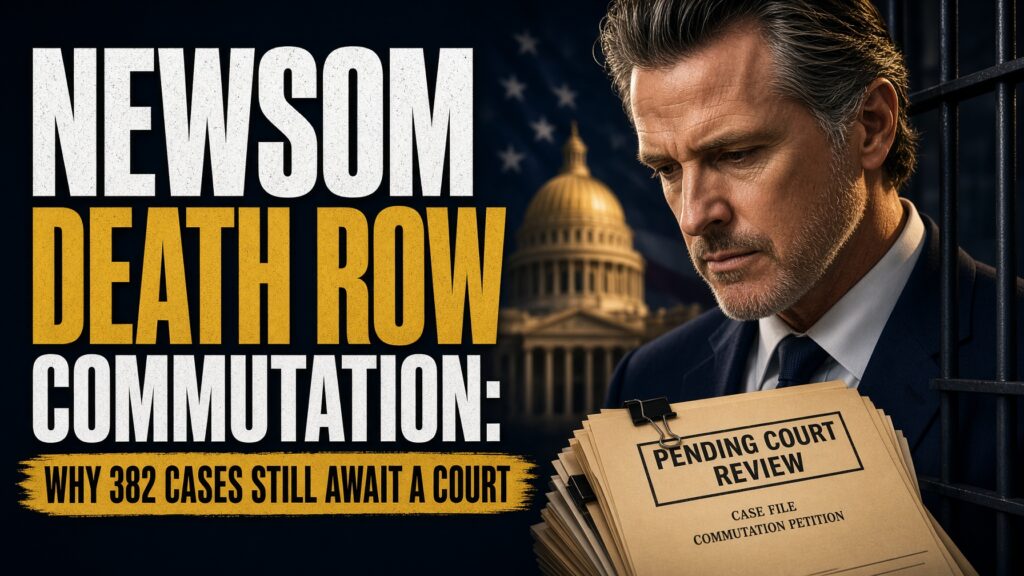
California’s governor has moved to erase the largest death row in the Western Hemisphere, yet most of the order still needs a court’s approval, and victims’ families are demanding to know who answers for the verdicts being undone.
One letter just moved to rewrite 548 jury verdicts.
On Thursday, November 5, 2026, Gov. Gavin Newsom announced he will use his clemency authority to commute every death sentence in California to life without parole [wire-confirmed, CBS News]. The decision arrives seven years after his 2019 moratorium on executions and weeks before he leaves office in January. It is already being called the largest mass commutation of death sentences in American history [press reporting, NYT via WPXI].
What Exactly Did Newsom Announce?
The order covers 529 men and 19 women held in California prisons [press reporting]. Newsom says the state has the largest death row in the Western Hemisphere, and it accounts for roughly a quarter of all condemned prisoners in the United States [Mother Jones]. Each sentence would become life without the possibility of parole.
Newsom called the decision “among the most difficult” of his career [KTVU]. Those whose sentences are commuted will not be eligible for the Board of Parole Hearings’ new commutation and resentencing regulations [CalMatters]. In practical terms, the governor is describing a permanent change, one that holds no matter who runs the state next.
Support Independent Local Journalism
TheTownHall.News is a non-profit reader-supported journalism. Just $5 helps us hire local reporters, investigate important issues, and hold public officials accountable across Alameda County. If you believe our community deserves strong, independent journalism, please consider donating $5 today to support our work.Is This Decision Actually Final?
Not yet, and few headlines say so plainly. The California Constitution requires a recommendation from the state Supreme Court, with four justices concurring, before a governor can grant clemency to anyone convicted of more than one felony [CBS News Sacramento]. Law Dork counts 382 of the 548 commutations as needing that approval [Law Dork analysis].
That means more than two-thirds of the order is, for now, a declaration of intent. High-profile inmates such as Richard Allen Davis are among the cases being submitted to the court [Long Beach Post]. The seven justices, not the governor, will decide whether most of this holds. For many Californians, that is the part of the story that matters most.
Who Decided These Sentences in the First Place?
Juries did. Prosecutors describe the process this way: a jury hears aggravating and mitigating evidence and returns a verdict, the trial judge reviews it, and the case goes to the California Supreme Court on automatic appeal [San Luis Obispo County DA letter]. District Attorney Dan Dow points to cases where that court unanimously affirmed the sentence years later.
Voters have weighed in too. Californians declined to abolish the death penalty at the ballot box in 2012 and again in 2016 [state election results]. Every one of these 548 sentences began with a jury verdict. Should one governor’s letter outweigh them all?
What Do the Numbers Actually Tell Us?
- That is how many commutations still depend on four of seven justices agreeing. The question no one in Sacramento has answered: if the governor’s own order cannot take effect without the court, who is truly making this decision?
The numbers cut in several directions. At least 25 people have received death sentences since the 2019 moratorium began, 11 of them in Riverside County [press reporting]. Supporters of the commutation read that as proof of arbitrary enforcement. Critics read it as proof that juries keep returning the verdict the law allows.
How Are Victims’ Families Responding?
With anger, and with a request made before the announcement. Dow asked Newsom to name the victims in every clemency decision he made [SLO County DA letter]. The California District Attorneys Association argued that erasing judgments without examining each case’s facts disserves justice [press reporting].
Topo Padilla of Crime Victims United said his group was “absolutely disgusted” at the prospect, noting that a judge and jury had decided the penalty [KTVU]. A family waited years for a verdict. Did anyone ask them before it was undone?
Is a verdict still a verdict if a single letter can erase it?
What Do Supporters of the Commutation Actually Believe?
Supporters make a serious case. They argue that a death sentence in California depends less on the crime than on which county prosecutes it, and they cite studies suggesting Black defendants are far more likely to be sentenced to death than others convicted [press reporting]. The state Supreme Court has already sent a legal challenge on those racial-disparity claims to a lower court for evidence. They also note that a moratorium is temporary, while a commutation is permanent. And they point out that life without parole is no release: these inmates would die in prison.
Those points deserve a real answer. The arbitrariness concern is legitimate, but it argues for fixing how the penalty is applied, not for erasing individual jury findings in a single stroke, including cases where guilt is not in doubt. The disparity claim is being tested in court, a process a blanket order could leave unresolved. And permanence is precisely the point critics raise: an executive order that no future voter or legislature can revisit sits uneasily with a system built on checks and balances.

Does This Reach Beyond California?
It does, and politics is part of the picture. Newsom is widely discussed as a 2028 presidential hopeful, and at least one moderate Democratic strategist warned that a mass commutation would complicate a national run [press reporting, Newsweek and GV Wire]. Whatever his motives, an action of this size sets a template for what a governor can attempt in the final weeks of a term.
Limited government depends on limits that bind even sympathetic causes. The constitutional requirement for court review is a check on clemency in the hardest cases. Voters of every view have a stake in whether that check holds.
The Question That Outlasts the Headline
Strip away the announcement and the argument comes down to one thing. Do 548 verdicts, reviewed by trial judges and by the state’s highest court, carry less authority than a governor’s conscience? Newsom has answered yes. The seven justices of the California Supreme Court have yet to answer for 382 of them.
What do you think: should one governor be able to undo a jury’s work in a single letter? Share this article and tell us where you stand.
Key Questions This Story Raises:
- Will the California Supreme Court approve the 382 commutations that require its recommendation, and on what standard of review?
- Did victims’ families get any voice before a decision that changes the sentences of those who harmed them?
- If a mass commutation is acceptable for these cases, what limits remain on a governor’s clemency power?
So is California ending capital punishment through the courts and the ballot box, or through a single signature? The real question isn’t whether you agree with the death penalty. It is whether you accept a system where verdicts last only until a governor decides otherwise.
Still have questions? Stay informed: subscribe for daily coverage of accountability and the rule of law. Think others need to see this? Share the article. Want your voice to count? Find your state senator and Assembly member at findyourrep.legislature.ca.gov, contact their offices, and ask where they stand on clemency limits and on the Supreme Court’s review of these commutations.