CAL DOGE Explained: Steve Hilton’s California Fraud Probe
A gubernatorial candidate says his self-styled watchdog has found hundreds of billions in California waste. The state calls it misleading. Two months before Election Day, voters are left sorting fact from campaign math.
$425 billion. That is the number one candidate says California has wasted in five years.
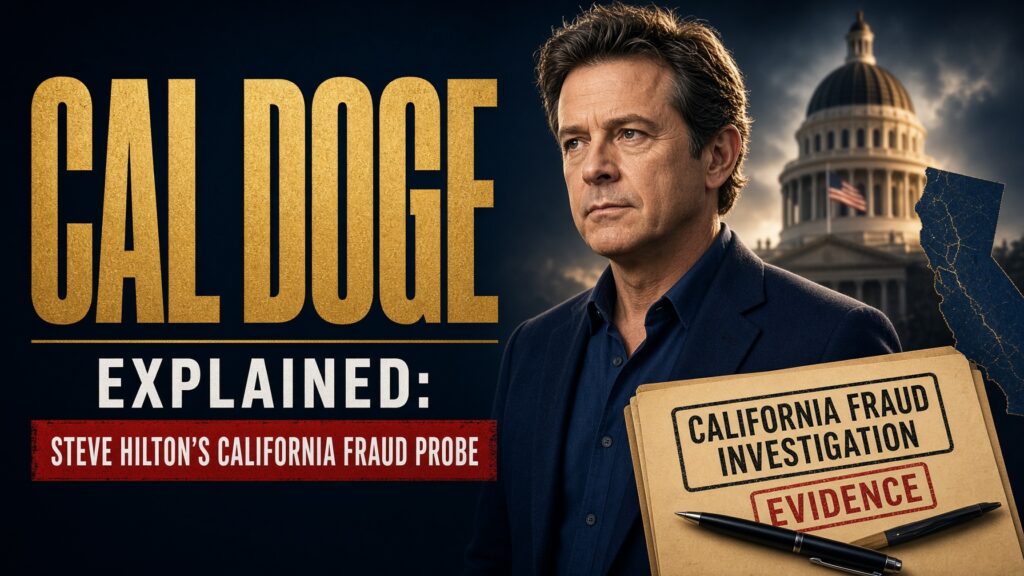
The claim comes from CAL DOGE, an unofficial fraud-hunting operation launched in late January 2026 by Republican gubernatorial candidate Steve Hilton and his running mate for state controller, Herb Morgan. Modeled openly on Elon Musk’s federal Department of Government Efficiency, CAL DOGE has released a series of “Fraud Reports” throughout 2026 alleging waste across cannabis tax revenue, solar subsidies, and other state programs. With Hilton facing Democrat Xavier Becerra in the November general election, the timing means every figure CAL DOGE publishes lands squarely inside an active campaign.
Support Independent Local Journalism
TheTownHall.News is a non-profit reader-supported journalism. Just $5 helps us hire local reporters, investigate important issues, and hold public officials accountable across Alameda County. If you believe our community deserves strong, independent journalism, please consider donating $5 today to support our work.What Exactly Is CAL DOGE?
CAL DOGE is not a government agency. Despite its name, it has no legal connection to the State of California — it is an initiative run by Hilton’s campaign team, including director Jenny Rae Le Roux, and described by its own materials as staffed by “investigators, tech advisors, and citizen journalists.” Hilton has said the effort will play “a huge part in ending 16 years of Democrat one-party rule this November.”
That distinction matters for how every subsequent number should be read. A state audit carries statutory weight and a nonpartisan author. A campaign fraud report carries neither — its findings deserve scrutiny, not automatic credibility, regardless of which side is doing the alleging.
What Did CAL DOGE Actually Claim to Find?
CAL DOGE’s first major report, released in mid-February 2026, focused on Elevate Youth California, a Department of Health Care Services program funded by Proposition 64 cannabis tax revenue. The underlying facts here are independently verifiable: DHCS’s own program materials confirm the agency has awarded more than $370 million through 517 grants since 2019. That part is not in dispute.
What is disputed is the characterization. CAL DOGE alleges the money — intended for youth substance-abuse prevention — was instead steered toward “civic engagement,” voter registration, and political organizing by grantee nonprofits, including a $1 million award to Young Invincibles and $800,000 to Asian Refugees United for programming CAL DOGE says has nothing to do with substance abuse. Newsom’s office pushed back directly, stating that grant requirements explicitly prohibit “partisan activities” as a use of funds — implying the grants complied with the law even if their programming reads as advocacy-adjacent.

Did the State Actually Respond to These Claims?
Yes, though selectively. Governor Newsom’s office denied CAL DOGE’s characterization of the Elevate Youth grants on social media, and Hilton’s team responded by filing a formal federal complaint seeking an investigation. Attorney General Rob Bonta, asked about fraud in state government more broadly, said California’s “DOJ, our law enforcement agents, our investigators, and our prosecutors have been on the ground… fighting fraud, waste, and abuse for years,” citing nearly $3 billion recovered in stolen taxpayer funds.
If California has already recovered $3 billion in taxpayer fraud, why does a single campaign claim to have found more waste in one week than the state found in seven years? Both claims can’t be fully true at once, and neither side has offered independent, third-party verification of its own math.
How Did CAL DOGE Get From $370 Million to $425 Billion?
This is where the numbers require the most caution. CAL DOGE’s individual case reports — the $370 million cannabis-grant claim, a separate $1 billion solar-subsidy claim where the group says only $72 million was actually spent on panels — are narrow and tied to specific programs. Its larger totals are not.
The $250 billion figure comes from a preliminary document titled “Califraudia,” authored by Hilton and Morgan themselves and described in their own materials as “based on independent analysis.” The subsequent $425 billion figure, released as CAL DOGE’s fourth report, is described by Hilton as an analysis of “Newsom’s own public data” compiled by his campaign team. Neither figure has been reviewed by the nonpartisan State Auditor, the Legislative Analyst’s Office, or any independent accounting body.
Is a number “public data” if the only people who’ve shown their work are the ones running for office on the strength of it?
None of that means the underlying concern is baseless. It means the topline totals are campaign estimates, not audited findings, and readers deserve to know the difference before repeating either number as fact.
Support Independent Local Journalism
TheTownHall.News is a non-profit reader-supported journalism. Just $5 helps us hire local reporters, investigate important issues, and hold public officials accountable across Alameda County. If you believe our community deserves strong, independent journalism, please consider donating $5 today to support our work.Why Does This Matter Beyond One Governor’s Race?
$40 billion. That’s the combined, independently documented total in unemployment fraud and untracked homelessness spending that California’s own nonpartisan State Auditor has flagged over the past decade — separate from anything CAL DOGE claims. The question that outlasts this election: why does it take either a campaign or a news investigation to make these numbers visible, instead of the Legislature’s own oversight process?
That overlap is the real story here. Whether or not CAL DOGE’s largest dollar totals hold up, the underlying premise — that California’s government has a documented pattern of underenforcing its own oversight — comes from the state’s own nonpartisan auditor, not just from a campaign.
What Do Critics of CAL DOGE Actually Believe?
Skeptics make a fair point that deserves a direct answer, not dismissal. They note CAL DOGE has no independent audit standing, that its name deliberately borrows credibility from an official-sounding federal program despite having zero government affiliation, and that its release schedule — timed report by report through campaign season — looks less like disinterested oversight and more like opposition research with a press office. They also point out that neither Elevate Youth California nor its named grantees have substantively responded on the record to CAL DOGE’s specific allegations, leaving the claims one-sided in most reporting so far.
Those are legitimate concerns, and they matter. But they don’t answer the underlying question CAL DOGE is asking: if the state auditor has already documented that lawmakers routinely fail to act on nonpartisan fraud warnings, is it really implausible that a motivated outsider, using public records, could find more? The honest answer is that CAL DOGE’s individual, document-backed claims — like the $370 million Elevate Youth figure — deserve scrutiny on their own merits. Its nine- and eleven-figure campaign totals do not yet meet that same bar.
Key Questions This Story Raises:
- Which of CAL DOGE’s specific, document-backed claims hold up under independent review — and which are campaign-season estimation dressed up as an audit?
- Why hasn’t the nonpartisan State Auditor’s office been asked to formally verify or refute CAL DOGE’s largest totals before Election Day?
- If Hilton loses in November, does an “unofficial” oversight effort like CAL DOGE simply disappear — and does that tell voters something about whether it was built to last or built to win?
So is CAL DOGE a genuine accountability project uncovering fraud Sacramento would rather ignore, or a campaign talking point wearing an audit’s clothing? The honest answer, based on what’s verifiable today, is probably both at once — real underlying grant data wrapped in numbers no independent office has yet confirmed. The real question isn’t whether California has a fraud and accountability problem — the state’s own auditor already answered that. It’s whether voters can tell the difference between a documented finding and a campaign estimate before they mark a ballot.
Still have questions about where your tax dollars are going? Stay informed — subscribe for daily coverage of government spending and accountability. Think your neighbors need to see this? Share this article. Want your voice to count? Contact the California State Auditor’s office and ask whether CAL DOGE’s largest claims will receive an independent review before November.