Fresno Prosecutor Stabbing: Suspect Charged in Targeted Attack
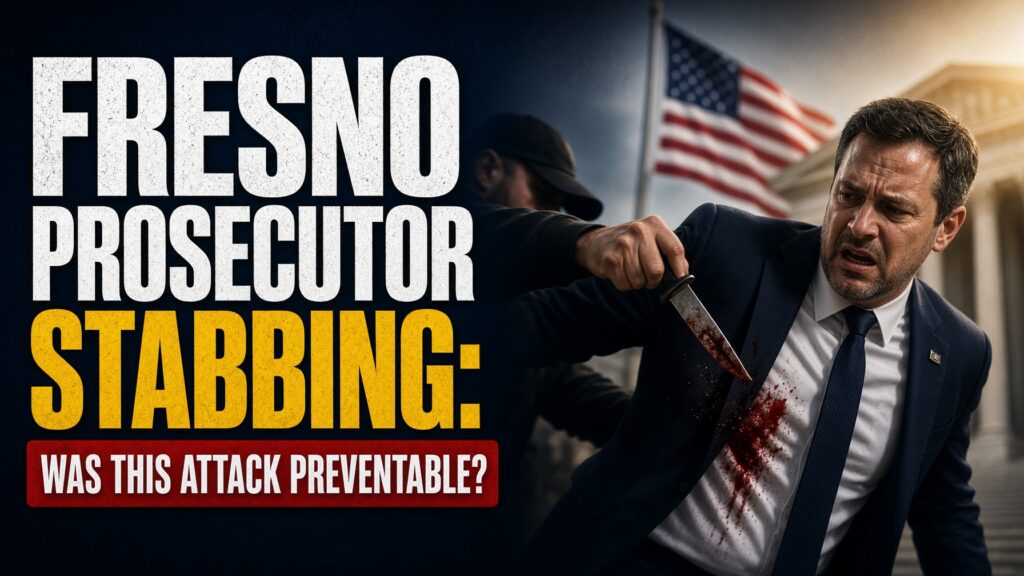
A senior Fresno County prosecutor was stabbed three times in broad daylight. Now investigators say it wasn’t random at all.
As the Fresno prosecutor stabbing investigation unfolds, one question is spreading faster than the headlines: if a convicted offender can track down and ambush the attorney who prosecuted him a decade later, who is actually being protected by California’s justice system? A man was stabbed. He is expected to survive. That single fact almost obscures the more disturbing one. Fresno County District Attorney Lisa Smittcamp confirmed Friday the attack outside the county courthouse was a targeted, retaliatory strike against a man doing his job [primary source: Fresno County DA’s Office statement]. That distinction changes this from a tragic anomaly into a test of whether the system protects the people who enforce it.
What Actually Happened at Courthouse Park?
Dispatchers received a report at 1:13 p.m. Thursday that a man had been stabbed in Courthouse Park, a public space fronting the Fresno County Superior Court [wire service: local sheriff’s office statement]. Deputies assigned to the courthouse responded within minutes and located the suspect near Fresno Street and Van Ness Avenue three minutes later. Deputies used a Taser to take the suspect into custody and recovered a weapon from him. The victim, a senior deputy district attorney whose name has not been released out of respect for his family, was taken to Community Regional Medical Center conscious, breathing, and talking. He has since been released and is expected to make a full recovery, Smittcamp said.
Support Independent Local Journalism
TheTownHall.News is a non-profit reader-supported journalism. Just $5 helps us hire local reporters, investigate important issues, and hold public officials accountable across Alameda County. If you believe our community deserves strong, independent journalism, please consider donating $5 today to support our work.Who Is the Suspect, and Why Did He Target a Prosecutor?
The Fresno County Sheriff’s Office identified the suspect as 42-year-old Dustin Crawford, a Fresno resident. He has been booked on felony attempted murder and attempted murder of a public official, plus a misdemeanor obstruction charge, with bail set at $1 million. This was not a chance encounter. Smittcamp said Crawford had been sentenced years earlier in a 2016 case her office prosecuted — the same case the stabbed deputy district attorney had worked on. Sheriff John Zanoni said the entire assault was captured on security video, and both officials described it as premeditated. “This is not a crime committed in a random act of violence by a mentally ill man,” Smittcamp said.
Was This Attack Foreseeable — and What Does That Mean for Accountability?
Here the story moves from a single violent act to a systemic question. A man sentenced nearly a decade ago apparently located the prosecutor who worked his case and acted on that grievance in a public park outside a courthouse. Should a prosecutor who worked a case ten years ago still have to look over his shoulder today? Smittcamp is now asking that publicly, tying the incident to what she calls failures in California’s criminal justice reform framework — arguing the state’s approach to sentencing and offender monitoring leaves prosecutors exposed long after cases close. That is her assessment, not a settled finding; Crawford’s full record and original sentencing details aren’t yet public. But the underlying question deserves scrutiny regardless of the specific case: does California track whether convicted offenders may pose a renewed threat to the officials who handled their cases years later?
What Do the Numbers Actually Tell Us?
One prosecutor. Three stab wounds. Zero warning. The question no one has answered yet: what system, if any, exists to flag renewed threats from past defendants — and why didn’t it apply here? Fresno County has not released data on how often courthouse-adjacent personnel face threats, and no comprehensive statewide dataset appears to track retaliatory violence against prosecutors specifically. That gap is itself part of the story — without consistent reporting, the public has no way to know whether this was an outlier or a pattern.
Is Courthouse Park Actually Safe?
Fresno Police Chief Mindy Casto pushed back publicly, telling reporters downtown Fresno is statistically safer than many other parts of the city. Sheriff Zanoni offered a more measured view, noting this is one of several violent incidents that have occurred at that specific park over his decades on the force. Both statements can be true. A neighborhood can be statistically safe on average while still failing to protect the specific officials who work there daily. If a courthouse can’t guarantee safety for the people prosecuting cases inside it, what does that say about protection for everyone else?

What Happens Next in the Case?
The case has been referred to the Tulare County District Attorney’s Office for prosecution — standard practice avoiding a conflict of interest since the victim works for Fresno’s DA. The Multi-Agency Gang Enforcement Consortium, a regional task force for serious violent crime, is leading the investigation. Crawford remains held on $1 million bail. His arraignment will determine how quickly the public learns more about his prior record and what specifically triggered the delayed retaliation.
What Do Supporters of This Policy Actually Believe?
Fair coverage requires acknowledging the other side of Smittcamp’s broader argument. Supporters of California’s criminal justice reform efforts argue these policies work as intended in the vast majority of cases, and that isolated violent incidents shouldn’t indict an entire framework. They cite state data showing most released individuals do not reoffend violently, and argue that reentry and mental health resources reduce recidivism more effectively than extended incarceration alone. That is a legitimate, mainstream policy position. But it runs into the specifics here. This wasn’t a general recidivism statistic — it was an alleged targeted attack on a specific official, years after his case closed. That timeline exposes a narrower gap general reentry statistics don’t capture: how the system tracks individualized threats against justice officials long after sentencing. Whatever one believes about broader reform, that question deserves its own answer. <blockquote> If the person who prosecutes you a decade ago is still someone you can hunt down in a public park, what exactly has the system prevented? </blockquote>
Key Questions This Case Raises
- Did any warning signs exist between Crawford’s 2016 sentencing and Thursday’s attack — and if so, who missed them?
- Should California monitor potential threats against prosecutors, judges, and witnesses years after a case concludes?
- Will Tulare County pursue maximum charges, or will this follow the plea-negotiation pattern critics say enables repeat violence?
Why Are So Many Californians Starting to Ask Questions?
This incident lands in a state already debating criminal justice policy, sentencing reform, and public safety. Prosecutors statewide have increasingly said reform-oriented policies shift risk away from offenders and onto victims, witnesses, and the officials who handle their cases. Smittcamp frames this stabbing as part of that larger pattern, not an isolated event. This isn’t a Fresno problem — it’s a question about whether California protects the people who enforce its laws. Whether or not readers agree with her broader critique, a targeted, premeditated attack on a sitting prosecutor is hard to dismiss as unrelated to that debate.
The Question That Remains
A prosecutor did his job a decade ago. This week, he nearly paid for it with his life. The case against Dustin Crawford will now play out in Tulare County, and details of his prior case will likely surface as it advances. But the larger question Smittcamp raised won’t be resolved by a single conviction. It’s a question about whether California’s justice system protects the people who keep it running — and whether accountability applies to the systems responsible for managing risk after cases close. The real question isn’t whether this attack could have been prevented — it’s whether the next one will be.
What do you think — does California do enough to protect the prosecutors, judges, and witnesses who serve in its courts? Share this article and let us know.
Support Independent Local Journalism
TheTownHall.News is a non-profit reader-supported journalism. Just $5 helps us hire local reporters, investigate important issues, and hold public officials accountable across Alameda County. If you believe our community deserves strong, independent journalism, please consider donating $5 today to support our work.Still have questions about this case? Stay informed — subscribe for daily coverage of accountability stories across California. Think others need to see this? Share the article. Want your voice to count? Contact your county’s District Attorney’s office or state legislator and ask what protections exist for justice officials handling violent cases — then attend a local public safety meeting to raise it directly.