Oakland Fire Advisory Near EBMUD: What Residents Should Know
As Oakland Fire Department issues an urgent advisory for a fire near West Grand and Wake Avenue, residents are asking a bigger question: who is actually responsible for warning them — and why does one Instagram post seem to be doing all the work?
As smoke rose over West Oakland Sunday morning, a basic question went unanswered for hours: who is actually telling residents what is happening?
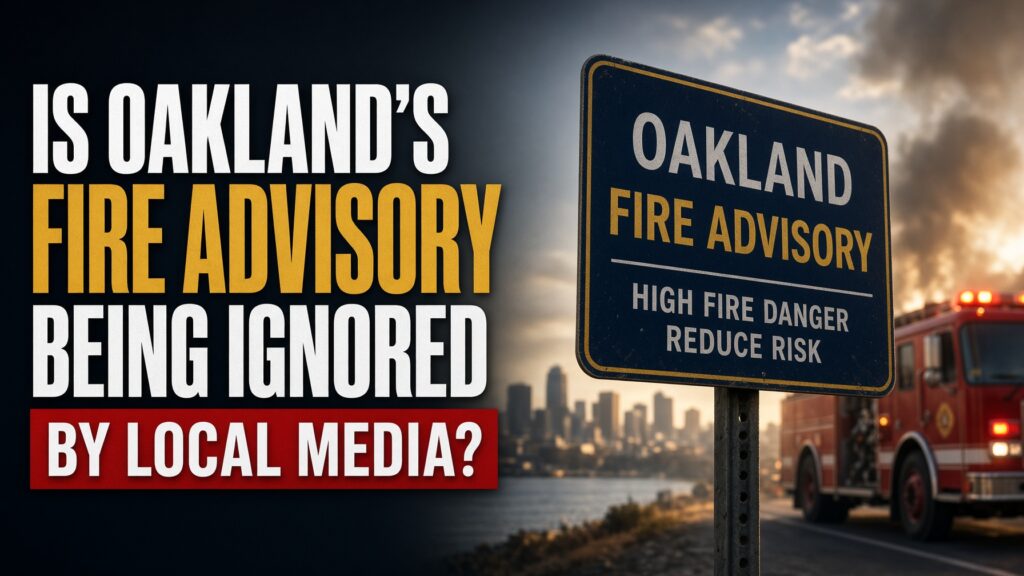
Oakland Fire Department’s official Instagram account, @oaklandfireca, posted a public safety advisory just after 9 a.m. Sunday. The message was direct. Residents within three miles of West Grand Avenue and Wake Avenue should keep their windows closed. Crews were fighting a fire involving old railroad trestles and vegetation near the East Bay Municipal Utility District’s wastewater treatment property. No structures were reported threatened. Forward progress on the fire had reportedly stopped.
Support Independent Local Journalism
TheTownHall.News is a non-profit reader-supported journalism. Just $5 helps us hire local reporters, investigate important issues, and hold public officials accountable across Alameda County. If you believe our community deserves strong, independent journalism, please consider donating $5 today to support our work.Two hours after that post went up, no major Bay Area news outlet had published a story on it. Not a wire report. Not a local television alert. Just a single social media post, sitting with hundreds of engagements and a growing thread of confused residents asking the same thing: is this actually happening right now?
What Did The Advisory Actually Say?
The OFD advisory named a specific intersection, a specific hazard, and a specific instruction. West Grand Avenue and Wake Avenue sits near the EBMUD Main Wastewater Treatment Plant, adjacent to the old BNSF and Union Pacific railroad right-of-way in West Oakland [source: OFD Instagram advisory]. The department said crews were actively engaged with a fire on the old train trestles and surrounding vegetation.
Two details stood out. First, OFD said no structures were currently threatened, a notable reassurance given how close the area sits to homes, businesses, and the port corridor. Second, the department reported forward progress on the fire had stopped, standard incident terminology meaning crews had established a perimeter that was holding.
For residents inside that three-mile radius, the instruction was simple: close your windows and limit outdoor exposure to smoke. That is not a minor courtesy. It is the kind of directive that, in a functioning information ecosystem, reaches every resident within minutes, not just the ones scrolling Instagram.

Why Does This Trestle Keep Catching Fire?
This is not the first time flames have found this exact stretch of track. In July 2022, a fire at the same railroad trestle near the Wood Street corridor burned so intensely that then-Oakland Fire Chief Reginald Freeman warned the aging wooden structure could collapse from repeated fire damage. That blaze forced a shutdown of Interstate 80 connector ramps and blanketed the East Bay in smoke.
A public utility’s wastewater plant sits steps from a wooden rail trestle that has now burned more than once. How many times does that have to happen before someone is accountable for fixing it?
The area surrounding the trestle has a documented history of fires tied to homeless encampments along the Wood Street corridor, with dozens of blazes recorded between 2021 and 2022 alone [source: local news archives]. Ownership of the trestle itself has been attributed to BNSF Railway and Union Pacific, private rail companies, while much of the surrounding land has been under Caltrans jurisdiction. That patchwork of ownership has long complicated cleanup and fire prevention efforts in the corridor.
Who Is Responsible For Public Safety Communication Here?
Oakland taxpayers fund a fire department, an emergency management division, and a regional alert system built specifically to notify residents during exactly this kind of incident. AC Alerts, Nixle, and the city’s siren network all exist for moments like this one.
Yet as of Sunday morning, the most detailed information available to the public came from a single fire department Instagram post, not a city-wide alert push, not a press release, and not a story from any local outlet. Residents commenting on the post openly questioned why no news organization had reported it yet.
Support Independent Local Journalism
TheTownHall.News is a non-profit reader-supported journalism. Just $5 helps us hire local reporters, investigate important issues, and hold public officials accountable across Alameda County. If you believe our community deserves strong, independent journalism, please consider donating $5 today to support our work.That gap matters. Not every household follows a fire department’s social media account. Elderly residents, non-English speakers, and anyone without a smartphone depend on broader alert systems and traditional media to reach them. If the only warning system working is a fire department’s own social feed, is that really a warning system at all?
What Do The Numbers Actually Tell Us?
3 miles. That is the radius Oakland Fire Department told residents to treat as an active smoke hazard zone Sunday morning. The question city officials owe residents an answer to: how many people actually live inside that radius, and how many of them received this advisory through a channel other than Instagram?
West Oakland is a densely populated corridor bordering the Port of Oakland, Interstate 880, and a mix of residential and light industrial property. A three-mile radius from that intersection reaches deep into neighborhoods far from the fire itself, underscoring how seriously OFD treated the smoke risk even while describing the fire as contained on the ground.
What Do Supporters Of The Current Alert System Actually Believe?
Some city officials and emergency managers would argue this response worked exactly as intended. OFD posted quickly, gave clear instructions, and updated residents in real time through a platform many people already check daily. Supporters of the current system point out that social media allows fire departments to communicate faster than traditional broadcast media ever could, cutting out the delay of press releases and news cycles.
That argument has real merit. Speed matters in an active incident, and OFD’s post was specific, calm, and actionable. But speed is not the same as reach. A fast message that only reaches people already following a single Instagram account is not the same as a citywide alert that reaches every resident in a three-mile hazard zone, regardless of which apps they use or which outlets they trust. The city’s own AC Alerts system exists precisely because no single social platform can guarantee that coverage.
Is This The Accountability Moment Oakland Needs?
Recurring fires at the same trestle are not a mystery. They are a pattern, one tied to years of unresolved encampment conditions, fragmented land ownership between private rail companies and public agencies, and infrastructure that keeps burning without a permanent fix. Every time this trestle ignites, it becomes a public safety event, a traffic disruption, and an air quality hazard for a corridor already carrying more than its share of industrial burden.
Why does the public keep learning about its own safety hazards from a fire department’s Instagram comments section instead of the agencies responsible for preventing them?
Residents deserve more than a single social post explaining why they should keep their windows shut. They deserve a public accounting of why this specific location keeps burning, who owns the responsibility for fixing it, and why a citywide alert system did not appear to activate for a fire large enough to warrant a three-mile advisory.
Key Questions
- Why did OFD’s advisory reach residents primarily through a single Instagram post rather than the city’s AC Alerts or Nixle emergency systems?
- Who bears responsibility for the fire-prone railroad trestle near Wake Avenue, given its history of repeated fires since at least 2022?
- What permanent steps, if any, have BNSF, Union Pacific, Caltrans, or the City of Oakland taken to prevent this corridor from catching fire again?
Has Oakland Solved This Problem, Or Just Survived It?
Forward progress on Sunday’s fire may have stopped. Forward progress on fixing the underlying problem has not. A wooden trestle with a documented fire history sits beside a public utility’s treatment plant in a densely populated corridor, and the alert system meant to protect nearby residents appears to run through a single social media account.
The real question isn’t whether this fire will be extinguished. It’s whether anyone in Oakland’s government will treat this as the wake-up call it clearly is, before the next fire on that same stretch of track makes headlines no one can ignore.
Still have questions about how Oakland handles public safety alerts? Stay informed with continuing coverage. Think your neighbors need to see this? Share the article. Want your voice to count? Contact the Oakland City Council’s Public Safety Committee and ask directly why citywide alert systems did not activate for Sunday’s advisory.