California vs. Meta: What the $1.4 Trillion Lawsuit Could Cost You
As Attorney General Rob Bonta’s case against Meta opens in an Oakland federal courtroom, Californians are left asking a harder question than whether Meta is guilty — it’s who actually benefits if the state wins.
A trillion-dollar number just walked into an Oakland courtroom.
On August 18, opening statements began in a federal trial that could reshape Facebook and Instagram forever — and could also hand California and three other states a legal payday larger than most national economies. California Attorney General Rob Bonta, alongside the attorneys general of Colorado, Kentucky and New Jersey, is leading the trial set to begin in an Oakland federal court. The case matters right now because the numbers being floated aren’t hypothetical anymore — they’re sitting in front of a federal judge in Oakland, and taxpayers deserve to know exactly what’s being asked for, and why. Calonews
Meta’s alleged sins are real. But is a $1.4 trillion demand accountability, or has government litigation become its own profit center?
Support Independent Local Journalism
TheTownHall.News is a non-profit reader-supported journalism. Just $5 helps us hire local reporters, investigate important issues, and hold public officials accountable across Alameda County. If you believe our community deserves strong, independent journalism, please consider donating $5 today to support our work.What Is California Actually Alleging Against Meta?
The attorneys general allege Meta’s business model focuses on maximizing how much time and attention children spend on Facebook and Instagram, and that the company violated children’s privacy through features and data practices deployed on its platforms. A deputy California attorney general told jurors in her opening statement that Meta designed its products to “hook the users, hold them for as long as they can, harvest their data, and then hide the truth from the public.” The trial is being presided over by Judge Yvonne Gonzalez Rogers and is expected to last about six weeks, with Meta CEO Mark Zuckerberg possibly called to testify. An eight-person jury is expected to issue an advisory verdict, but the judge herself will determine Meta’s actual liability. PBS + 3
How Much Money Are the States Really Asking For?
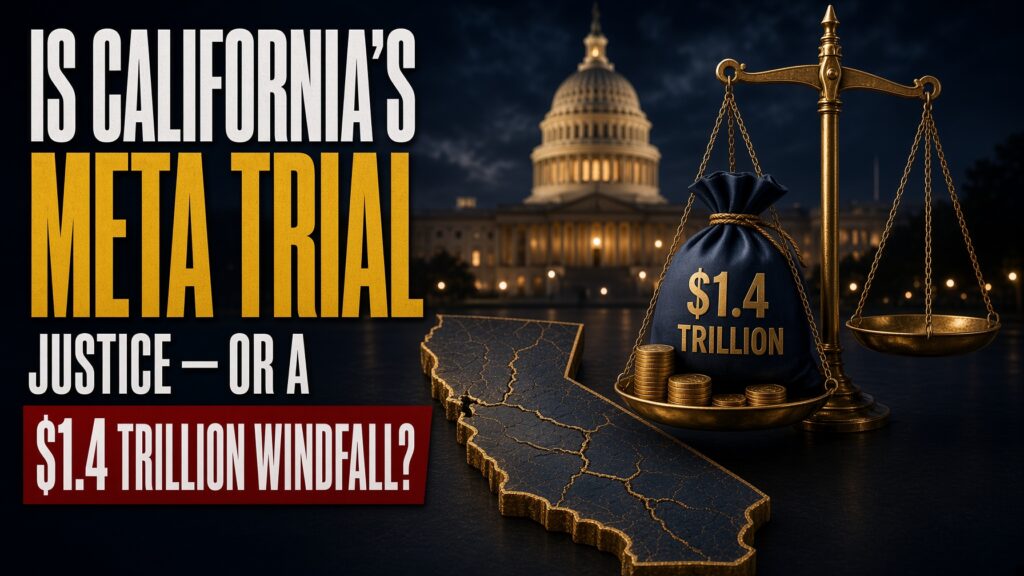
$1.4 trillion. That’s the theoretical maximum penalty attorneys general have floated — a figure close to Meta’s entire market value. The question no parent, taxpayer, or Meta shareholder has gotten a straight answer to: what number are the states actually seeking, and who decided it? Bonta has said the states are not seeking a specific dollar amount, and when asked what the figure should be, pointed to Meta’s roughly $200 billion in annual revenue as a possible benchmark — “maybe more, maybe less.” Meta has called the potential penalty “untethered to any claimed violation,” writing in a court filing that “a sanction of that size has no analog in the history of consumer protection enforcement.” Even legal scholars sympathetic to the states’ case are skeptical of the trillion-dollar figure — Cornell Law professor James Grimmelmann said plainly that Meta “doesn’t have that much money and could not get it.” NPR + 2

A jury doesn’t set Meta’s punishment. A single federal judge does — after states floated up to $1.4 trillion with no fixed number in writing.
Is This Deterrence — Or a Blueprint for Litigation-Funded Government?
Here’s where fiscal accountability enters the picture. California has been down this road before. The 1998 tobacco Master Settlement Agreement promised billions to protect children from cigarette marketing — and decades later, watchdog groups have documented that much of that money was diverted into general state budgets rather than public health programs. If Meta loses and a nine- or ten-figure judgment follows, taxpayers have every right to ask whether the money will fund child mental health services and platform safety, or whether it simply becomes a new revenue stream for state government, decided by attorneys general and judges rather than legislators and voters.
If the tobacco settlement taught Californians anything, shouldn’t they demand to know where a Meta judgment would actually go — before the verdict, not after?
What Does the Evidence Against Meta Actually Show?
Support Independent Local Journalism
TheTownHall.News is a non-profit reader-supported journalism. Just $5 helps us hire local reporters, investigate important issues, and hold public officials accountable across Alameda County. If you believe our community deserves strong, independent journalism, please consider donating $5 today to support our work.To be fair to the states’ case, the trial isn’t built on speculation alone. Former Meta engineering director Arturo Béjar testified that the company prioritized moving quickly and rolling out new products over safety, and that despite working on safety at Meta, he struggled to prevent his own teen daughter from encountering inappropriate content and solicitations from strangers on Instagram. That testimony follows two prior losses for Meta, which faces thousands of similar lawsuits and has already been ordered to pay just shy of $1 billion in damages combined across earlier cases. A New Mexico court separately ordered Meta to pay $567 million to address kids’ mental health online after finding its platforms constituted a public nuisance. Parents watching this case have legitimate reasons for concern, and no one should dismiss real evidence of corporate wrongdoing simply because the proposed penalty looks politically convenient. CNN + 2
What Do Supporters of This Lawsuit Actually Believe?
Supporters of the case, including New Jersey Attorney General Jennifer Davenport, argue Meta is “deceiving consumers about Facebook and Instagram’s dangers” and “putting the profits… over the health of a generation of young people.” Child-safety advocates note that smaller settlements in the past — fines representing a tiny fraction of a tech giant’s annual revenue — have done little to change platform design. That argument deserves a fair hearing: a modest fine against a company earning $200 billion a year functions less like deterrence and more like a cost of doing business. But scale alone doesn’t answer the accountability question. A penalty large enough to be meaningful is also large enough to invite exactly the kind of unchecked, unelected financial windfall that fiscal watchdogs have warned about since the tobacco settlement era. Real child protection and real government accountability aren’t mutually exclusive — but nothing in this case guarantees California voters will get both. NPR
Is this deterrence for a company that harmed children — or a blueprint for government funding itself through litigation instead of legislation?
Key Questions This Trial Raises
- If Meta is found liable, will the judgment actually go toward child mental health programs, or into the state’s general fund?
- Should a single federal judge have the power to set a penalty potentially worth trillions of dollars with no legislative guardrails?
- Does California’s pursuit of a maximal dollar figure strengthen the case for child safety, or undermine public trust that this is about anything other than money?
Is Oakland’s Verdict the Beginning of the Accountability Californians Actually Want?
Meta’s product decisions harmed real families, and the testimony emerging from this Oakland courtroom deserves to be taken seriously by anyone who cares about children online. But holding a corporation accountable and handing government an unaccountable financial windfall are not the same thing, and California voters have watched that distinction blur before. The lingering question isn’t whether Meta will lose this case — plenty of legal observers think it will. It’s whether the money that follows will actually protect a single child, or whether the state that promised accountability from Meta will end up needing some accountability of its own.
Still have questions about where this case is headed? Stay informed — subscribe for daily coverage as the trial unfolds. Think other Bay Area parents need to see this? Share the article. Want your voice heard on how any settlement money gets spent? Contact your California state legislator and ask them to require public reporting on the use of any Meta judgment funds before the trial concludes.