Secaucus Diesel Spill: New Jersey Data Center Fuel Leak Explained
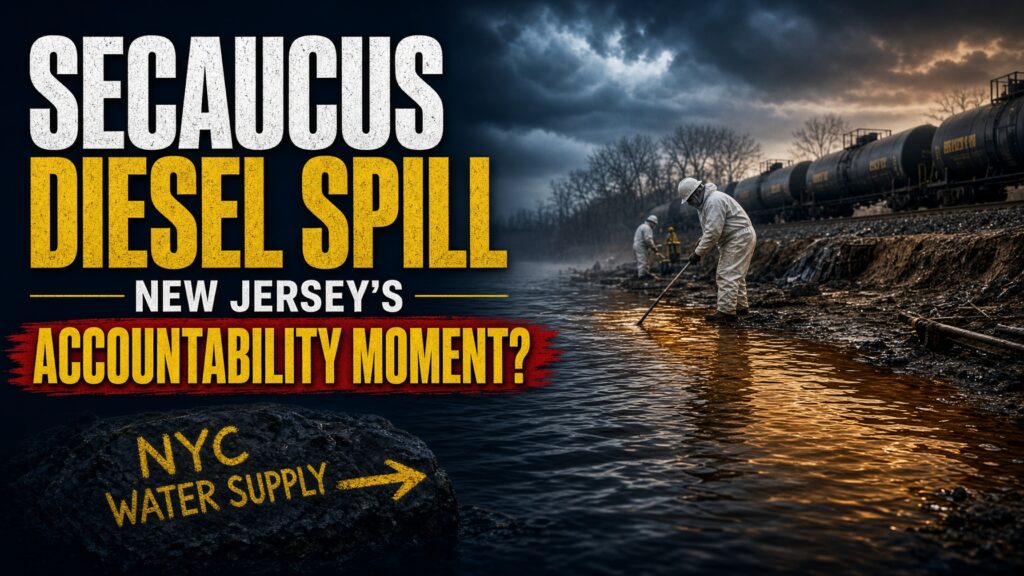
As New Jersey’s data center industry keeps expanding into the Meadowlands, a 5,500-gallon fuel spill in Secaucus is raising a question officials would rather avoid: who is actually watching these facilities, and who pays when they fail?
A quarter-century-old data center just failed a basic safety test. On the evening of September 11, 2026, roughly 5,500 gallons of diesel fuel spilled from a storage tank at Equinix’s NY2 facility in Secaucus and flowed into Anderson Creek, a tributary of the Hackensack River.
The timing matters. New Jersey has spent this year fighting over how fast data centers should be allowed to expand, with the state recently enacting new regulatory guardrails while leaving zoning decisions to individual towns. The Secaucus spill landed in the middle of that fight, and it has handed both sides of the debate new ammunition.
What Actually Happened at the Equinix Facility?
The spill was discovered Friday evening when operations staff detected a fuel release from a tank outside the building [company statement, reported by multiple outlets]. Equinix stopped the leak, brought in the remediation firm Clean Harbors, and notified the Secaucus Fire Department, which alerted the New Jersey Department of Environmental Protection and the Hudson Regional Health Commission.
State officials say the fuel was contained before it reached the Hackensack River itself, and the DEP has reported no observed impacts on wildlife or nearby drinking water intakes [NJ DEP statement]. By Monday, cleanup crews had recovered roughly 3,500 of the estimated 5,500 gallons from the creek [local reporting]. That is genuinely good news. It is also not the full story.
Support Independent Local Journalism
TheTownHall.News is a non-profit reader-supported journalism. Just $5 helps us hire local reporters, investigate important issues, and hold public officials accountable across Alameda County. If you believe our community deserves strong, independent journalism, please consider donating $5 today to support our work.Was This Really Just a “Computer Glitch”?
Secaucus Mayor Michael Gonnelli initially told reporters the spill was caused by a “computer glitch,” noting the facility has operated since 2001 without a prior incident. Equinix later gave a more specific explanation, telling reporters the release stemmed from two broken valves used in the facility’s routine fuel-filtration process [company statement to Fortune].
A 25-year-old facility with backup diesel systems just discovered its own valves could fail without anyone catching it in time — how many other tanks across the state have never been stress-tested this way? That is not a rhetorical flourish. It is the plain implication of a facility operator admitting equipment failure rather than a software error caused the leak.
Who Is Actually Watching New Jersey’s Data Centers?
Here is the uncomfortable part. Equinix detected its own leak, hired its own contractor, and is now writing its own report on what caused it [company statement]. The DEP is monitoring the cleanup, but as of the most recent reporting, a state spokesperson said officials did not yet have information on potential fines or enforcement action against the company.
5,500 gallons. That’s the amount of diesel a single valve failure sent toward a protected tidal wetland — the question no regulator has yet answered is what would have happened if the creek had been just slightly larger or the boom crews slightly slower.
Is it really oversight if the company causing the spill is also the one investigating it?
Hackensack Riverkeeper Bill Sheehan has pushed the state to pursue a natural resource damages claim against Equinix, similar to a 1994 case in which a company responsible for a caustic soda spill on the same river ultimately funded a major restoration project. That is the kind of accountability mechanism that exists on paper. Whether New Jersey uses it here remains an open question.
The Local Backlash Already Underway
The spill has reenergized opposition to data centers across New Jersey, and Secaucus is not an isolated flashpoint. A proposed $1.8 billion data center on Kenilworth’s former Merck pharmaceutical campus has already drawn packed public meetings and a lawsuit from developers who say local officials illegally rewrote zoning rules under public pressure [local reporting].
Gonnelli made a pointed observation after the spill: towns like Jersey City and Bayonne have already banned data centers within their borders, yet a spill upstream in Secaucus still reached their shared waterway. No town can wall itself off from a river that runs through its neighbor’s backyard. That is a genuine limitation of leaving oversight entirely to local zoning boards.

Why a Statewide Ban Might Be the Wrong Fix
Advocacy groups, including the Climate Revolution Action Network, are now using the spill to push for a statewide moratorium on new data centers. That demand is understandable, but a blanket ban solves the wrong problem. The spill was not caused by the existence of data centers in New Jersey. It was caused by two valves at one specific, aging facility that nobody had apparently pressure-tested in years.
Shutting down an entire industry because one operator’s equipment failed does nothing to fix inspection gaps, fine schedules, or reporting requirements. It simply moves the jobs, tax revenue, and infrastructure investment to a neighboring state with looser rules and no guarantee of better maintenance. The actual fix is boring and specific: mandatory third-party tank inspections, real fines tied to spill volume, and a public enforcement record New Jersey residents can actually check.
What Do Data Center Ban Advocates Actually Believe?
Supporters of a moratorium make a case worth taking seriously. They argue the Meadowlands is an already-stressed tidal ecosystem that cannot absorb repeated industrial accidents, that the current patchwork of local zoning decisions leaves no single authority accountable for a river that crosses a dozen town lines, and that an industry expanding this fast should not be trusted to self-regulate its own fuel storage.
Those points land. A tidal marsh that supports fish, shellfish, and migratory birds does not care which town issued the permit for the facility upstream. But a moratorium punishes every operator for one company’s maintenance failure, including data centers that have run for decades without incident. The more defensible answer is not fewer data centers — it is real, verifiable oversight of the ones already here, backed by fines large enough that cutting corners on valve maintenance stops being cheaper than fixing them.
Who Pays When the Next Valve Fails?
Equinix says it is “committed to resolving this quickly, transparently, and responsibly” and is finalizing a root-cause report. Words are easy. What New Jersey residents deserve is a public accounting: how much this cleanup actually costs, whether Equinix pays a fine that reflects the risk it created, and whether the DEP publishes an inspection record the next town fighting a data center proposal can actually rely on.
This is not a story about whether artificial intelligence infrastructure should exist in New Jersey. It is a story about whether the state’s current system of local zoning plus voluntary corporate self-reporting is enough to protect a shared river. Right now, the evidence says it barely was.
Key Questions This Story Raises:
- Why did New Jersey learn about broken valves at a 25-year-old facility only after 5,500 gallons of diesel had already spilled?
- Should the DEP be required to publish tank-inspection and fine records for every data center in the state, rather than responding facility by facility after incidents occur?
- If local towns can ban data centers but still absorb their pollution, is zoning-by-town actually capable of protecting a shared watershed?
So is the Secaucus diesel spill New Jersey’s accountability moment, or just another headline the state waits out until the next one comes? Equinix has promised transparency. The DEP has promised monitoring. Neither promise has yet produced a public number for what this spill will actually cost the company responsible for it. The real question isn’t whether data centers belong in New Jersey — it’s whether anyone will actually hold one accountable when it fails.
Support Independent Local Journalism
TheTownHall.News is a non-profit reader-supported journalism. Just $5 helps us hire local reporters, investigate important issues, and hold public officials accountable across Alameda County. If you believe our community deserves strong, independent journalism, please consider donating $5 today to support our work.Still have questions about how New Jersey regulates its data center boom? Stay informed — subscribe for daily coverage of accountability and environmental policy. Think your neighbors need to see this? Share the article. Want your voice to count? Contact the New Jersey Department of Environmental Protection and your state legislators and ask whether they will require mandatory third-party inspections and published fine records for every data center fuel tank in the state.