

Houston Water Meter Errors: How Many Others Are Still Hidden?
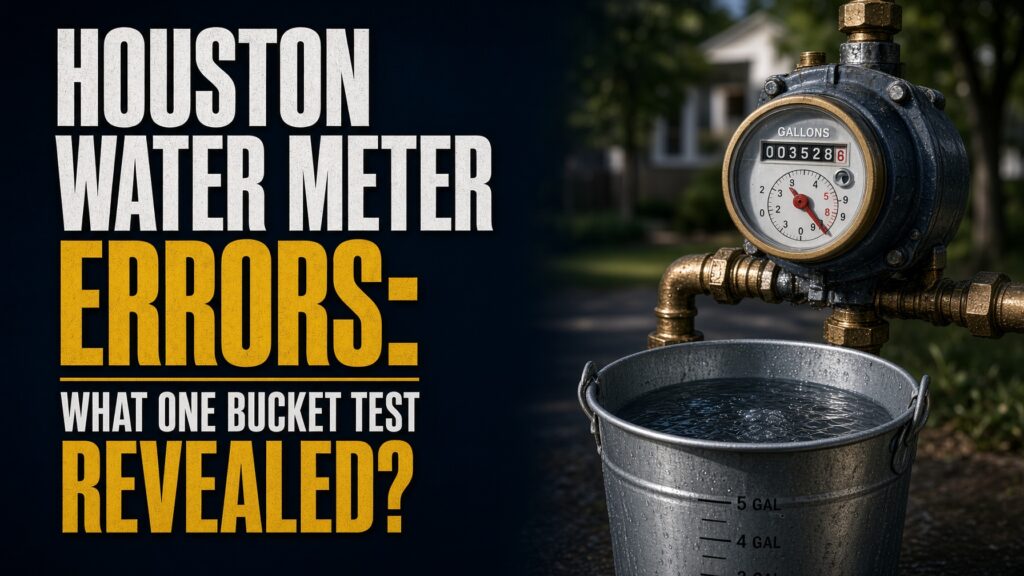
A garden hose and a five-gallon bucket exposed a billing error that city crews had missed, and raised a question City Hall still hasn’t fully answered.
He poured five gallons. His meter counted twenty-two. That was the result Houston homeowner Edgar Zavala recorded, and it now anchors a KPRC 2 investigation into the city’s water billing. The timing matters: on October 21, Houston City Council voted unanimously to add $5.5 million to its water meter contract, bringing the total to $43.5 million, while customers say they still can’t get straight answers [KPRC 2 reporting].
What Did a Five-Gallon Bucket Reveal?
Zavala, an Energy Corridor homeowner and former KPRC 2 employee, opened his July bill and found $479. August brought $820. The city said he had used 27,000 gallons in one month, even though he and his wife were staying elsewhere while their house was on the market [KPRC 2 reporting]. Told it could take up to 30 days for someone to check his meter, he tested it himself. He shut off every tap, wrote down the reading, filled a five-gallon bucket from a hose and checked again. The dial moved from 218 to 240, about 22 gallons, more than four times what went into the bucket. In the KPRC video, the meter’s register is identified as a Badger Model 70, built for a one-inch meter. His meter is five-eighths of an inch. The size is printed at the top of page two of a Houston water bill, so any customer can check.
Support Independent Local Journalism
TheTownHall.News is a non-profit reader-supported journalism. Just $5 helps us hire local reporters, investigate important issues, and hold public officials accountable across Alameda County. If you believe our community deserves strong, independent journalism, please consider donating $5 today to support our work.Why Did the Wrong Equipment End Up on Houston Meters?
A meter register is the readout that converts flow into the number you’re billed for. Attach the wrong one and the meter records faster or slower than the water actually used. This was not the first time. Houston Public Works Director Randy Macchi told KPRC 2 that a manufacturer shipped the wrong equipment in a large order at the end of 2022, and much of it was installed in 2024. The department identified 637 meters with incorrect registers and says it replaced all of them by the end of March [KPRC 2 reporting, city official statements]. Nearly 700 customers had been billed for water they never used, including one who received a $683 bill. Zavala’s case, discovered months later, is why people are asking whether the count of 637 was complete.
Is This Really an Isolated Case?
That is what the city says. Macchi called Zavala’s situation isolated, noting that the same contractor installed six other registers on that route the same day and the city confirmed all six were correct. He declined to speak on camera for the follow-up report. Here is the sequence that gives readers pause. Zavala emailed the city his findings and got no reply. A Public Works employee eventually came by, looked for a leak, and reportedly said meter accuracy wasn’t his department’s job. A crew replaced the register the same day the reporter showed Macchi the video. A customer found the error with a bucket. The city fixed it after a TV reporter called. Who is checking the meters when no one is watching? The city credited Zavala $872, but the letter never mentioned that wrong equipment caused his bills. Meanwhile, KPRC 2 mailed letters to the 637 customers already identified. Of 44 who replied so far, 25 said the city had never contacted them and they had received no refund or credit. That is a small, self-selected group, not proof of a pattern, but it is a result the city has been asked to explain.
What Do the Numbers Actually Tell Us?
Houston has about 500,000 meters in the ground, according to Macchi, and they are failing at an accelerated rate. Meters last roughly 20 years. The city has replaced 30,000 since 2024 and needs at least 300,000 more, while about 230,000 remote-reading sensors have been replaced or installed [KPRC 2 reporting, city figures]. 32 billion gallons. That is how much water Public Works says goes unaccounted for every year. The question the city has yet to answer plainly: who ends up paying for water that nobody can measure? [city Public Works data via KPRC 2] The original contract with Sensus USA was awarded in November 2020 with a $38 million cap. It now stands at $43.5 million, and Macchi has indicated more funding could be requested in 2027. Separately, about 15,000 customers owe the city roughly $30 million in unpaid bills, which one council member linked directly to the metering problem.
What Do Supporters of the City’s Approach Actually Believe?
They make a real argument. Replacing a utility’s metering system across 500,000 connections is a massive job, they say, and equipment that ages out at 20 years can’t be swapped overnight. The city identified the 637 bad registers, replaced them, and council voted unanimously to keep funding the fix. Macchi has also been public about the scale of the problem rather than denying it. Those points deserve credit. It is also true that the new remote-reading system is designed to catch exactly these discrepancies, and customers who get new equipment are supposed to be notified and monitored afterward. But the strongest evidence for caution comes from the city’s own account. The error in Zavala’s case was found by a customer, not by the system built to catch it, and the fix followed media attention rather than a routine audit. Macchi himself acknowledged that high bills still happen today. Spending more is not the same as proving the spending works.

Who Is Watching Your Water Meter?
Houston residents shouldn’t have to audit their own utility. Until the city can show its numbers are right, though, personal diligence is the cheapest protection a household has. Start with page two of your bill, which lists your meter size. Then try what Zavala did: shut off all water inside, record the reading, run a measured amount through a hose, and compare. KPRC 2 encourages customers to film the test and send the results to its ENOUGH team. That is how limited government is supposed to work: the public agency delivers a reliable service, and when it falls short, citizens and the press hold it to account.
Is it a billing system if the customer has to audit it?
The Question Houston Still Owes You
Every dollar spent on meters comes from ratepayers, and every misread meter lands on a household budget. Houston is spending tens of millions to modernize a system that, by its own director’s account, still produces high bills. The investment may be necessary. The accountability has to match it. If a hose and a bucket can find what a city missed, what would a full audit find? Key Questions This Story Raises:
- How did the city confirm that all incorrectly installed registers were found, and will it publish its audit method?
- Why had 25 of 44 responding customers heard nothing from the city about a refund or credit?
- After $43.5 million, when will Houston show ratepayers independent proof the new meters read accurately?
So is Houston fixing its water billing, or funding the next round of fixes? The real question isn’t whether your meter is right. It’s whether anyone at City Hall will prove it before your next bill arrives. What do you think: should Houston be required to audit its meters publicly? Share this article and tell us where you stand. Still have questions? Stay informed: subscribe for daily coverage of government accountability. Think your neighbors need to see this? Share the article. Want your voice to count? Contact your Houston city council member through the City of Houston website and ask for a public audit of meter accuracy and a timeline for notifying affected customers.