
Spain Train Crash: What We Know About the Toledo Collision
Two high-speed trains, one of them standing still, and at least 64 lives lost on a line that was supposed to be safe. As Spain mourns its second rail disaster in nine months, who answers for it?
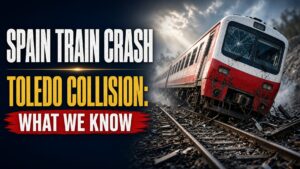
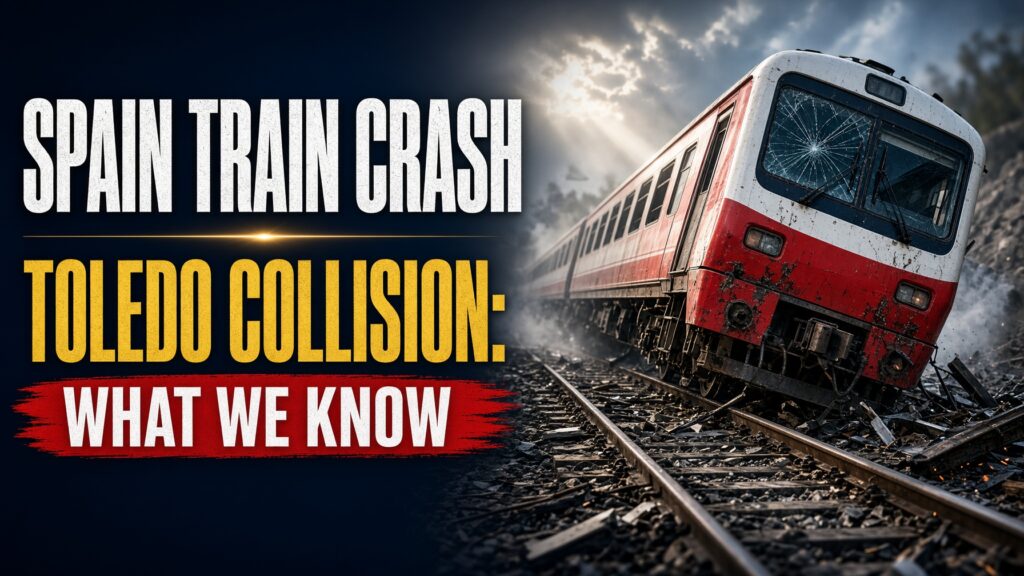
Dozens of passengers boarded a morning train and never arrived. On Wednesday, October 28, 2026, a Renfe AVE high-speed train struck the rear of a stationary Iryo train near Urda, in Spain’s Toledo province, south of Madrid. Regional authorities put the death toll at 64, and some outlets are reporting 68, with rescuers still searching. It is Spain’s worst rail accident since 2013 [wire reporting], and it comes just nine months after another deadly collision involving the same two operators on the same line.
What Do We Know About the Toledo Collision?
The facts that are confirmed are grim enough. Spain’s rail infrastructure operator, Adif, placed the crash at kilometre 118 of the Madrid-Andalusia high-speed line [Adif statement via news reports]. Roughly 397 passengers were aboard the Renfe train and 147 aboard the Iryo train, according to regional officials [AFP, Geo News]. Two carriages left the track, and emergency services told Spanish agency EFE that at least two fell down an embankment [EFE via Israel National News]. Helicopters and dozens of emergency vehicles raced to the scene. Rail services between Madrid and Andalusia were suspended, cutting one of the country’s busiest corridors. Injury figures vary widely across early reports, from roughly 80 to 179. That range is a reminder of how fluid the first hours of any disaster are, and why careful readers should treat every early number as provisional.
Support Independent Local Journalism
TheTownHall.News is a non-profit reader-supported journalism. Just $5 helps us hire local reporters, investigate important issues, and hold public officials accountable across Alameda County. If you believe our community deserves strong, independent journalism, please consider donating $5 today to support our work.Why Did One Train Reach Another That Had Stopped?
This is the question that matters most, and the honest answer is that no one has publicly confirmed it. One report claims the Renfe train was cleared past a red signal before hitting the Iryo service [IBTimes, unconfirmed]. Other outlets have raised the possibility of a rail fracture, and early accounts mentioned a signaling problem [Oneindia, Townhall.com, unconfirmed]. Those are leads, not findings. Naming a culprit before investigators finish would be unfair to the dead and to anyone who may be wrongly blamed. But the basic mechanism, a fast train reaching a stopped one, is exactly what modern signaling systems exist to prevent. If a high-speed train can reach a stopped train ahead of it, what exactly was supposed to stop it?
Is This Spain’s Second High-Speed Disaster in Nine Months?
Yes. In January, a train derailed in southern Spain near Adamuz and struck an oncoming train, killing roughly 45 people, with reports varying between 45 and 46 [AP, Geo News]. The operators involved were the same two companies now at the center of this crash, on the same Madrid-Andalusia corridor. Nine months. That is the gap between two of the deadliest rail accidents Spain has seen in over a decade. The question investigators and politicians will now have to answer: what changed on that line between January and October? Coincidence is possible. Different causes are possible. But when the same corridor produces two mass-casualty accidents in under a year, the public is entitled to ask whether lessons were learned, and whether anyone verified that they were.
Who Is Responsible When Public Rail Fails?
Renfe is Spain’s state-owned railway operator, while Iryo is a private competitor [AFP]. Adif manages the track and signaling infrastructure and is a public entity [publicly known, Spanish government]. That mix matters for accountability, because responsibility can fall across an operator, an infrastructure manager, a regulator, and a government ministry at once. For taxpayers anywhere, that should sound familiar. When a service is funded by the public and run by a public body, accountability depends on transparency. Who signed off on the signaling? Who audited the track? Who decides whether a train may proceed? The answers should be public, specific, and attached to names and offices rather than diffused across agencies. Governments exist to carry out a short list of core duties well, and protecting passengers on a system they fund and oversee is one of them. Spending on modern infrastructure means little if oversight does not keep pace.
Is a safety system really a system if no one can say who is responsible when it fails?
What Do Supporters of Spain’s Rail System Actually Believe?
Defenders of high-speed rail make a serious argument. They point out that high-speed rail remains one of the safest ways to travel, that two accidents do not by themselves prove a systemic failure, and that rushing to judgment before investigators finish risks blaming the wrong people. Many also argue that public investment in modern rail has delivered real benefits to millions of Spanish travelers, and that one tragedy should not erase that. That case deserves a real answer. Investigators should be allowed to work, and nothing here proves that high-speed rail as a concept is unsafe. Cause and fault are still open questions. But “rail travel is safe overall” is not an answer to “why did this specific line fail twice?” Both statements can be true at once. A system can be statistically safe and still have a specific weakness that demands a specific explanation. A safety record is something to be defended with transparency, and it cannot stand in for it.

Could This Moment Force Real Transparency?
Disasters often produce promises first and reforms later, if at all. What separates the two is usually public pressure and public records. Spanish authorities have opened an investigation and the prime minister has expressed solidarity with victims [Euronews, Times of Oman]. Solidarity is necessary, but it is not accountability. Condolences are the beginning of a government’s duty after a disaster. A full public accounting is the rest of it. Independent investigation is the standard that other countries have learned to value. In the United States, the National Transportation Safety Board investigates rail accidents separately from the railroads and the agencies that regulate them, precisely so that the people who run the system are not the ones grading it [federal agency structure]. Whether Spain’s investigation proves equally independent and public will say a great deal about what comes next.
Why Should American Readers Care?
This crash happened thousands of miles away, but the questions travel well. America is also debating how much to spend on passenger rail, who should operate it, and who answers when something goes wrong. Spain’s rail network is often held up as a model, which makes its failures instructive rather than foreign. If a celebrated system can fail twice in nine months, then reputation alone cannot be treated as proof of safety. Any government asking taxpayers to fund passenger rail should be able to show, in plain language, how it verifies that the trains will not collide. Key Questions This Story Raises:
- What did investigators find after the January crash on the same line, and were the recommended fixes completed before this one?
- Why was a high-speed train able to reach a stationary train, and which system, signal, or decision failed?
- Who is publicly accountable, by name and office, for signaling and track safety on Spain’s high-speed network?
The Question That Outlasts the Headline
So is anyone finally accountable for rail safety in Spain? Not yet, and perhaps not for a long time. The dead cannot be brought back, but the public can demand that the investigation be thorough, independent, and open. Anything less leaves the next set of passengers relying on hope. What do you think: should governments that fund and run passenger rail be required to publish their safety audits? Share this article and tell us where you stand. The real question isn’t whether trains can be made safer. It’s whether anyone will be held to account if they aren’t.
Still Have Questions? Here’s How to Get Involved
Want to follow the investigation as it develops? Stay informed. Subscribe for daily coverage of accountability and public safety. Think others need to see this? Share the article and start the conversation in your own community. Want your voice to count? Contact your member of Congress and ask what independent safety oversight and public reporting standards apply to the passenger rail systems your tax dollars support. Most congressional websites offer a simple contact form