
Prospector 5 Rig Sinking: Who Answers for the Workers Still Missing?
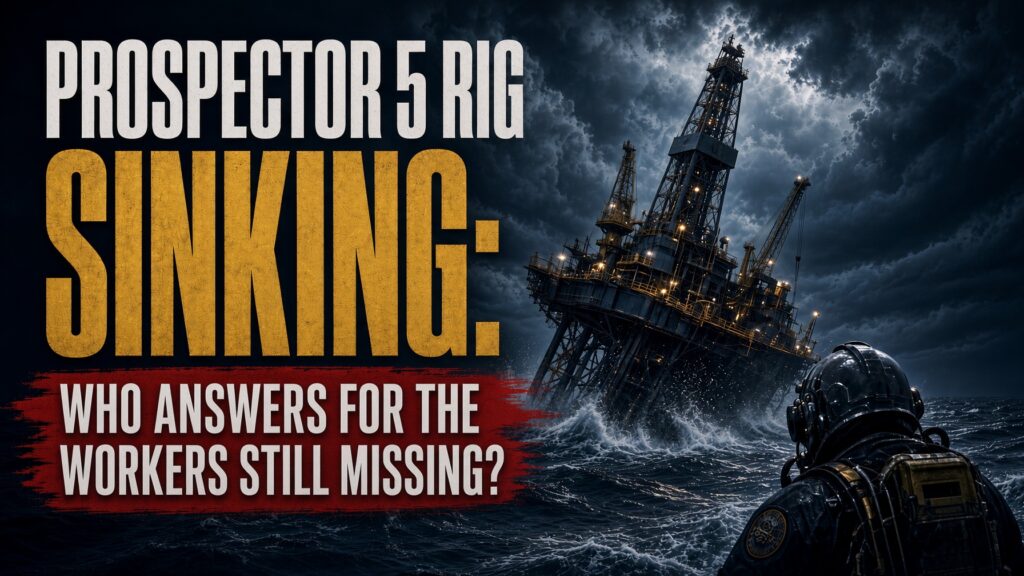
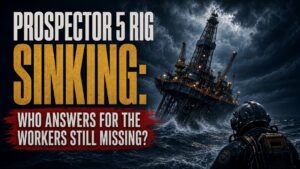
A drilling rig went down off Gabon before it drilled a single well, and families are waiting for word on five people. Before the headlines move on, who will explain what happened, and when?
Five families are still waiting for answers.
On Saturday, October 24, at 8:37 p.m. local time, the Prospector 5 jack-up rig lost stability and sank off the coast of Gabon [BW Energy statement]. Of the 115 people aboard, 110 were accounted for. The search for the rest is continuing, and the questions about how this happened are only beginning.
Support Independent Local Journalism
TheTownHall.News is a non-profit reader-supported journalism. Just $5 helps us hire local reporters, investigate important issues, and hold public officials accountable across Alameda County. If you believe our community deserves strong, independent journalism, please consider donating $5 today to support our work.What Do We Actually Know About the Prospector 5 Rig Sinking?
Start with what the companies have confirmed. The rig, owned and operated by Borr Drilling and contracted to BW Energy, sank during jacking operations as it prepared for a campaign on the Dussafu Marine licence [BW Energy statement]. It had not yet begun drilling [Reuters].
The casualty count is where accounts diverge. Gabon’s government says five people are missing and searches are under way. Reuters, citing three sources familiar with the matter, reports that one employee has died and four remain missing, including three Gabonese nationals and one other expatriate [wire report, unnamed sources]. The government has not confirmed a death.
Until it does, “five unaccounted for” is the only figure every account supports. Gabon’s petroleum ministry has assembled a crisis unit with the navy, state oil company Gabon Oil, BW Energy and Borr [Reuters].
What Is a Punch-Through, and Why Does It Matter?
Borr says preliminary information points to a punch-through during preload activities [Borr Drilling statement]. In plain terms, the base of one of the rig’s legs suddenly broke through the seabed and sank into the sediment, tilting the platform until it lost stability [Maritime Executive].

Preloading is a standard step in positioning a jack-up, meant to test whether the seabed will hold before drilling starts [industry practice]. If the test exists to find weak ground, how did it end with a rig on the bottom?
Nothing public yet explains why the seabed gave way, what surveys preceded the operation, or whether procedures were followed. Those are exactly the questions an investigation exists to answer, and the word “preliminary” deserves emphasis. Readers should be wary of any account, including the early company statements, that presents a cause as settled before investigators have examined the evidence.
If a rig can be lost during a routine stage of preparation, how routine is the risk to the people aboard?
Who Is Responsible for Finding the Answers?
Offshore accountability comes in layers. Borr owns and operates the rig. BW Energy holds 73.5 percent of the licence and Panoro Energy holds 17.5 percent [Reuters]. Gabon’s government oversees the waters off Mayumba and is leading the crisis response.
Layers can protect workers. They can also let responsibility drift between companies, contractors and regulators until nobody owns the answer.
Support Independent Local Journalism
TheTownHall.News is a non-profit reader-supported journalism. Just $5 helps us hire local reporters, investigate important issues, and hold public officials accountable across Alameda County. If you believe our community deserves strong, independent journalism, please consider donating $5 today to support our work.A limited-government view does not mean no one answers. It means responsibility is clear, enforced and public. Companies that profit from dangerous work owe their people a duty of care. Regulators owe the public an impartial investigation and a timely, published result. Seabed data, preload monitoring logs and decision records are the kind of evidence that turns an investigation from a promise into a finding.
Accountability that no one can locate is not accountability. When workers go missing, someone must say, on the record, who answers for what.
A Production Shutdown, but No Reported Spill
BW Energy suspended production at its nearby MaBoMo facility. The company says that follows standard procedure during drilling preparations [BW Energy statement]. Panoro Energy reported no damage to the facility and no accidental discharges [Panoro statement via Reuters].
Those are early company reports, not independent findings. Environmental claims in the first days of any offshore incident should be treated as provisional until regulators verify them. No restart date for MaBoMo has been reported, and investors and Gabonese communities alike will want that timeline.
110 of 115. That is how many people were accounted for after a rig that had not yet drilled its first well went down [company statements]. The question no one has answered: what happened in the minutes before the ground gave way?
What Do Defenders of the Offshore Industry Actually Believe?
Defenders make a serious case. Offshore drilling is among the most heavily regulated industrial activities in the world, they argue, and positioning a jack-up is work crews perform routinely. They also warn against judging before the facts are in, and they note that oil production supports jobs and public revenue in countries like Gabon.
Those points deserve respect. Nothing here is a verdict, and no public evidence assigns blame to any party.
But routine is not the same as risk-free. The 2010 Deepwater Horizon blowout in the Gulf of Mexico killed 11 workers and led to sweeping changes in American offshore oversight [federal investigation records]. Industry credibility is not built by silence after a disaster. It is built by fast, transparent findings that show the system can learn.
“If a rig can be lost before it drills a single well, how confident should anyone be that the risk is fully understood?”
Why Should Americans Care About a Rig Off West Africa?
Borr Drilling is listed on the New York Stock Exchange, so American investors have a direct stake in how the company responds [market listing data]. Jack-up rigs are also a common platform in shallow waters worldwide, including the Gulf of Mexico [industry reference].
The deeper reason is principle. Americans who value personal responsibility and fiscal accountability should expect the same from every industry: clear ownership of risk, honest communication with families, and consequences when standards fail. Families deserve prompt, plain communication from employers, not carefully hedged statements. That standard applies in Houston as much as in Libreville.
Behind every drilling schedule and production target are people who go offshore expecting to come home. Five of them are still unaccounted for.
When a rig sinks before it has drilled a single well, shouldn’t the public expect a full and timely accounting of why?
Key Questions This Story Raises:
- What did seabed surveys and preload monitoring show before the punch-through, and will that data be made public?
- Which authority will lead the investigation, and when will it publish its findings?
- Who is keeping the families of the missing informed, and are they getting plain answers?
The Question That Outlasts the Search
Strip away the technical vocabulary and the story is simple. People went to work, a rig sank, and five of them have not been found. The search comes first, and everything else should wait for it.
But once the search ends, the harder part begins. The companies, the regulators and the government each hold pieces of the truth. The families do not hold the pieces, only the loss.
The real question isn’t whether offshore energy can be done safely. It’s whether the people responsible will show their work in public, and whether the answers will arrive before the headlines move on.
Still have questions about what happened? Stay informed: subscribe for daily coverage of accountability and safety stories. Think others need to see this? Share the article. Want your voice to count? Contact your member of Congress and ask whether federal offshore safety investigations are published promptly and in full.