FEMA Hotel Payments: What the Court Ruling Means for Taxpayers
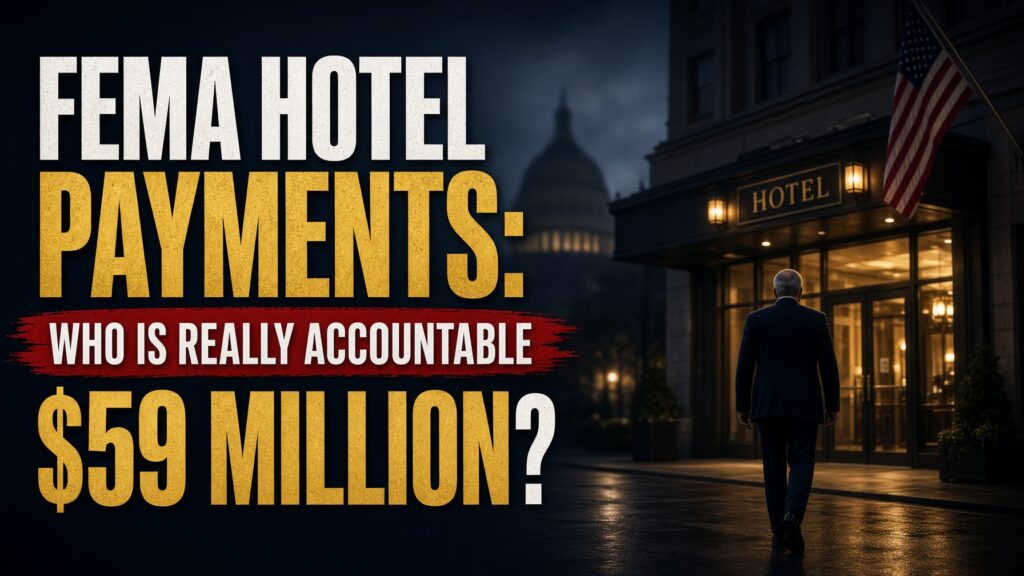
A federal judge has ruled that FEMA’s fired chief financial officer was let go unlawfully. Millions of Americans are now asking the bigger question: who actually answers for how this money was approved?
Four federal employees were fired over $59 million in migrant-housing payments. A federal judge has now ruled that one of them was fired unlawfully. The question of who answers for the money has never been settled. Why does this matter now? On July 17, 2026, Judge Michael Nachmanoff ruled that the firing of former FEMA chief financial officer Mary Comans violated federal law and ordered a name-clearing hearing [federal court ruling, via Federal News Network]. The government is appealing, and in August a magistrate judge refused to let the Justice Department delay that hearing [E&E News, Washington Post reporting]. A fight most Americans first saw as a viral post is back, and it is far more complicated than the post suggested.
What Actually Happened in February 2025?
On February 10, 2025, Elon Musk wrote on X that DOGE had discovered FEMA sent $59 million “last week” to luxury hotels in New York City [Musk post, via Fox News]. The next day, DHS announced four firings: FEMA’s chief financial officer, two program analysts and a grant specialist, for “circumventing leadership” [DHS statement, via Fox News and Reuters]. Acting FEMA chief Cameron Hamilton said the payments were suspended and that personnel would be held accountable [wire reporting]. Then-Secretary Kristi Noem announced she had clawed back the payment [DHS statement]. Later reporting described an $80 million New York grant that FEMA ultimately recovered [The Hill]. The message from Washington was fast and forceful: someone had defied the president. What the public received far less of was a paper trail.
Support Independent Local Journalism
TheTownHall.News is a non-profit reader-supported journalism. Just $5 helps us hire local reporters, investigate important issues, and hold public officials accountable across Alameda County. If you believe our community deserves strong, independent journalism, please consider donating $5 today to support our work.What Do the Numbers Actually Tell Us?
Start with the headline figure. Of the $59.3 million, about $19 million paid for hotels, while the rest covered food, security and other services, according to officials [Fox News, New York Sun]. New York City’s mayor’s office said it never paid luxury rates, and officials said none of the money came from a disaster relief grant [New York City officials, via AP and NY Sun]. The money was also not a surprise. It flowed through the Shelter and Services Program, which Congress created in 2023 [E&E News], and the funding was appropriated by Congress and allocated to the city by FEMA the year before, according to AP reporting [AP, via NewsNation]. E&E News reported the payments had been approved months earlier. A Lead Stories fact check at the time found DHS never confirmed the $59 million figure and that the original post offered no evidence for its framing [independent fact-check]. That does not settle whether every dollar was well spent. It does mean “rogue bureaucrats sent a secret check” is a much harder story to prove than it sounded in February 2025.
Who Decided a Disaster Agency Should Run a Migrant Shelter Program?
$1 billion. That is roughly how much FEMA had spent through the Shelter and Services Program by early 2025 [E&E News, trade press]. The question Congress has never answered plainly: why is an agency built for hurricanes and wildfires administering immigration-related reimbursements? Disaster response is FEMA’s core job. Yet by 2025 it also managed payments tied to Customs and Border Protection’s mission [AP, via NewsNation], and Reuters noted that Republicans had criticized the program before the firings [Reuters]. That is a legitimate limited-government critique. When agencies drift from their core mission, oversight drifts with them. When a disaster agency administers immigration spending, who answers to the taxpayer: the employee who processes the payment, or the Congress that wrote the program? A firing can end a career. It cannot, by itself, fix a program.
Did Washington Follow Its Own Rules When It Fired Her?
On process, the court says no. Judge Nachmanoff rejected the argument that the president can fire senior officials without a hearing or a chance to transfer, and ordered a name-clearing hearing so Comans can respond to public accusations [federal court ruling, via Federal News Network]. The ruling does not return her to FEMA [CFO.com]. Comans disputes the government’s account. Her lawyers say the payments were approved months earlier through a congressionally authorized program and that she followed procedure [court filings, via CFO.com and E&E News]. In a recent filing she also alleges that former Secretary Noem and aide Corey Lewandowski fed false information about her firing to a social media influencer [E&E News]. Those are allegations, not findings.
If the government can announce a firing before it can prove its case, what protects the next employee, or the next taxpayer? Conservatives who prize law and order should read this ruling closely. Fiscal accountability and due process are not rivals. A government that ignores one rarely respects the other.
What Do Defenders of the Firings Actually Believe?
Supporters make a serious argument. Elected presidents set policy, they say, and an agency official who bypasses leadership on politically charged spending undermines the voters’ choice. Many Republicans had already criticized the program, and a January 2025 executive order launched a review of FEMA [Reuters]. On that view, swift action signaled that spending requires political accountability. That argument deserves a real answer. The administration has every right to end or redirect a program, and it halted the payments and announced a clawback [DHS statement]. But the court’s finding concerned how the firing was done, not whether policy could change. And claims about luxury stays or disaster-relief money were disputed by officials at the time [AP, NY Sun]. Policy disagreement is legitimate. Treating a contested payment as proof of wrongdoing is something else, and a name-clearing hearing exists precisely to test it.

What Should Taxpayers Demand Next?
Three reforms would serve conservatives and skeptics alike [editorial opinion]. Congress could require every Shelter and Services Program payment to appear in a public, itemized ledger. It could name in statute exactly which official signs off, so responsibility is never murky. And it could ask whether a disaster agency should run the program at all. Taxpayers deserve a spending system where the approval trail is public before the headlines, not after the firings. Nobody should learn about $59 million from a social media post.
Key Questions This Story Raises:
- Who, specifically, approved each Shelter and Services Program payment, and will that chain of approval be made public?
- Why does a disaster agency administer immigration-related reimbursements, and should Congress move the program?
- If a court finds a firing unlawful, what does that mean for how the government announces personnel actions in the future?
The Question That Outlasts the Headline
Strip away the viral posts and the rebuttals, and one question remains. When taxpayer money is spent in ways that spark outrage, does the system hold accountable the people who designed it, or only those who processed it? A name-clearing hearing will test one woman’s reputation. It will not answer that. Only Congress can. What do you think: should Congress move this program out of FEMA entirely? Share this article and tell us where you stand. The real question isn’t whether $59 million was too much. It’s whether anyone will answer for how the next billion is approved. Will they?
Still have questions? Stay informed: subscribe for daily coverage of government spending and accountability. Think others need to see the full story? Share this article. Want your voice to count? Contact your member of Congress and ask whether they support a public, itemized ledger of every Shelter and Services Program payment. Most House and Senate offices accept messages through their official websites.