Is the Greenland Deal Really the Historic Win Trump Claims?
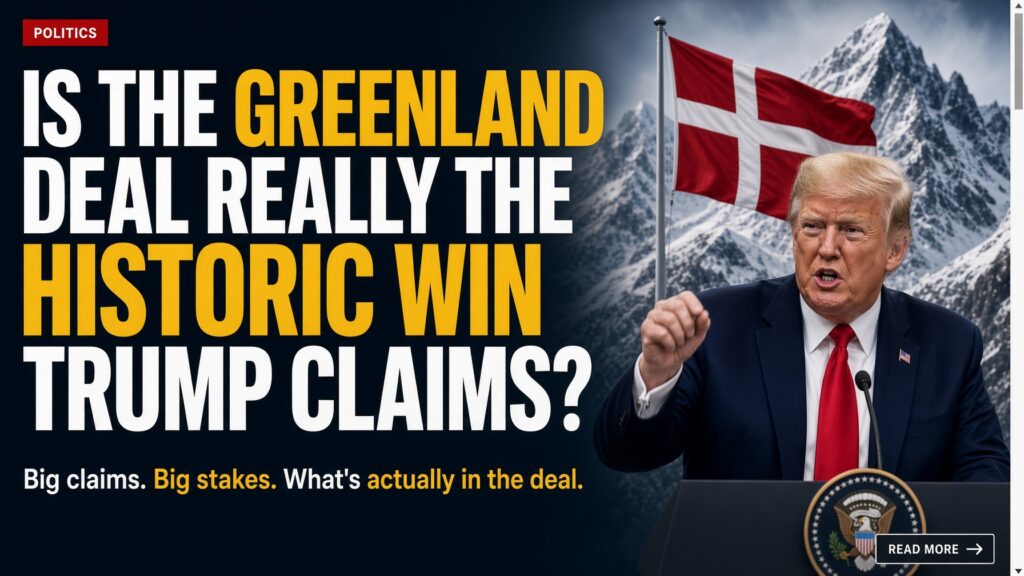
President Trump says the United States just secured “permanent control” over Greenland’s security at “NO COST.” Denmark says something far more limited actually happened — and the paperwork isn’t even signed yet.
No cost. No end. No sovereignty transfer. Those three claims cannot all be fully true at once, and untangling them matters.
President Trump announced on social media Friday that the United States, Denmark, and Greenland had reached an agreement granting America “permanent control over security, and all other needs” on the Arctic island [wire-confirmed, multiple outlets]. Within hours, Denmark’s government confirmed a deal exists — but described something considerably narrower than a president’s Truth Social post suggested.
Support Independent Local Journalism
TheTownHall.News is a non-profit reader-supported journalism. Just $5 helps us hire local reporters, investigate important issues, and hold public officials accountable across Alameda County. If you believe our community deserves strong, independent journalism, please consider donating $5 today to support our work.What Did Trump Actually Announce?
Trump called it an “Infinite Life” agreement with no end date, claiming it addresses “ALL of our many U.S. concerns” and comes at zero cost to American taxpayers [Truth Social post, wire-confirmed]. He said the U.S. would immediately begin building a larger military footprint in Greenland and that no U.S. adversary could ever establish a base, military presence, or sensitive investment there without Washington’s written approval.
That is a real expansion of American reach in the Arctic. Greenland already hosts U.S. forces under a decades-old defense arrangement with Denmark [CNBC]. What changes, according to Trump’s own description, is the scope of American authority over who else gets access to the island going forward.
Who Actually Controls Greenland Now?
Here is the part getting lost in the celebration: nobody. Denmark’s government stated plainly that the agreement does not give the United States sovereignty over Greenland [wire-confirmed]. Danish Prime Minister Mette Frederiksen described it instead as a deal that “strengthens our common security in the Arctic and the North Atlantic area” and benefits NATO and Europe broadly [Danish PM statement via wire reporting].
If Denmark says sovereignty never changed hands, is “permanent control” the right way to describe what actually happened? That is not a rhetorical trick — it is the exact gap between the announcement and the agreement Denmark’s own government is describing.

Why Did Denmark Insist This Isn’t Annexation?
Context explains the caution. Trump spent much of the past year pressuring Denmark to sell Greenland outright, at times declining to rule out taking it by force from a NATO ally [CNBC]. Denmark and Greenland repeatedly said the island was not for sale, and the European Union publicly rebuked the annexation push earlier this year.
Against that backdrop, Copenhagen has every incentive to draw a hard line in public between “expanded security cooperation” and “loss of sovereignty.” The joint statement from Denmark and Greenland’s leadership emphasized the deal recognizes the territorial integrity of the Kingdom and the Greenlandic people’s right to self-determination [wire-confirmed]. Whatever Washington calls this arrangement, Copenhagen is not calling it a transfer of ownership.
What Happens Next — And When?
This is where “breaking news” needs a reality check. The agreement has not been signed. Leaders from all three governments said Friday they expect to formally sign it next week, timed to coincide with the United Nations General Assembly in New York [NBC News, ABC7]. Even after signing, parliamentary action in both Denmark and Greenland is still required before the deal becomes enforceable.
A deal announced on social media before a single legislature has voted on it is not a done deal — it’s a press release. That distinction matters for anyone tracking whether this becomes durable U.S. policy or another headline that fades once the news cycle moves on.
Does “No Cost” Actually Hold Up?
This is the fiscal accountability question nobody in Washington is being asked directly. Trump says the agreement comes at “NO COST to the United States.” But he also said the U.S. will “immediately begin the process of developing a large Military presence” in Greenland [Truth Social post].
Support Independent Local Journalism
TheTownHall.News is a non-profit reader-supported journalism. Just $5 helps us hire local reporters, investigate important issues, and hold public officials accountable across Alameda County. If you believe our community deserves strong, independent journalism, please consider donating $5 today to support our work.Building out military infrastructure in one of the most remote, logistically difficult environments on Earth is not free. Bases, personnel rotations, cold-weather equipment, and construction all carry a price tag paid by American taxpayers, regardless of what any agreement says about licensing fees or land costs. Calling a military buildup “no cost” doesn’t make the bill disappear — it just moves it off the press release and onto the taxpayer. That distinction deserves scrutiny before anyone declares total fiscal victory.
50%. That’s roughly the share of Arctic shipping lanes projected to open as sea ice recedes over the coming decades — the question nobody in Washington has answered is what a “no cost” military buildup there will actually cost over the next fifty years [industry and government Arctic policy estimates].
Why Does This Matter for U.S. Security Right Now?
Strip away the political theater, and there is a genuine strategic case here. Greenland sits along the shortest Arctic approach between North America and Russia, and its rare earth mineral deposits have drawn interest from both Beijing and Moscow. An agreement that blocks rival powers from bases, military presence, or sensitive investment on the island without U.S. approval addresses a real national security gap — one previous administrations acknowledged but never closed.
Is it possible for a deal to be strategically sound and still be oversold to the American public at the same time?
That is not an accusation of bad faith. It is a recognition that a genuinely useful security arrangement and an accurately described one are not automatically the same thing. Both can be true, or only one can — and right now, the public only has a president’s social media post and a foreign government’s cautious correction to go on.
What Do Supporters of the Greenland Deal Actually Believe?
Supporters of the agreement make a case worth taking seriously. They argue that for over a century, presidents have recognized Greenland’s strategic importance without ever locking in a durable security arrangement, and that Trump’s willingness to apply sustained pressure — however blunt — is what finally produced a written commitment from Denmark. They point to the explicit language barring adversary bases and investments as a concrete, verifiable win regardless of how it’s packaged politically.
That argument has real merit. Getting any formal commitment from a reluctant ally after months of public friction is not nothing, and blocking rival access to Arctic real estate is a legitimate strategic gain. But a strategic gain is not the same as the sweeping, cost-free, sovereignty-adjacent victory being described in a celebratory social media post. Supporters are right that something real was achieved. They are on shakier ground if they accept the announcement’s framing without asking what “permanent” and “no cost” will actually mean once lawmakers in Copenhagen and Nuuk vote on it.
Key Questions This Story Raises:
- If Denmark says sovereignty was never on the table, why did the announcement describe “permanent control” over “all other needs” in Greenland?
- Who is actually paying for the “large Military presence” Trump says will begin immediately, and has Congress been briefed on the cost?
- Since Danish and Greenlandic parliamentary approval is still required, what happens to this “Infinite Life” agreement if either legislature says no?
Is This the Accountability Moment — Or Just Another Headline?
The honest answer sits between the two loudest reactions online. This is neither the annexation some had hoped for nor an empty gesture. It is a real, still-unsigned security arrangement that expands U.S. influence in the Arctic while leaving Greenland’s sovereignty formally untouched — and leaving its actual costs unexplained.
Whether this becomes a lasting strategic win or a footnote depends entirely on what happens after next week’s signing ceremony: whether Danish and Greenlandic lawmakers ratify it, and whether the White House ever puts a real number on what “no cost” is going to cost. The real question isn’t whether America gained ground in the Arctic — it’s whether anyone in Washington will admit what it actually costs to keep it.
Still have questions about what this deal really means? Stay informed — subscribe for daily coverage of the policies shaping American foreign policy. Think your friends are getting the wrong idea from a single social media post? Share this article. Want your voice to count? Contact your member of Congress and ask whether this Arctic security agreement will come before lawmakers for oversight before U.S. forces expand into Greenland.