Prop 50 Gerrymander Ruling: What California Voters Should Know?
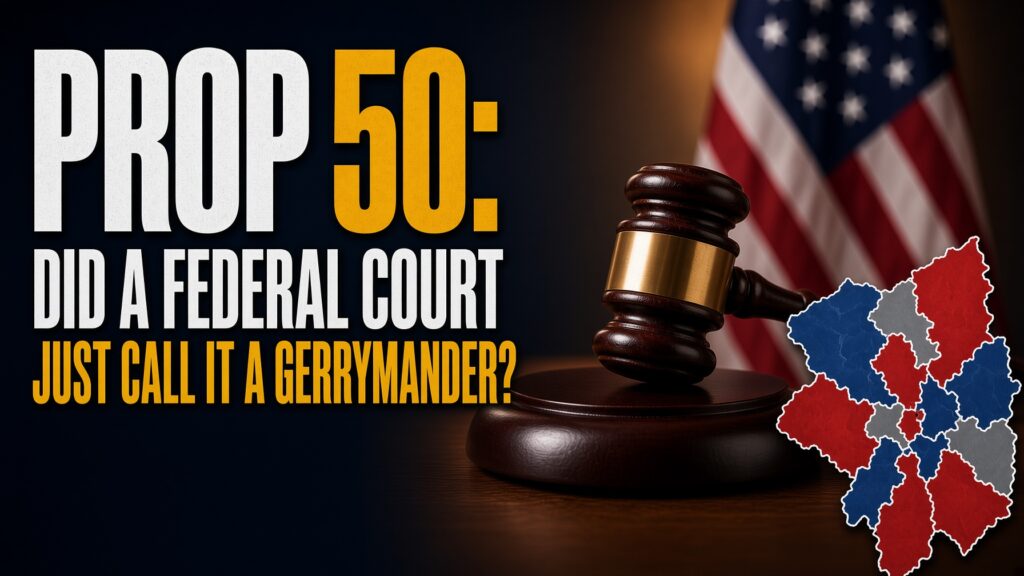
California voters were told Proposition 50 was a defensive, transparent response to Texas. A federal court just ruled it was something else entirely — and the legal fight over California’s congressional maps is far from over.
A federal court already said the quiet part out loud.
In upholding Proposition 50 this year, a three-judge federal panel ruled the measure was “exactly what it was billed as: a political gerrymander designed to flip five Republican-held seats to the Democrats.” That finding matters right now because California’s congressional map fight is not settled. A federal hearing on August 19 will consider motions to dismiss the consolidated lawsuit still challenging the maps, meaning the legal and financial fight over Prop 50 continues well into its second year.
What Exactly Did the Courts Rule on Prop 50?
Voters approved Proposition 50 in a November 2025 special election with roughly 64 percent support, authorizing new congressional district lines through the end of the decade. California Republicans, joined later by the Trump administration’s Department of Justice, sued within a day of the vote, arguing the map illegally favored Hispanic voters by race. A federal three-judge panel rejected that racial-gerrymandering claim in a 2-1 ruling, with Judge Josephine Stanton writing for the majority and Judge Kenneth Lee dissenting. The panel upheld the map as lawful. But in doing so, the majority also plainly stated the map’s purpose was partisan advantage. A federal court called Prop 50 a “political gerrymander” in its own ruling — while ruling it legal. Is that really the transparent process Sacramento promised voters?
Support Independent Local Journalism
TheTownHall.News is a non-profit reader-supported journalism. Just $5 helps us hire local reporters, investigate important issues, and hold public officials accountable across Alameda County. If you believe our community deserves strong, independent journalism, please consider donating $5 today to support our work.Why Does the Word “Gerrymander” Matter Here?
Governor Gavin Newsom and legislative leaders spent the entire 2025 campaign framing Prop 50 as a defensive, temporary countermeasure to Texas Republicans, not partisan gerrymandering itself. Newsom explicitly said California was pursuing “a very transparent, temporary and public process,” distancing the effort from the closed-door redistricting he criticized in Texas. A federal court’s own language undercuts that framing. Courts do not typically use the word “gerrymander” loosely, and having a federal panel apply it directly to Prop 50, even while ruling the map constitutional, is a meaningful distinction for voters who were told this was principled self-defense rather than a power play.
Has Every Legal Challenge to Prop 50 Really Failed?
Not entirely, and not yet finally. California Attorney General Rob Bonta has stated that every challenge to Prop 50 has failed “to date,” and that claim holds up: the California Supreme Court and federal courts have rejected five separate lawsuits, and the U.S. Supreme Court declined in February to block the map from being used in the 2026 midterms. Five lawsuits rejected, one Supreme Court emergency bid denied — but the case isn’t closed. Should voters trust “we won every round so far” as the final word?
“In other words, the ‘impetus for the adoption’ of the Proposition 50 Map was ‘partisan advantage pure and simple.'”
Is the Legal Fight Actually Over?
No. The consolidated federal lawsuit brought by the California GOP, the Trump administration, and individual voters is still active. Court records show California and intervening parties filed motions to dismiss the case in April, opposition briefs followed in May, and a hearing on those motions is scheduled for August 19. That means well over a year after voters approved Prop 50, taxpayers and candidates are still funding and navigating active federal litigation over maps that are already being used to recruit and file candidates for 2026.
This is not a fringe procedural footnote. The Department of Justice itself is a named party pressing the case, which means federal resources, not just state and county funds, are also being spent litigating the legitimacy of California’s own congressional lines. Whatever the outcome of the August 19 hearing, the fact that a sitting U.S. Department of Justice is still actively challenging a state’s voter-approved map nearly a year after it passed says something about how contested this process remains, regardless of which side voters ultimately trust more on the underlying policy question.
What Do the Numbers Actually Tell Us?
64 percent. That is the share of California voters who approved Proposition 50 in November 2025 [ballot results]. The question the ongoing litigation raises is not whether voters had the right to decide this. They clearly did, and decisively. The real question is whether a “temporary, transparent” special election process that has now generated a full year of federal litigation, a Supreme Court emergency appeal, and an active DOJ lawsuit was ever as clean or as low-cost as it was sold to voters. 64 percent of California voters approved Prop 50 as a “temporary, transparent” fix — a year of federal litigation later, was that promise kept?

What Do Supporters of Prop 50 Actually Believe?
Supporters make a straightforward case worth taking seriously. Texas Republicans, under pressure from President Trump, redrew their own congressional map first, specifically to add Republican-favorable seats mid-decade, well outside the normal post-census redistricting cycle. Prop 50 backers argue California had little choice but to respond in kind or accept a structural disadvantage heading into a pivotal midterm election. They point out that voters, not legislators acting unilaterally, made the final call at the ballot box, and that the map includes trigger language and a sunset provision limiting it to this decade.
That argument carries real weight, and the historical sequence supports it: Texas acted first. Where accountability-minded readers can reasonably push back is on the gap between rhetoric and result. Calling a plan “temporary and transparent” while a federal court simultaneously labels it a partisan gerrymander is not a contradiction voters should simply wave away. Both things being true at once is exactly why continued judicial and public scrutiny of Prop 50 is warranted, regardless of which side initiated the mid-decade redistricting arms race.
KEY QUESTIONS
- If a federal court itself calls Prop 50 a “political gerrymander,” does the “temporary defensive measure” framing voters were sold still hold up?
- How much taxpayer money has the state spent defending Prop 50 in five-plus lawsuits, with litigation still ongoing into a second year?
- With an August 19 hearing still pending, could any outcome still change how California’s 2026 congressional races are run?
So Where Does the Prop 50 Fight Go From Here?
The August 19 hearing on motions to dismiss will not resolve the case outright, but it will signal whether the consolidated challenge from California Republicans and the Justice Department survives to a fuller trial. Meanwhile, candidates are already filing to run under the new district lines, and the 2026 primary calendar is moving forward regardless of the litigation’s outcome. That timeline mismatch, a live congressional map used in filing deadlines while its legal foundation remains contested in federal court, is itself worth voter attention. The real question isn’t whether Prop 50 will ultimately survive in court. It’s whether Sacramento will ever be straight with voters about the difference between a defensive countermeasure and a partisan gerrymander a federal court has already named as exactly that.
What do you think — was Prop 50 a necessary defense of California’s voters, or the gerrymander a federal court says it was? Share this article and let us know.
Still have questions about what the August 19 hearing could mean for your district? Stay informed — subscribe to The Town Hall News for daily accountability coverage. Think California voters deserve straight answers about the true cost and character of Prop 50? Share this article. Want your voice to count? The California Secretary of State’s office and your county registrar post public records on redistricting litigation and 2026 candidate filings — review them directly and see how your own district lines changed.