Alien Enemies Act Deportations: What the Courts Ruled and What Comes Next?
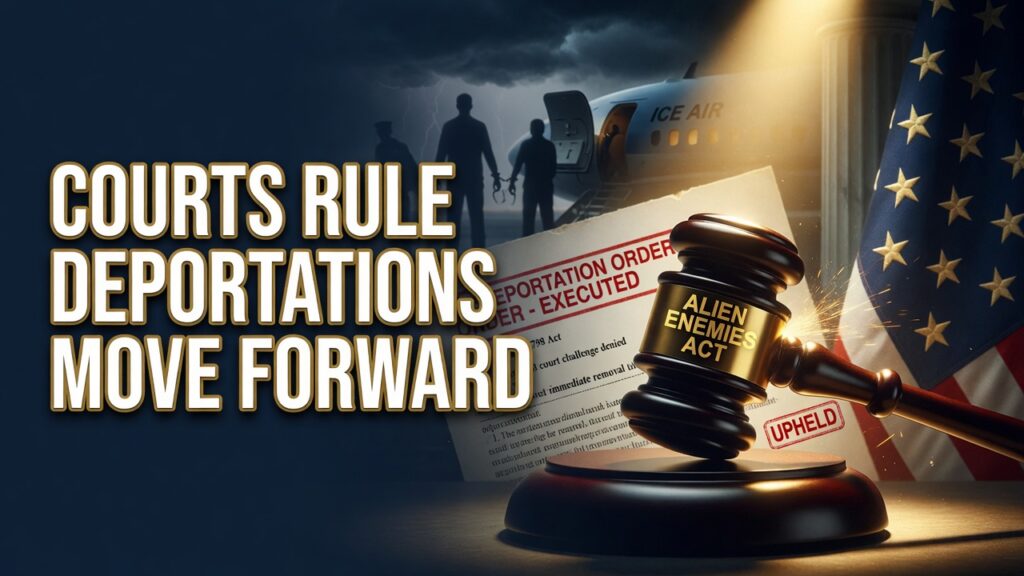
A wartime law from 1798 is at the center of the most consequential immigration legal battle in modern American history — and the Supreme Court has not yet delivered its final word.
A 227-year-old statute designed for declared wars is now being used to fast-track deportations in peacetime. As courts continue to clash with the executive branch over the Alien Enemies Act, millions of Americans are asking a question that cuts across every political line: who actually has the authority to decide who gets due process — and who doesn’t?
The stakes could not be higher. In March 2025, the Trump administration invoked the Alien Enemies Act of 1798 for the first time ever during peacetime, declaring the Venezuelan gang Tren de Aragua an invading force and ordering the rapid deportation of approximately 278 Venezuelan nationals to El Salvador’s notorious CECOT mega-prison. The operation was executed within 24 hours of the proclamation, with several deportation flights taking off while federal courts were still issuing orders to stop them. That collision between executive power and judicial authority has since ignited one of the most fiercely contested legal fights in a generation.
Support Independent Local Journalism
TheTownHall.News is a non-profit reader-supported journalism. Just $5 helps us hire local reporters, investigate important issues, and hold public officials accountable across Alameda County. If you believe our community deserves strong, independent journalism, please consider donating $5 today to support our work.What Is the Alien Enemies Act — and Why Does It Matter Now?
The Alien Enemies Act was passed in 1798 during a period of genuine international crisis. Congress intended it as a wartime tool, and until March 2025, it had been invoked exactly three times in American history — during the War of 1812, World War I, and World War II, all involving declared conflicts with foreign nation-states. The law grants the president sweeping authority to detain and deport nationals of a hostile foreign power without the procedural protections that normally govern immigration cases.
The Trump administration’s argument is straightforward: Tren de Aragua is a terrorist organization with documented ties to the Venezuelan government, its members have infiltrated the United States illegally, and that infiltration constitutes an “invasion” under the law’s plain meaning. Supporters argue this is exactly the kind of decisive executive action that a law-and-order administration owes to American citizens who have watched violent gang activity spread across the country.
The federal government invoked a wartime law — in peacetime — to deport hundreds of people without individual hearings. If that doesn’t demand judicial scrutiny, what does?
The problem is not the goal. Removing violent gang members from American soil is a legitimate law enforcement priority that commands broad public support. The problem is the method, the speed, and the staggering number of documented cases in which the wrong people were swept up in the process.

Who Was Actually Deported to El Salvador’s Mega-Prison?
This is where personal responsibility and government accountability collide in ways that should concern every American who believes in limited, honest government. Investigations by multiple outlets revealed that DHS used a validation guide that allowed officers to designate someone as a Tren de Aragua member based solely on tattoos, clothing, or being photographed with someone else under suspicion.
Andry Hernández Romero, a gay makeup artist who fled Venezuela to seek asylum in the United States, was labeled a gang member because two wrist tattoos reading “Mom” and “Dad” each had a small crown above them. DHS intelligence had noted that some Tren de Aragua members use crown imagery. No other evidence linked him to the gang. In another case, Frengel Reyes Mota appears to have been incorrectly identified because his file was merged with another person’s, importing gang designations that belonged to someone else entirely. Experts on Tren de Aragua have also confirmed that the gang does not use identifying tattoos as a matter of practice — making the entire evidentiary basis for dozens of designations factually groundless.
278 men were deported to a foreign mega-prison in under 24 hours, many without lawyers, hearings, or any real opportunity to say: “You have the wrong person.”
What Did the Courts Actually Rule?
The viral claim that the Supreme Court issued a sweeping 5-4 ruling granting Trump “broad wartime authority” under the Alien Enemies Act is not accurate. What actually occurred is more nuanced — and more unsettling for anyone who values the rule of law regardless of political affiliation.
In April 2025, the Supreme Court did overturn a lower court injunction, permitting some deportations to proceed. But the Court was unanimous on one critical point: every individual targeted under the Alien Enemies Act must be given a reasonable opportunity to challenge their designation before a judge. That procedural requirement was denied to every man who was placed on a flight to El Salvador on March 15, 2025.
Support Independent Local Journalism
TheTownHall.News is a non-profit reader-supported journalism. Just $5 helps us hire local reporters, investigate important issues, and hold public officials accountable across Alameda County. If you believe our community deserves strong, independent journalism, please consider donating $5 today to support our work.“The Supreme Court unanimously confirmed that the March 2025 deportees were denied due process. The question that remains — and the one that will define presidential power for decades — is whether the executive branch answers for it.”
In September 2025, the Fifth Circuit Court of Appeals — the most conservative federal appeals court in the country — ruled 2-1 that the Trump administration cannot use the Alien Enemies Act to deport alleged Tren de Aragua members. The majority found that gang activity does not constitute an “invasion” or “predatory incursion” under the statute’s historical meaning. The case is expected to reach the Supreme Court for a definitive ruling on the merits, which has not yet been issued.
238 men. Deported to a foreign prison. Based on tattoos. Is this what “law and order” is supposed to look like?
What Do Supporters of This Policy Actually Believe?
This is a question worth engaging seriously. Supporters of the administration’s approach argue that Tren de Aragua poses a documented, escalating threat to American communities. They point to INTERPOL confirmation as recently as December 2024 that the gang has emerged as a significant U.S. security concern, and to the genuine operational challenge of processing thousands of cases through a strained immigration court system that already faces multi-year backlogs. From this perspective, the Alien Enemies Act represents a constitutionally grounded emergency tool that a commander-in-chief is entitled to deploy when conventional mechanisms are too slow.
The response to this argument is not that the threat is imaginary. It is that the government’s own execution was so flawed that it imprisoned people based on evidence that experts called baseless. A government serious about law and order should be equally serious about getting the right people. Fiscal conservatives should also note that the United States paid El Salvador to house these detainees — and then paid again to repatriate 200 of them to Venezuela via a prisoner swap in July 2025 that secured the release of 10 American nationals and lawful permanent residents. Accountability for the taxpayer demands better targeting, not just more speed.
Is This the Accountability Moment We Have Been Waiting For?
[$X paid to El Salvador to detain, then repatriate, deportees whose designations were built on flawed checklists. The question every fiscal conservative should be asking: who authorized that spending — and who answers for it?]
A criminal contempt proceeding was opened against the Trump administration for defying a federal court order while deportation flights were still airborne. That proceeding has since been paused at the D.C. Circuit level, but it has not been dismissed. The doctrine of separation of powers — one of the foundational structural commitments of the American constitutional order — is on the line in ways that extend far beyond immigration policy.
Parents who believe in civic values and constitutional literacy should be paying attention. The precedent being set here is not just about one president’s use of one obscure statute. It is about whether future presidents — of any party — can invoke “invasion” rhetoric to bypass individual rights at scale. The machinery of emergency powers, once expanded, rarely contracts voluntarily.
Key Questions This Article Raises:
- If the Supreme Court has not yet ruled on the merits of the Alien Enemies Act’s application to gangs, what legal authority currently governs any future deportations under this law?
- Who within DHS authorized a validation checklist that experts say was factually incompatible with how Tren de Aragua actually operates — and have they been held accountable?
- If the executive branch defied a federal court order mid-flight, and a contempt proceeding was opened and then paused, what precedent does that set for the next administration that finds judicial orders inconvenient?
The Question That Outlasts This Presidency
Every American who believes in personal responsibility should be able to hold two ideas simultaneously: violent gang members should be removed from this country, and the government does not get to skip due process because it is in a hurry. Those are not contradictory positions. They are the same position, applied consistently.
The final Supreme Court ruling on the Alien Enemies Act has not yet arrived. When it does, it will define the outer boundary of executive immigration power for generations. The real question is not whether you support border security. The real question is whether you trust this government — or any government — to correctly identify the enemy when the stakes are this high and the safeguards have been stripped away.
What do you think — is it too late to demand accountability for how this law was applied? Share this article and make your voice heard.
Still have questions? Stay informed — subscribe for daily coverage of the courts, immigration policy, and constitutional law. Think others need to hear this? Share the article with someone who deserves the full picture. Want to make your voice count? Contact your representative through congress.gov and ask where they stand on Alien Enemies Act reform.