Israel Military Merger: What NDAA Section 219 Really Does- Is US Sovereignty at Risk?
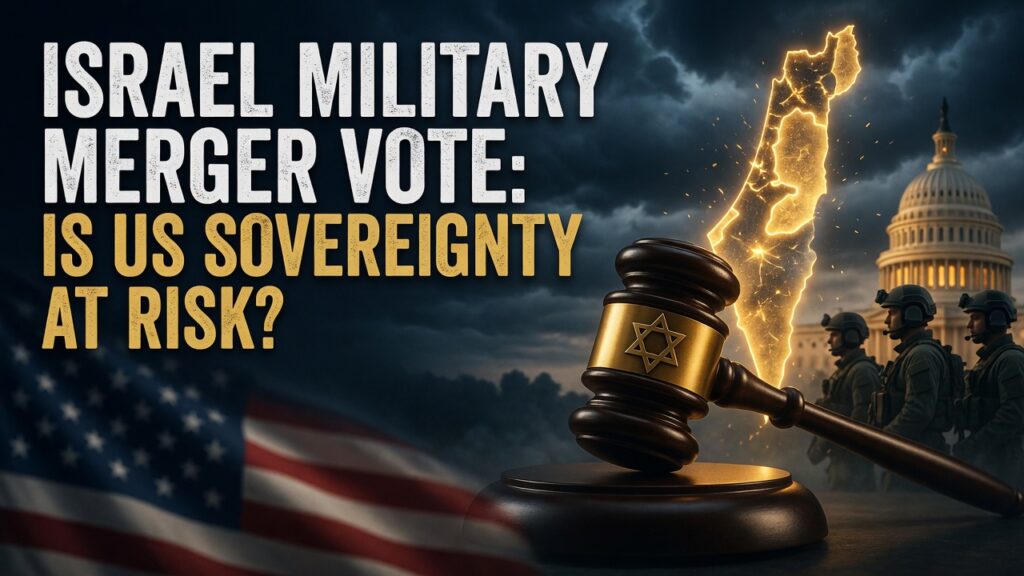
As the House pushes a permanent defense-technology pact with Israel through the annual defense bill, Americans are asking a blunt question: who actually controls the future of the American military — Washington, or someone else?
Congress just voted on whether America’s military future belongs to America alone. The House passed the Fiscal Year 2027 National Defense Authorization Act on July 22 by a razor-thin 216-212 margin, and buried inside it is a provision that has lawmakers from both parties calling it a threat to American independence [House Clerk Roll Call 278].
This matters right now because the provision, Section 219, doesn’t expire. It creates a permanent Pentagon office dedicated to merging U.S. and Israeli defense technology, supply chains, and weapons planning for years to come — through this administration and every one after it.
Support Independent Local Journalism
TheTownHall.News is a non-profit reader-supported journalism. Just $5 helps us hire local reporters, investigate important issues, and hold public officials accountable across Alameda County. If you believe our community deserves strong, independent journalism, please consider donating $5 today to support our work.What Does Section 219 Actually Do?
Section 219 directs the Pentagon to appoint an “executive agent” whose sole job is synchronizing American and Israeli defense programs. That office would identify jointly developed technologies, coordinate weapons production, and report to Congress annually through 2030 [House Armed Services Committee summary].
Rep. Thomas Massie called it a provision that “tragically merges our military technology and supply chains with Israel’s.” Massie, a Kentucky Republican, joined Democrat Ro Khanna in a bipartisan amendment to strip the section entirely. House leadership blocked a floor vote on that amendment before the bill ever reached the floor.
That procedural move — denying members a clean vote to remove the provision — is itself part of the story. When leadership won’t let elected representatives vote on stripping a permanent foreign-integration clause from a defense bill, voters have every right to ask why.
Who Actually Voted for This?
This isn’t the first time this fight has surfaced this year. Earlier in the summer, Massie proposed cutting more than $3 billion in aid to Israel, largely destined for its military, and that amendment was defeated in a separate House vote. Section 219 represents a different and arguably more consequential approach: instead of an annual aid number Congress can raise, lower, or eliminate each year, it builds a permanent structural relationship that sits outside the normal appropriations fight entirely.

The vote broke down almost entirely on party lines, but not perfectly. Republicans backed the bill 209-7. Democrats opposed it 205-6. One independent voted yes [House Clerk Roll Call 278].
Florida Rep. Byron Donalds, the Trump-endorsed frontrunner for Florida governor, voted yes. So did most of the Republican conference. But not all of it — Florida Rep. Anna Paulina Luna, who has publicly endorsed Donalds’s campaign and calls herself an “America First and Florida First patriot,” voted no alongside Massie. That split among Florida Republicans themselves shows this isn’t a simple left-versus-right story. It’s a fight over sovereignty that cuts through both parties.
Is This Really a “Merger” of Two Militaries?
That’s the most contested word in this entire debate, and it deserves an honest answer. Section 219 does not disband, combine, or place the U.S. military under joint command with Israel’s. There is no unified force structure, no shared chain of command, and no transfer of American troops to foreign control.
What it does create is a standing legal framework for permanent technology-sharing, joint weapons development, and supply-chain integration that would be far harder for a future Congress or president to unwind than the year-to-year aid packages America has used for decades. Critics argue that permanence is the point — and the danger.
If a future administration wanted to change course on this alliance, would Congress even have the power to do it anymore?
Support Independent Local Journalism
TheTownHall.News is a non-profit reader-supported journalism. Just $5 helps us hire local reporters, investigate important issues, and hold public officials accountable across Alameda County. If you believe our community deserves strong, independent journalism, please consider donating $5 today to support our work.Why Are So Many Americans Starting to Ask Questions?
Because permanence changes everything. A foreign aid vote happens every year, in the open, where voters can hold their representatives accountable. A permanent statutory integration office does not need to be revisited. It becomes part of the machinery of government, insulated from the next election.
That is precisely the concern Rep. Adam Smith, the top Democrat on the House Armed Services Committee, raised when he withdrew his support for an earlier version of the same language, saying the arrangement would be “extraordinarily difficult for future presidents or Congresses to undo, regardless of changing public opinion” [Common Dreams].
“This amendment is an existential threat to American sovereignty and democracy.”
That line came from a member of Congress speaking about the bill on the floor. Whether or not you agree with everything else that lawmaker believes, the sentence itself asks a question worth sitting with.
What Do the Numbers Actually Tell Us?
216-212. That’s how close this vote was in a chamber where Republicans hold a majority. The question no one in Washington wants to answer: if a provision this consequential can barely survive a vote in a GOP-controlled House, why was it structured so members never got a separate vote on removing it?
What Do Supporters of This Policy Actually Believe?
Supporters make a serious case, and it deserves a fair hearing. Rep. Mike Lawler, R-N.Y., pushed back hard on “merger” framing, arguing the provision reflects the same kind of cooperative agreements, intelligence-sharing, and joint technology development the U.S. already conducts with many allies — not a surrender of command authority. Backers say formalizing the process gives the Pentagon faster access to Israeli-developed defense technology and strengthens an alliance both parties have supported for decades.
That argument isn’t unreasonable on its face. The United States has long-standing joint programs with allies like the UK and Australia. But those arrangements were built through individually negotiated agreements Congress could revisit. Section 219 goes further by locking a specific bilateral relationship into permanent statute — which is exactly why members from both parties, not just one faction, tried to strip it out.
What Happens If No One Speaks Up?
The bill now moves to the Senate, where a separate version of the NDAA must be reconciled through conference committee before anything becomes law. That means the provision is not final. It also means there is still a window for public pressure to shape the outcome.
This is where accountability actually happens, or doesn’t. Conference committees negotiate final bill language behind closed doors, out of public view, before sending a take-it-or-leave-it package back to both chambers for an up-or-down vote. Once that happens, individual provisions like Section 219 rarely get stripped out, because doing so would require unraveling the entire negotiated compromise. That makes the coming weeks — while the Senate debates its own version — the last realistic window for a provision like this to be changed rather than simply accepted.
Limited-government conservatives have spent decades arguing that permanent, hard-to-reverse commitments belong to voters and their elected representatives, not to entrenched bureaucratic arrangements insulated from election-day consequences. That principle doesn’t change depending on which country or which administration is involved. A defense relationship built on annual, transparent votes keeps Washington accountable. A defense relationship built into permanent statute does not.
Key Questions This Story Raises
- If this provision is permanent, will any future Congress ever get a real vote to undo it?
- Why did House leadership block a floor vote on removing Section 219 before final passage?
- Should any bilateral defense arrangement — with any nation — be locked into permanent law rather than renewed through annual, accountable votes?
The Question That Won’t Go Away
Congress didn’t merge two militaries this week. But it did take a serious step toward making one foreign relationship permanent and far harder to change than ordinary policy — buried inside a $1.15 trillion bill most Americans never saw a headline about. The real question isn’t whether Section 219 technically merges commands. It’s whether Americans are comfortable with any permanent, hard-to-reverse foreign entanglement being written into law without a clean, standalone vote.
Should any single foreign relationship ever be locked into permanent U.S. law without a direct, standalone vote of the people’s representatives?
That’s the question this vote leaves behind. And it’s not going away when the news cycle moves on.
Still have questions about what’s really in the NDAA? Stay informed — subscribe for daily coverage. Think your neighbors need to see this? Share the article. Want your voice to count? Contact your senator before the Senate takes up its own version of the bill and tell them where you stand on Section 219.