Are Homeless Voters Being Used to Swing LA ‘s Mayor Race — Without Their Knowledge?
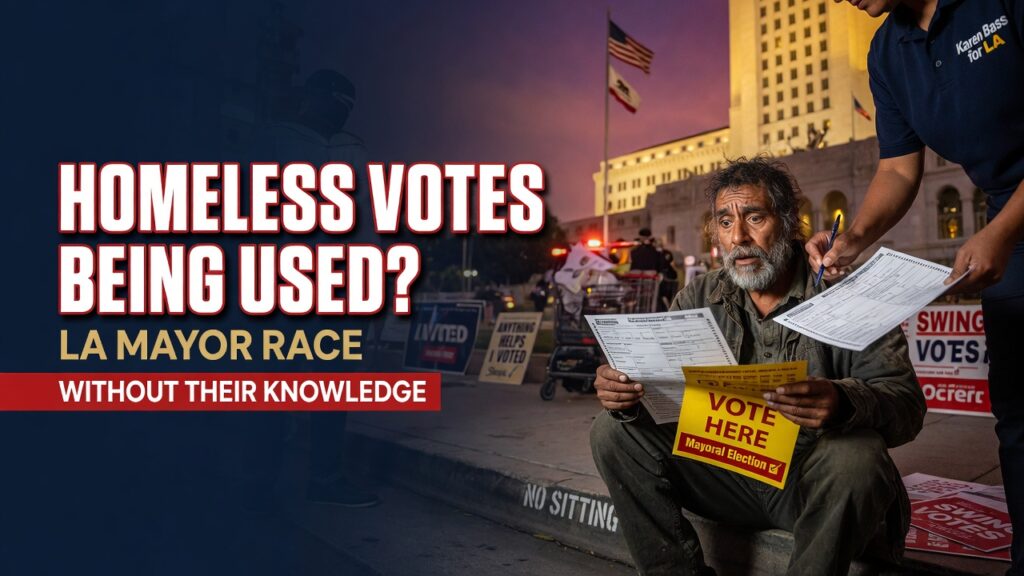
A federal investigation is now underway — and a trail of public records links one mayoral candidate’s committee to the very organizations at the center of the controversy.
Seven thousand, six hundred registered voters. Thousands of them tied to shelters that cannot house them.
That number — drawn from a New York Post review of Los Angeles voting records — sits at the heart of a growing election integrity scandal that erupted this week as the results of the LA mayoral primary trickled in. As progressive City Councilmember Nithya Raman surged past reality-TV candidate Spencer Pratt to claim a November runoff spot against incumbent Mayor Karen Bass, questions about how those ballots arrived — and who orchestrated the effort to collect them — are now being asked in federal courtrooms, not just on social media.
Support Independent Local Journalism
TheTownHall.News is a non-profit reader-supported journalism. Just $5 helps us hire local reporters, investigate important issues, and hold public officials accountable across Alameda County. If you believe our community deserves strong, independent journalism, please consider donating $5 today to support our work.What Do the Numbers Actually Tell Us?
The scale is difficult to dismiss. According to voting records reviewed by the New York Post, approximately 7,600 voters across Los Angeles are registered at homeless shelters, supportive housing developments, and social service providers. On its own, registering to vote from a shelter address is legal — homeless individuals have the right to vote. But the registrations at addresses that offer no beds at all are harder to explain.
The Midnight Mission in Skid Row tops the list with 1,160 registered voters — yet the facility provides beds for only 84 men and 36 women. That is a registration-to-bed ratio of more than ten to one.
7,600. That is how many Los Angeles voters are registered at homeless shelters and service providers — thousands at locations with no overnight capacity.
The St. Joseph Center in Venice, a homeless services drop-in center that provides no accommodations whatsoever, lists 185 registered voters at its address. That center received a $600,000 taxpayer-funded grant awarded while Nithya Raman chaired the City Council’s Housing and Homelessness Committee. A photograph showing Raman personally presenting the check appeared on the center’s website — until reporters from the New York Post began asking questions. The image was quietly removed. Neither Raman’s campaign nor the center has responded to requests for comment.

Is There a Direct Link Between Raman and These Organizations?
The $600,000 grant is a matter of public record, not speculation. What remains under investigation is whether the pipeline of funds from Raman’s committee to organizations like St. Joseph Center created a political relationship that then translated into organized voter registration drives on the candidate’s behalf.
If a city councilmember funds an organization with taxpayer dollars — and that organization registers hundreds of voters at an address with zero beds — someone needs to explain how that happened.
Public records show that hundreds more registrations are tied to supportive and affordable housing projects connected to LA County social services, with nearly 200 added in the final weeks before the voter registration deadline. Over 80 voters are registered at four behavioral health and addiction treatment facilities. Another 313 registrations are linked to LA County social services locations. The pattern is not random. The clustering around the registration deadline, and around organizations receiving public funds from committees Raman chaired, raises questions that deserve direct answers.
What Witnesses Are Saying on the Ground
Accounts from individuals who live near these facilities add texture that public records alone cannot provide. A Skid Row resident described years of organized pushes to register voters in the area, with claims of cash payments and cigarettes offered as incentives during what he called “big push” efforts. One registered voter near the Midnight Mission, identified in reporting as Bo Jackson, reportedly could not recall registering to vote and could not name a single candidate in the very mayoral race his ballot would have affected.
These are not anonymous internet rumors. A related federal case has already produced a guilty plea. Brenda Lee Brown Armstrong, a 64-year-old Marina del Rey woman identified by prosecutors as a longtime petition circulator, agreed to plead guilty to a felony charge of paying homeless individuals to register to vote on Skid Row. First U.S. Assistant Attorney Bill Essayli was direct: “Before she could have a homeless person sign a petition, she first needed to get them to register to vote, and that’s what she paid them to do.”
Support Independent Local Journalism
TheTownHall.News is a non-profit reader-supported journalism. Just $5 helps us hire local reporters, investigate important issues, and hold public officials accountable across Alameda County. If you believe our community deserves strong, independent journalism, please consider donating $5 today to support our work.“If California wants to restore public trust, we invite them to comply with federal law and allow us to audit its voter rolls.” — First U.S. Assistant Attorney Bill Essayli
Is the Federal Government Finally Stepping In?
The answer, for once, appears to be yes — and it predates this week’s controversy. In April 2025, U.S. Attorney Essayli announced the formation of the Homelessness Fraud and Corruption Task Force, a multi-agency body comprising federal prosecutors from the Major Frauds Section, the Public Corruption and Civil Rights Section, and the Civil Fraud Section, backed by the FBI, IRS Criminal Investigation, and the HUD Office of Inspector General.
The task force was originally formed to investigate the misuse of the billions in taxpayer dollars allocated to address homelessness in Southern California — money that auditors found was spent with poor oversight, disjointed programs, and a near-total absence of financial controls. Now, Essayli has confirmed his office will also investigate the specific voter registration concerns raised by the New York Post reporting, pledging to “follow the evidence” wherever it leads.
Is it too late to ask who was really served by all that money — the homeless, or the political networks that managed it?
This is precisely the kind of accountability moment that civic institutions exist to provide. The question is whether California’s state leadership will cooperate or obstruct. California Attorney General Rob Bonta has already pushed back, calling the fraud allegations “irresponsible and dangerous” and citing the absence of widespread fraud findings in previous election audits. That is a legitimate data point. It is not, however, an explanation for 185 voter registrations at an address with no beds.
What Do Supporters of This Policy Actually Believe?
Defenders of California’s current voter registration framework make a coherent argument. Homeless individuals are among the most politically marginalized populations in America. Allowing them to register at service provider addresses — rather than requiring a traditional home address — is a deliberate policy choice to ensure they are not disenfranchised. Voter registration drives at shelters and drop-in centers are, under this view, a civic good. The absence of a bed at a given address does not necessarily mean the person registered there has no connection to that location.
California also operates without voter ID requirements by design — Sacramento lawmakers have concluded that the costs of disenfranchisement outweigh the risks of fraud. Election integrity advocates disagree, but it is worth acknowledging that the policy rests on a genuine values judgment, not pure negligence.
These are fair points. They do not, however, address the specific evidence: the guilty plea of a woman paid to register homeless voters, the removal of a photograph tying a funded organization to a mayoral candidate, or the near-200 new registrations added in the final weeks before the deadline at addresses connected to publicly funded service providers. Good-faith election reform can coexist with demanding answers about specific, documented irregularities.
Key Questions This Story Demands Answered
- Why was the photograph of Raman presenting a check to St. Joseph Center removed from the center’s website immediately after press inquiries began?
- Who organized the voter registration drives at facilities with no capacity to house the registered voters — and were those drives coordinated with any political campaign?
- Will California’s state officials cooperate with federal investigators, or will they treat oversight as an attack rather than a safeguard?
The voters of Los Angeles — housed and unhoused alike — deserve an election decided by legitimate ballots cast by real, informed participants. The woman who pleaded guilty to paying for registrations did not operate in a vacuum. Someone organized the effort. Someone funded the outreach. And someone decided to take a photograph down when a reporter started calling.
The real question is not whether fraud is theoretically possible in a system without ID requirements and with unregulated ballot harvesting. The real question is whether the people of Los Angeles will demand to know who was pulling the strings — before the November runoff makes the answer irrelevant.
Think this story demands more scrutiny? Share it with someone who votes in Los Angeles. Want daily coverage of election integrity issues? Subscribe to our newsletter. Want to make your voice count? Contact your California state representative and ask them where they stand on federal oversight of voter roll audits.