USPS Ballot Rule 2026: What California Voters Need to Know
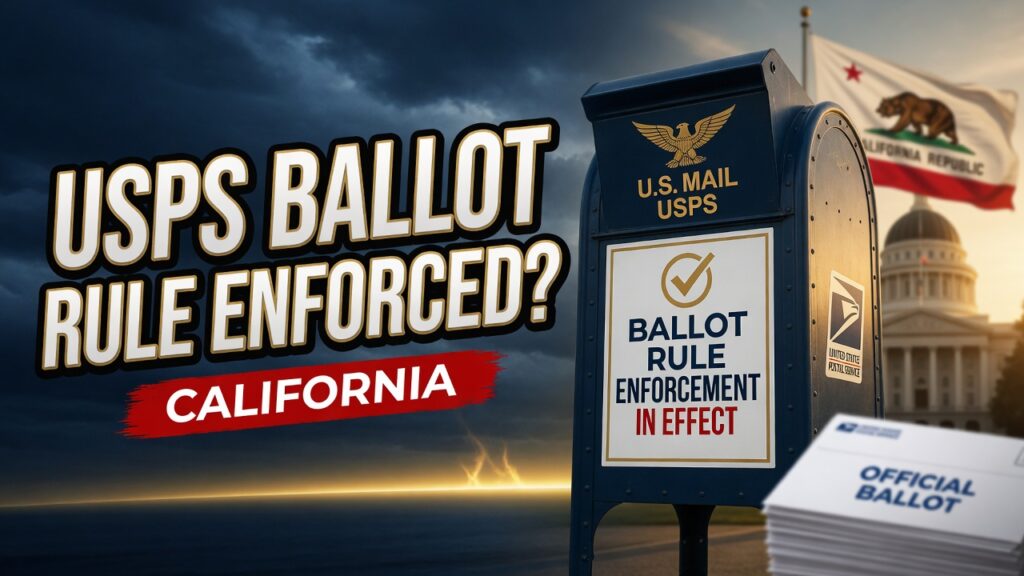
As a federal appeals court hands the Trump administration a win on mail ballots, millions of Californians are asking: is my vote still protected — or is that protection about to run out?
A federal appeals court just handed election integrity advocates a win. The question now is what happens next.
On July 17, 2026, the D.C. Circuit Court of Appeals stayed a lower court order that had blocked the U.S. Postal Service from moving forward with new mail ballot delivery rules tied to President Trump’s March executive order on citizenship verification. The ruling does not settle the underlying legal fight, but it lets USPS resume work on a rule that could determine whether millions of mail ballots reach voters this November.
Support Independent Local Journalism
TheTownHall.News is a non-profit reader-supported journalism. Just $5 helps us hire local reporters, investigate important issues, and hold public officials accountable across Alameda County. If you believe our community deserves strong, independent journalism, please consider donating $5 today to support our work.Why This Ruling Matters Right Now
The stakes could not be higher. With the 2026 midterms less than four months away, the timeline for finalizing election mail procedures is shrinking fast. Postmaster General David Steiner told Congress plainly that USPS would withhold ballot delivery from states that refuse to submit their voter rolls for verification, framing the policy as an effort to make sure the right ballots go to the right people. That single sentence has driven a summer of litigation, and Friday’s ruling is the first time a federal appellate court has sided with the administration’s approach, even on a temporary basis.
What Does the Executive Order Actually Require?
Executive Order 14399, signed March 31, 2026, directs USPS to work with the Department of Homeland Security and the Social Security Administration to verify citizenship before mailing ballots. States would be required to submit detailed voter manifests, including names, addresses, and barcode identifiers, at least 60 days before a federal election. States that decline to comply would risk having their ballots withheld entirely. Supporters call it basic housekeeping. Critics call it federal overreach into a process the Constitution reserves for the states.
Is California Actually at Risk of Losing Ballot Delivery?
Not yet, and voters deserve to know that distinction. In June, U.S. District Judge Indira Talwani in Boston issued an injunction blocking enforcement of the order against 24 jurisdictions, including California, that sued over the policy. That injunction remains in place. Separately, U.S. District Judge Emmet Sullivan in Washington, D.C. blocked the rule nationwide in early July, finding it likely violated a 2021 settlement between USPS and the NAACP requiring the agency to prioritize timely election mail delivery. Friday’s appeals court ruling stayed Sullivan’s nationwide block, not Talwani’s California-specific one. In practical terms, USPS can now resume the rulemaking process, but California’s ballots are still shielded while the broader case plays out.
A federal court just ruled USPS is likely to win this fight. Should California voters be worried, or is this exactly how oversight is supposed to work?

Who Actually Decides How Ballots Get Delivered?
That is the constitutional question underneath all of this. Judge Talwani wrote that no law passed by Congress gives USPS authority to control mail-in voting, and that the Constitution reserves election administration to the states. The D.C. Circuit panel took a narrower view, finding the NAACP’s challenge was likely premature because the rule remains in proposed form rather than finalized. Both rulings can be true at once, which is exactly why this case is headed toward further appeals rather than resolution.
“There can be no do-over once the election occurs.”
That line from the D.C. Circuit’s ruling captures the urgency driving USPS and the Trump administration to keep pushing the rule forward before ballots go out this fall.
- That is how many states and jurisdictions currently remain shielded from the rule by a federal injunction. The question Washington has not answered: what happens to that shield once the appeals process runs its course? [federal court filings]
Do you trust a patchwork of federal judges to decide how your ballot gets delivered?
What Happens Between Now and November?
USPS still has to finalize the rule, a process with its own legal deadlines. The executive order set an August 3 deadline for USPS to propose a final version. The Trump administration has already appealed Talwani’s injunction to the First Circuit Court of Appeals, arguing that a divided system — part of the country under the rule and part exempt — is unworkable this close to an election. Postal worker unions have separately raised concerns about putting mail carriers in the position of deciding which ballots move and which do not. Every one of these threads has to resolve within roughly fifteen weeks.
Election officials in the affected states now face a genuine planning problem. Ballot design, envelope printing, and mailing schedules are typically locked in months ahead of a general election, not weeks before it. If California’s injunction were lifted late in the process, the state could be forced to redesign its mail ballot system on an emergency timeline, which raises its own accountability questions about cost and readiness. That uncertainty, more than any single ruling, is what election administrators say worries them most heading into the fall.
Support Independent Local Journalism
TheTownHall.News is a non-profit reader-supported journalism. Just $5 helps us hire local reporters, investigate important issues, and hold public officials accountable across Alameda County. If you believe our community deserves strong, independent journalism, please consider donating $5 today to support our work.What Do Supporters of This Policy Actually Believe?
It is worth engaging honestly with the administration’s argument rather than dismissing it. Supporters of the rule argue that verifying voter rolls before mailing ballots is a reasonable safeguard, not a novel one, and that USPS already handles sensitive data for passports and other federal processes. They point out that the rule does not prevent anyone from voting; it requires states to confirm eligibility data the states already collect. From that view, states refusing to comply are the ones creating risk for their own voters, not the federal government.
That argument deserves a fair hearing, but it runs into two real problems. First, two separate federal judges, appointed by presidents of different parties, found the implementation legally deficient on different grounds, which suggests the concerns go beyond partisan objection. Second, the compressed timeline means any final rule will be tested for the first time in a live federal election, with limited room to fix mistakes before ballots are due. Reasonable people can support verification in principle while still asking whether this particular rollout, this close to Election Day, is the right way to get there.
Key Questions This Story Raises
- Will California’s injunction hold once the Talwani appeal reaches the First Circuit, or is this a temporary shield?
- Can USPS finalize a workable national rule by the August 3 deadline without disrupting ballot delivery in states still under injunction?
- If courts ultimately uphold the rule, how quickly could California be required to comply before the 2026 midterms?
Is This the Accountability Moment Voters Have Been Waiting For?
That depends on what happens next, not what happened Friday. The ruling is a procedural win for USPS and the administration, not a final verdict on whether the executive order survives. But it is the clearest signal yet that a federal appellate court sees a real chance the rule holds up. For an outlet built on fiscal accountability and rule of law, the throughline is simple: taxpayers fund an agency now caught between competing court orders, a hard deadline, and an election four months away. Whatever your view of the underlying policy, that is not a stable way to run a national mail system.
So here is the question that will not go away: when courts, a federal agency, and the White House cannot agree on who controls your ballot, who is actually accountable if something goes wrong this November?
Still have questions about how this could affect your vote? Stay informed, subscribe for daily coverage as this case develops. Think other Californians need to see this? Share the article before the next ruling drops. Want your voice to count? Contact your California Secretary of State’s office or your congressional representative to ask where they stand on the USPS rule and how it affects voters in your county.