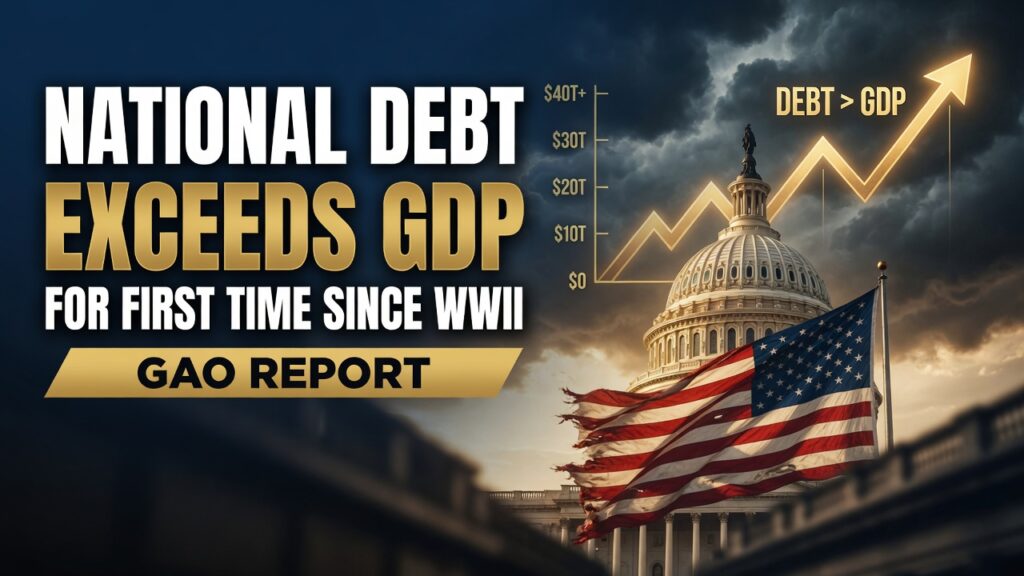
National Debt Exceeds GDP for First Time Since WWII: GAO Report
As Washington unfolds a fiscal milestone Americans were promised would never come, millions are asking a simple question: who let this happen, and who is going to pay for it?
The federal government’s debt now outweighs the entire U.S. economy. For the first time since the years following World War II, publicly held debt has surpassed the size of the country’s total economic output — a threshold the Government Accountability Office confirmed in June 2026. This is not a projection or a warning. It already happened.
The GAO reported that as of April 2026, publicly held debt reached $31.3 trillion, roughly equal to the size of the entire U.S. economy [federal data, GAO]. By early July, that figure had climbed to $31.68 trillion, according to the Senate Joint Economic Committee’s monthly debt update [federal data, JEC]. Total gross national debt, which includes intragovernmental obligations, stood at $39.39 trillion. The last time debt-to-GDP crossed this line was 1946, in the immediate aftermath of the most expensive war in American history. This time, there was no war to justify it.
Support Independent Local Journalism
TheTownHall.News is a non-profit reader-supported journalism. Just $5 helps us hire local reporters, investigate important issues, and hold public officials accountable across Alameda County. If you believe our community deserves strong, independent journalism, please consider donating $5 today to support our work.Why Did This Happen Now?
The answer is not complicated, even if Washington treats it that way. The GAO’s fiscal health report points to a persistent mismatch: the federal government has spent more than it collects in revenue nearly every year this century [federal data, GAO]. Tax policy, entitlement growth, and rising interest costs have combined to accelerate borrowing well beyond what the economy can absorb.
Perhaps the most alarming detail is what interest payments alone are now costing taxpayers. Net interest spending in fiscal year 2025 exceeded federal spending on national defense, and the GAO projects that trend will continue [federal data, GAO]. The Congressional Budget Office forecasts net interest costs will approach $1.04 trillion for fiscal year 2026 [CBO estimate]. That is money spent servicing past decisions, not funding a single school, road, or service for a single American family.
Washington spent more on interest payments than on national defense last year — and called it normal.
Who Is Really Paying for This?
Every dollar of debt is a claim on future taxpayers. Total gross national debt now amounts to roughly $292,217 per household, according to the Joint Economic Committee’s July tracking [federal data, JEC]. Over the past year alone, debt grew by more than $20,800 per household. That is not an abstraction. It is a bill with your name already on it.

Before we are engulfed in a financial crisis, shouldn’t Washington be forced to answer for how we got here?
The burden does not stop with today’s number. The GAO projects publicly held debt will grow more than twice as fast as the economy over the next decade, reaching 123 percent of GDP by 2036 [federal data, GAO]. The Congressional Budget Office puts the long-term trajectory even higher: 175 percent of GDP by 2056 [CBO estimate]. Under current policy, net interest alone is projected to consume nearly 10 percent of GDP by that year — a figure the GAO calls unsustainable.
$31.68 trillion. The question no one in Washington wants to answer: where did the accountability go?
What Do the Numbers Actually Tell Us?
Some economists argue the milestone is more symbolic than dangerous, noting that markets barely reacted when the news broke. That reaction misses the point entirely. A market that has already priced in decades of reckless borrowing is not evidence of safety — it is evidence of resignation. Wall Street expected this. That should alarm taxpayers more, not less.
The deeper concern is structural. The Congressional Budget Office has warned that by 2031, the average interest rate on federal debt is expected to exceed the economy’s growth rate for the first time in decades [CBO estimate]. When that happens, debt no longer shrinks relative to the economy on its own — it compounds. Left unaddressed, this dynamic can produce what economists call a debt spiral, where borrowing to pay past interest becomes the primary driver of future borrowing.
If a household spent this way for two decades straight, would any bank still extend it credit?
Support Independent Local Journalism
TheTownHall.News is a non-profit reader-supported journalism. Just $5 helps us hire local reporters, investigate important issues, and hold public officials accountable across Alameda County. If you believe our community deserves strong, independent journalism, please consider donating $5 today to support our work.Is Congress Even Paying Attention?
There are signs some lawmakers recognize the danger. The House Budget Committee has publicly warned that failing to close the gap between spending and revenue risks either prolonged economic stagnation or a sudden sovereign debt crisis that could threaten the dollar’s role as the world’s reserve currency. Some economists, including former U.S. Comptroller General David Walker, have gone further, proposing a constitutional amendment that would cap publicly held debt at 90 percent of GDP by 2040, with automatic enforcement mechanisms and re-election consequences for lawmakers who fail to comply.
Whether that specific proposal advances is uncertain. What is clear is that Congress has repeatedly treated “must-pass” legislation, like the Highway Trust Fund reauthorization due by September 30, 2026, as an opportunity to add spending rather than curb it. Fiscal accountability requires more than a warning report once a year. It requires lawmakers willing to say no.
Key Questions This Report Raises
- Who in Washington is accountable for two decades of deficit spending, and will voters demand answers before the next election?
- Can Congress reform entitlement spending and interest costs without triggering the debt spiral the CBO has warned about?
- What happens to ordinary Americans — their taxes, their savings, their retirement — if lawmakers continue to do nothing?
What Do Supporters of Continued Spending Actually Believe?
Not everyone views this milestone as a crisis. Some economists argue that because the United States borrows in its own currency and Treasury demand remains strong, with recent bid-to-cover ratios above 2.0 for notes and bonds, the government retains room to maneuver [federal data, JEC]. They point out that markets have absorbed the news calmly and that debt-financed investment, if directed toward productivity, can pay for itself over time.
That argument deserves a fair hearing, but it does not hold up under the government’s own projections. The GAO itself, a nonpartisan watchdog, has explicitly called the current path unsustainable and warned that the longer Congress delays action, the more severe the eventual correction will be [federal data, GAO]. Confidence in Treasury demand today is not a guarantee of confidence tomorrow, especially as interest costs consume a growing share of every tax dollar collected.
Is This the Accountability Moment We’ve Been Waiting For?
The GAO does not issue warnings like this lightly. Its report is a nonpartisan verdict on decades of bipartisan decisions: spend now, bill later. The bill has arrived. The only question left is whether elected officials treat it as a wake-up call or another chart to file away until next year’s report.
Fiscal responsibility used to be a shared American value, not a partisan talking point. Limited government, balanced budgets, and honest accounting were once treated as basic obligations of public office. Restoring that standard will not happen through another commission or another report. It will happen when voters make clear that borrowing against their children’s future is no longer politically acceptable.
The real question isn’t whether this debt will affect you — it’s whether you’ll demand answers before the bill comes due.
Still have questions about what this means for your taxes and your community? Stay informed — subscribe for daily coverage. Think others need to see these numbers? Share this article. Want your voice to count? Contact your congressional representative and ask directly what they are doing to address the debt-to-GDP crisis before the next Highway Trust Fund vote this September.