California Cannabis Crackdown: $1.3 Billion Seized, Only 100 Arrests, Is the Crackdown Working or Just for Show?
As the state touts another quarter of record cannabis seizures, a harder question is emerging from the numbers: after four years and $1.3 billion in confiscated product, why have so few people actually been held accountable?
Twenty thousand plants. Twenty-four people detained. Zero names released.
That was the scene in Hayward on April 16, when officers from the California Department of Fish and Wildlife’s Cannabis Enforcement Program raided three industrial warehouses near the Hayward Executive Airport, seizing 20,133 marijuana plants in one of the largest East Bay enforcement actions of the year [state enforcement data]. The story matters again this week because on July 8, Governor Newsom’s office released the Unified Cannabis Enforcement Taskforce’s latest quarterly report — more than 63,000 pounds of illegal cannabis seized in just three months [governor’s office data]. The press releases keep coming. The plants keep burning. But taxpayers deserve to ask a more basic question: is any of this actually working?
What Happened in Hayward — and Why Does It Still Matter?
The April operation was no small affair. Officers hit three separate warehouse sites in a single day: 3,947 plants seized on Foley Street, 13,218 on Cabot Boulevard, and 2,968 on American Avenue, where eighteen people were detained [state enforcement data]. At every one of the three locations, investigators found illegal foreign-labeled pesticides — some of them fumigants — chemicals that never pass through any consumer-safety testing before that product reaches a dispensary shelf or a street corner [CDFW statement].
It was also the second major bust in Hayward in less than six months. In November 2025, a CDFW-led operation at industrial warehouses in the same city eradicated 6,157 plants [governor’s office data]. Alameda County has quietly become one of the epicenters of California’s illegal grow economy: in 2025, authorities destroyed 81,377 pounds of illicit cannabis in the county — trailing only Los Angeles in total plant count [state enforcement data].
Three months later, officials have not confirmed whether the three Hayward sites were connected. No identities have been released. No charges have been publicly announced. The investigation, we are told, remains ongoing.
Support Independent Local Journalism
TheTownHall.News is a non-profit reader-supported journalism. Just $5 helps us hire local reporters, investigate important issues, and hold public officials accountable across Alameda County. If you believe our community deserves strong, independent journalism, please consider donating $5 today to support our work.What Do the Numbers Actually Tell Us?
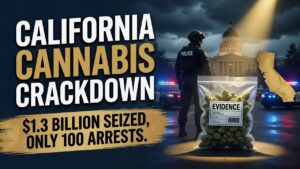
Zoom out, and the statewide picture is staggering. Since Governor Newsom launched the Unified Cannabis Enforcement Taskforce in 2022, coordinated operations have seized and destroyed more than 841,000 pounds of illicit cannabis — roughly 1.3 million plants — valued at over $1.3 billion, through more than 750 search warrants across 29 counties [governor’s office data].
Now look at the other side of the ledger. Those same task force efforts have produced approximately 100 arrests [governor’s office data].
Four years. 750 search warrants. $1.3 billion in seized product. One hundred arrests. Do the math — and then ask who is actually being deterred.
$1.3 billion. The question no one in Sacramento wants to answer: if that much illegal product was worth growing, who keeps financing it — and why aren’t they in court?
Seizures are not convictions. Detentions are not prosecutions. A warehouse full of plants can be replaced in a single growing cycle; an organized criminal enterprise is only dismantled when the people running it face real legal consequences. By the state’s own published figures, the ratio of enforcement activity to individual accountability is remarkably thin.
Who Is Really Paying for This Policy?
Californians were sold legalization in 2016 partly on the promise that a regulated market would starve the black market. Instead, licensed operators — the people who followed the rules, paid the licensing fees, and collected the taxes — now compete against untaxed, untested, unregulated product grown in warehouses a few miles from their storefronts.
The state’s own July report underscores the scale of the problem: in a single spring operation across Tulare, Kern, and Los Angeles counties, officers served 26 search warrants and found banned, unregistered, or foreign-labeled pesticides at or suspected at 13 of the cultivation sites [governor’s office data]. CDFW’s own director acknowledged these restricted chemicals are “frequently” found at grows tied to organized criminal enterprises [CDFW statement].
That’s not a few hobbyists with grow lights. That is industrial-scale organized crime operating inside a state that claims to have one of the most sophisticated regulatory regimes in the country. Legal operators pay the compliance costs. Consumers absorb the health risks. Taxpayers fund the raids. The organizers, so far, appear to bear remarkably little of the burden.
If the state can find 20,000 illegal plants in one city in one day, why can’t it name a single person responsible three months later?
Are Communities Being Protected — or Just Reassured?
To be fair, the environmental and safety case for enforcement is genuine. State officials note that unpermitted indoor grows often involve unregistered pesticides, electrical theft, and overloaded wiring that raises structure-fire risk in the surrounding neighborhood [governor’s office data]. Outdoor grows divert water and contaminate soil and waterways. Nobody should want a fumigant-laced warehouse operation next to a small business park in Hayward.
But protection requires follow-through. Red-tagging a building and shredding plants addresses the symptom. Prosecution addresses the disease. When two dozen people are detained and quietly released into an “ongoing investigation” with no public accounting, residents are left with press-release justice — impressive photographs, big numbers, and no visible consequences. If 24 people were detained at an illegal operation in your neighborhood and none were ever publicly charged, would you call that law and order?
What Do Supporters of This Policy Actually Believe?
Defenders of the current approach make a serious argument, and it deserves a fair hearing. They contend that enforcement is inherently incremental: seizures raise the cost of doing business for illicit operators, disrupt supply chains, and protect consumers from contaminated product even when prosecutions lag. They note that detentions during raids often involve low-level workers — sometimes trafficked or exploited labor — and that prosecutors rightly focus on building cases against financiers rather than charging trimmers. They also point out that the task force has seized more than $2.8 million in cash and over 250 firearms since 2022 [governor’s office data], evidence that operations are hitting criminal infrastructure, not just plants.
Those points have merit. But they cut both ways. If the true targets are the financiers, then four years and 750 warrants should have produced a visible pipeline of major prosecutions — and the state has published no such record. If workers are exploited labor, that is itself a human-trafficking scandal demanding charges against the exploiters. And if seizures alone deterred anyone, Hayward would not have needed two massive raids in the same city within six months. Disruption without accountability is a subscription service, not a solution.

Is This the Accountability Moment We’ve Been Waiting For?
There is a version of this story where California gets it right: transparent charging decisions, published prosecution outcomes, environmental restitution collected from convicted operators, and a legal market that finally competes on fair terms. The raw enforcement capacity clearly exists — the Hayward operation proved that in a single Thursday.
What’s missing is the second half of the rule of law: the part where the public learns who did it, who financed it, and what happened to them. Until the state publishes prosecution and conviction data with the same enthusiasm it publishes seizure totals, voters have every reason to treat these announcements with healthy skepticism.
A crackdown that never names names isn’t a crackdown. It’s a press strategy.
Key Questions
- Why has the state announced no charges or identities from the April Hayward raids, three months into an “ongoing investigation”?
- After 750 search warrants and $1.3 billion in seizures, why have UCETF operations produced only about 100 arrests?
- Who is financing warehouse-scale illegal grows in Alameda County — and what is the plan to prosecute them, not just their plants?
The real question isn’t whether California can seize illegal cannabis — it clearly can. It’s whether anyone responsible will ever stand in a courtroom. What do you think — is the crackdown working, or is it theater? Share this article and let us know.
Still have questions? Stay informed — subscribe to The Town Hall News for daily accountability coverage. Think others need to hear this? Share the article. Want to make your voice count? Contact the Alameda County District Attorney’s Office and ask what charging decisions have been made in the April 16 Hayward enforcement action — then attend your next city council public-comment session and ask the same question.