Hayward Cuts Back City Council Meetings, Raising Transparency Concerns
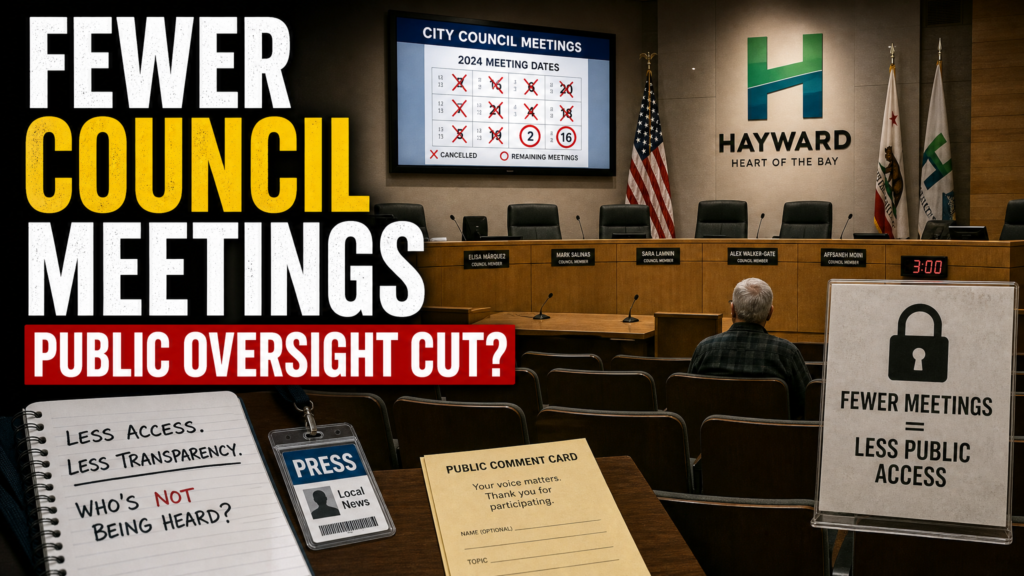
Hayward’s shift to fewer regular City Council meetings may look like a scheduling tweak. In practice, it means fewer built-in nights for public scrutiny, fewer routine opportunities for residents to speak, and a fresh test of whether City Hall values convenience over transparency. Source
When local government wants less public suspicion, it usually expands access, clarifies process, and makes itself easier to watch. Hayward is moving in the other direction. As of April 2026, the city’s regular council schedule was cut back to the first and third Tuesdays of each month, replacing the older pattern that publicly listed meetings on the first, third, and fourth Tuesdays. That is not a trivial change. It means one fewer preset regular meeting slot in a typical month. Source Source
For residents who care about budgets, land use, policing, housing, taxes, and contracts, fewer regular meetings can mean fewer predictable moments to challenge officials in public. For reporters and watchdogs, it means less routine face time with the elected body running the city. And for City Hall, it raises an uncomfortable question: if transparency is really a priority, why make oversight less frequent? Source
Support Independent Local Journalism
TheTownHall.News is a non-profit reader-supported journalism. Just $5 helps us hire local reporters, investigate important issues, and hold public officials accountable across Alameda County. If you believe our community deserves strong, independent journalism, please consider donating $5 today to support our work.Why This Issue Matters Now
This story is not about nostalgia for endless meetings. It is about how democratic oversight works in real life. A city council agenda is one of the few places where residents can regularly see power exercised in public: votes taken, contracts approved, ordinances introduced, and priorities exposed.
Hayward’s own March 2026 Councilmember Handbook says the meeting schedule change was approved on March 26, 2026, via Resolution 26-026. Under that updated schedule, regular council meetings are held on the first and third Tuesdays of each month at 7:00 p.m., except during council recess. The handbook also says meetings may be canceled or additional meetings may be scheduled on the second, fourth, or fifth Tuesdays if the mayor or city manager determines they are needed because of workload or necessity. Source
That flexibility matters. But flexibility is not the same thing as transparency. A predictable regular meeting schedule gives the public something fixed to rely on. A more discretionary system gives City Hall more control over when extra meetings happen and under what circumstances.
What Changed in 2026
The clearest official comparison comes from Hayward’s own public-facing materials. The city’s webcast page still says the Hayward City Council meets at 7:00 p.m. on the first, third, and fourth Tuesday of each month. That was the older public schedule. The March 2026 Councilmember Handbook, however, says the regular schedule was changed to the first and third Tuesdays, effective April 2026. Source Source

That means the city effectively reduced its standing number of regular monthly meetings from three to two. Yes, extra meetings can still be called. And yes, the City Council page shows that additional meetings did occur in spring 2026, including dates outside the first and third Tuesday pattern. But that actually proves the point: the city reduced the regular structure while preserving a discretionary ability to add meetings later when leaders decide they are necessary. Source Source
A routine meeting schedule belongs to the public. Extra meetings belong more to the institution.
Why Watchdogs Should Care
Watchdog journalism and public oversight do not depend only on whether meetings exist. They depend on whether meetings are frequent, regular, and easy to anticipate. When officials meet less often on a standing basis, scrutiny becomes less automatic.
That matters especially in a city like Hayward, where recent public issues have included labor concessions, tax hikes, utility megaprojects, rent rules, surplus land, homelessness funding, and sidewalk liability changes. These are not low-stakes housekeeping matters. They are exactly the kind of decisions that deserve repeated public examination, not fewer built-in opportunities for it.
There is also a practical reality. Many residents do not track Legistar calendars daily. They remember broad routines. “Council meets every first, third, and fourth Tuesday” is easier for the public to internalize than “Council usually meets first and third Tuesdays, but maybe second, fourth, or fifth too if leadership decides the workload requires it.” Public access gets weaker when the public must work harder just to follow the schedule.
Support Independent Local Journalism
TheTownHall.News is a non-profit reader-supported journalism. Just $5 helps us hire local reporters, investigate important issues, and hold public officials accountable across Alameda County. If you believe our community deserves strong, independent journalism, please consider donating $5 today to support our work.Predictable access is real access.
Fewer regular meetings mean fewer regular chances to push back.
The Transparency Problem Is Bigger Than the Schedule
One of the most revealing details is that Hayward’s own public information appears out of sync. The webcast page continues to describe the older three-Tuesday schedule, while the March 2026 handbook describes the newer two-Tuesday schedule approved through Resolution 26-026. That mismatch may seem small, but it points to a larger problem: if the city is going to change how residents access their government, the public record should be clear, consistent, and easy to understand. Source Source
This is where critics of the change have a strong case. Fewer regular meetings are already a transparency concern. Pair that with inconsistent public-facing information, and distrust becomes rational rather than emotional. A city that wants residents to trust it should not require them to cross-check multiple pages to figure out when their government normally meets.
What Supporters of the Change Would Say
There is a fair defense of the new schedule. Government time is not free. More meetings mean more staff preparation, more agenda management, more legal review, more administrative cost, and more strain on elected officials and city employees. A city facing fiscal pressure may reasonably ask whether it needs three regular monthly meetings if two regular meetings, plus extra meetings when necessary, can handle the workload more efficiently.
Hayward’s handbook plainly leaves room for that argument. It says additional meetings may be scheduled on the second, fourth, or fifth Tuesdays depending on workload or necessity as determined by the mayor or city manager. In other words, the city did not abolish the ability to meet more often. It reduced the default and retained flexibility. Source
Supporters could also point out that Hayward still provides multiple ways to follow proceedings. The city’s Legistar system offers agendas and documents, and the eComment system allows people to leave comments on specific agenda items when they cannot attend in person. Source Source
That is the strongest case for the city. It is not ridiculous. But it is not complete.
What Critics Get Wrong
Some opponents will overstate the schedule change and imply the public has been shut out entirely. That is not true. Hayward still holds council meetings, still streams them, still posts agendas, and still allows remote agenda comments through eComment. Additional meetings can still be scheduled outside the reduced regular cycle. Source Source
So the issue is not total secrecy. The issue is diminished routine access. A city does not need to cancel democracy to weaken accountability. It only needs to make scrutiny a little less frequent, a little less automatic, and a little more dependent on administrative discretion.
That is what makes this story worth attention. The change is subtle enough to sound harmless and significant enough to matter.
Counterargument: Isn’t Less Government a Good Thing?
In principle, limited government is a good thing. Fewer bloated processes, fewer performative meetings, and less bureaucratic waste should appeal to anyone who values efficiency and fiscal discipline. But fewer meetings are not automatically the same as smaller government.
A government can meet less often in public while continuing to exercise the same power over taxes, permits, contracts, zoning, and enforcement. If anything, concentrated agendas can make it harder for residents to follow complicated decisions. The real goal should not be fewer meetings for their own sake. It should be lean government that remains easy to monitor.
That is the line Hayward now has to prove it can walk. If the city wants credit for efficiency, it must pair the reduced schedule with better notice, cleaner public information, fuller agenda posting, and a visible willingness to call extra meetings when public business demands it.
Otherwise “efficiency” starts to look like insulation.
Key Takeaways
- Hayward’s March 2026 Councilmember Handbook says regular City Council meetings now occur on the first and third Tuesdays of each month, with the change approved on March 26, 2026 via Resolution 26-026. Source
- Hayward’s public webcast page still describes the older schedule of first, third, and fourth Tuesdays, creating a public-information discrepancy. Source
- The new structure reduces the number of regular preset monthly meetings while allowing additional meetings on the second, fourth, or fifth Tuesdays if leadership determines they are necessary. Source
- Hayward still provides public access tools including agendas, webcasts, and eComment for agenda items. Source
- The core debate is not whether meetings still exist. It is whether fewer regular meetings weaken routine public oversight.
Conclusion
Hayward’s meeting-schedule change is exactly the kind of quiet procedural move that deserves louder public attention. It does not eliminate public meetings. It does not abolish comment opportunities. But it does reduce the city’s built-in rhythm of public accountability and replace part of that rhythm with institutional discretion.
For a city managing major fiscal, housing, infrastructure, and governance questions, that should concern anyone who believes public business deserves public visibility. Open government is not measured only by whether doors are unlocked. It is measured by how often the public gets a real chance to walk through them.
If Hayward wants to reassure residents that this change is about efficiency rather than opacity, it should start by fixing its public-facing schedule information and making sure no one has to guess when government will next be in session.
Call to Action
If you care about transparency in Hayward, watch the council calendar closely, use the city’s agenda and eComment tools, share this story, support independent local reporting, and keep showing up. Governments rarely become more accountable because residents get quieter.
Source Links
- Hayward Councilmember Handbook, March 2026: https://www.hayward-ca.gov/sites/default/files/2026-04/CCO-Councilmember-Handbook-Updated-March-2026.pdf
- Hayward webcast/schedule page: https://www.hayward-ca.gov/services/city-services/watch-live-and-recorded-webcasts-city-council-and-planning-commission
- Hayward Legistar / eComment info: https://hayward.legistar.com/
- Hayward City Council body/calendar page: https://hayward.legistar.com/MainBody.aspx