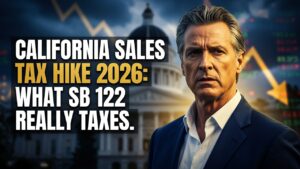
California Sales Tax Hike 2026: What SB 122 Really Taxes
As Sacramento quietly expands what gets taxed, millions of Californians are asking a simple question: how much higher can this go before someone has to answer for it?
California just got more expensive. Again. On June 29, 2026, Governor Gavin Newsom signed a budget package that taxes software subscriptions for the first time in state history — and it lands at the same moment a separate ballot fight over local tax votes is heading to voters this November.
Neither of these stories is hypothetical. Both are already law, or already on the ballot. And both raise the same question Californians keep asking every budget cycle: who is actually deciding how much you pay, and who gets to stop it?
What Exactly Did Newsom Just Sign?
Buried inside the 2026-27 budget, Senate Bill 122 rewrites California’s sales tax law to reach digital products for the first time. Prewritten software delivered electronically and remotely accessed Software-as-a-Service, or SaaS, are now defined as taxable tangible personal property, effective January 1, 2027.
That change is projected to bring in roughly $900 million a year for the state’s general fund, according to the Legislative Analyst’s Office [LAO estimate], plus more for local governments. A governor who once complained he was overpaying at Best Buy just extended that same tax to millions of households and small businesses buying software online. Custom-built software, video games, and streaming subscriptions are excluded. Everyday productivity tools are not.
Support Independent Local Journalism
TheTownHall.News is a non-profit reader-supported journalism. Just $5 helps us hire local reporters, investigate important issues, and hold public officials accountable across Alameda County. If you believe our community deserves strong, independent journalism, please consider donating $5 today to support our work.Why Is Your Software Bill About to Get More Expensive?
The Legislative Analyst’s Office itself warned that most of the new tax will land on business-to-business software purchases — but that does not mean consumers walk away untouched. Businesses that absorb a new tax rarely eat the cost quietly. They pass it forward, in higher prices, tighter margins, or fewer services.
Widely used platforms like Microsoft 365, Adobe Creative Cloud, Slack, and QuickBooks Online could all see costs shift onto the businesses and workers who rely on them daily. Alongside SB 122, Newsom also signed a rebuilt tax on health plans that still needs federal approval and could push insurance premiums higher for ordinary families. If your accounting software and your health premium both get more expensive in the same budget cycle, is that a coincidence — or a pattern?
Are Californians Actually Feeling This in Their Budgets?
Sacramento’s fiscal math is not abstract to the family deciding whether to renew a software subscription or skip it, or the small business owner recalculating margins after a new line item appears on an invoice. California’s own revenue outlook improved sharply this year [state budget projections], with the state projecting billions more in revenue than earlier estimates assumed. That improvement did not stop new tax measures from moving forward anyway.
Fiscal accountability means asking a basic question every household already asks itself: if the money is there, why does the bill still go up? Limited government does not mean zero government — it means spending decisions get scrutinized before they get passed down to taxpayers, not after.
Is 11.25% Already the Reality in Parts of California?
Here is what has not changed: California’s base sales tax rate remains 7.25%, the highest floor of any state in the country. But local district add-ons can push the total far higher. In cities like Lancaster and Palmdale, combined state and local sales tax already reaches 11.25% — a rate made possible because the Legislature has spent two decades granting individual cities and counties permission to exceed the state’s own 2 percent local tax cap.
More than 140 California jurisdictions already sit above that cap [state tax data]. State lawmakers keep approving exceptions to a limit voters were told would protect them.
11.25%. That’s the ceiling right now in parts of Los Angeles County — the question is which city gets waived into that club next.

Every time Sacramento grants one more city permission to break its own tax cap, what exactly is left of the cap?
What Do Supporters of Easier Local Tax Votes Actually Believe?
Supporters of the current system — including transit advocates and several local governments — make a real argument worth engaging honestly. They point out that requiring a two-thirds supermajority for every local tax measure can sink popular, narrowly-focused funding votes: transit upgrades, fire protection, open space preservation, and healthcare funding have all passed with less than two-thirds support in recent years and would have failed under a stricter threshold.
That is a legitimate policy tradeoff, not a bad-faith one. But it also proves the opposite point taxpayers keep raising: when the bar for raising your taxes gets lower, more of your taxes get raised. Fiscal accountability does not mean no government can ever fund anything — it means the people paying the bill get a real, structural say before the bill grows.
Is Prop 43 the Accountability Moment Voters Have Been Waiting For?
That structural fight now has a name on the November 2026 ballot: Proposition 43, the Save Prop 13 – Local Taxpayer Protection Initiative. It would restore a two-thirds vote requirement on local special tax measures and close loopholes that have let some local taxes bypass Proposition 13’s original property tax protections.
It is running alongside two companion measures — Proposition 41, which would require audits on special-tax revenue to prevent waste and diversion, and Proposition 42, which would bar state and local governments from taxing savings, retirement accounts, and home equity. Backers, led by Carl DeMaio’s advocacy group Reform California, argue that more than 250 separate local tax increases are already teed up on the same November ballot statewide.
Key Questions This Story Raises
- If software was never taxed before, why is now the moment lawmakers chose to change that?
- How many more California cities will be waived above the 2 percent local tax cap before voters get a real vote on the process itself?
- If Prop 43 passes, does it actually slow future tax hikes — or just shift where the fight happens next?
What Happens If Voters Don’t Act This November?
If Prop 43 fails, the current trajectory continues: individual cities and counties will keep seeking, and receiving, legislative permission to exceed the 2 percent cap, one waiver at a time, without a statewide check. Meanwhile, SB 122’s software tax and the rebuilt health-plan tax both take effect regardless of the ballot outcome — they were signed into law, not sent to voters.
That is the real split Californians are being asked to understand this year: some tax increases already happened without a public vote at all. Others are headed to the ballot precisely because opponents forced the question. Is it too late to reverse course, or is November the last real check voters have left?
The real question isn’t whether Sacramento will find new things to tax next — it’s whether Californians show up in November before that list grows again.
Still have questions about what’s actually in SB 122, the health-plan tax, or Prop 43? Stay informed — subscribe for daily accountability coverage from The Town Hall News. Think your neighbors need to see this? Share the article. Want your vote to count? Confirm your registration and look up exactly what’s on your local November ballot before Election Day.