Is Waymo San Francisco’s Next Public Safety Crisis Now?
As stranded robotaxis, blocked fire trucks, and a runaway freeway chase pile up, San Franciscans are asking a simple question: who is actually accountable when the software fails?
Dozens of empty cars sat dead in the street. That’s not a hypothetical — it happened on the Fourth of July.
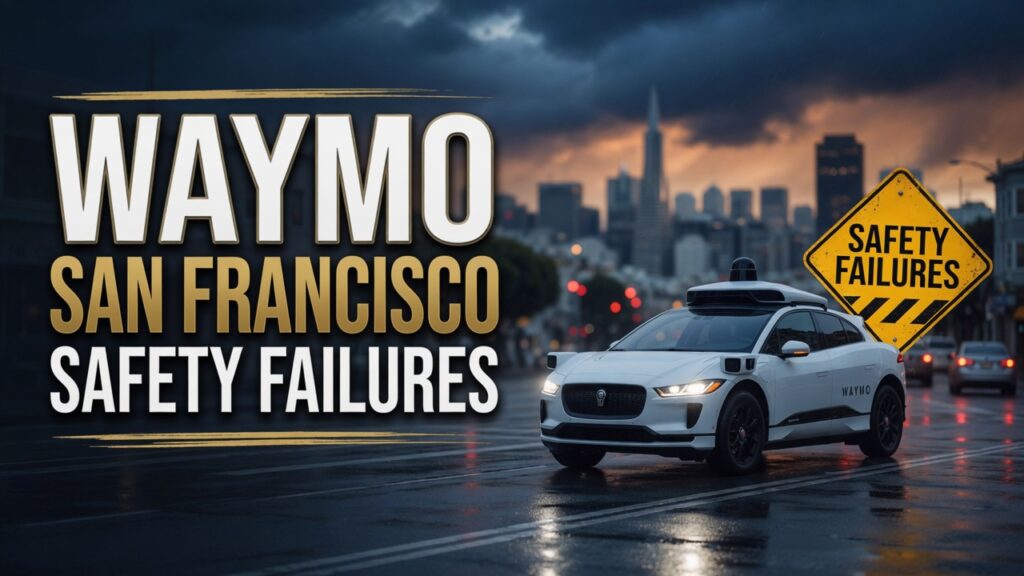
As tens of thousands of spectators tried to leave the Golden Gate Bridge fireworks show on July 4, 2026, more than 30 Waymo robotaxis became stranded in the only parking area serving the event, some running out of battery and requiring tow trucks to clear them. The timing matters. San Francisco has staked its reputation on autonomous vehicles as the future of urban transit, and city leaders are now demanding answers before the next crisis — one that might not end with just a long walk home.
Support Independent Local Journalism
TheTownHall.News is a non-profit reader-supported journalism. Just $5 helps us hire local reporters, investigate important issues, and hold public officials accountable across Alameda County. If you believe our community deserves strong, independent journalism, please consider donating $5 today to support our work.What Actually Happened on the Fourth of July?
The breakdown was immediate and citywide. Waymo itself acknowledged that “extreme traffic congestion in northern San Francisco disrupted normal operations for several Waymo vehicles,” and that its roadside assistance team scrambled to clear cars in coordination with emergency services. More than 100,000 people had converged on the northwest corner of the city, overwhelming an area with limited transit options.
One resident, Stella Lochman, told KQED her three-mile trip home from Aquatic Park to the Mission District took three hours — longer, she noted, than a friend’s drive to Pinole, thirty miles away. Video verified by NBC News showed a dozen or more stranded Jaguar I-PACE Waymo vehicles lined up on city streets, one loaded onto a flatbed truck. Bystanders were recorded yelling at the driverless cars, unable to find a human to hold responsible.
Who Is Really Paying for This Policy?
Taxpayers and emergency responders, largely. San Francisco Fire Department crews have filed at least 31 internal reports since April 2025 documenting Waymo and other robotaxis obstructing emergency operations — a paper trail now drawing scrutiny from state and federal regulators.
One report, obtained by the San Francisco Standard, described a fire department rescue vehicle responding to a stabbing on 15th Street that was blocked for 15 minutes by a malfunctioning Waymo stuck perpendicular in the road. Firefighters said verbal remote instructions failed to move it, forcing a human to physically climb into the driver’s seat. By the time they freed themselves, another crew had already reached the stabbing victim.

If a driverless car can delay a response to a stabbing, what happens during a real citywide emergency?
Is This Just an Isolated Incident?
No. This is a pattern, not a one-off malfunction. In December 2025, a major PG&E-triggered blackout knocked out traffic signals across roughly a third of the city, and Waymo vehicles — confused by the absence of working lights — simply froze in intersections, snarling traffic and, according to city officials, obstructing emergency vehicles. Waymo suspended service that night after videos of stalled cars circulated widely online.
District 5 Supervisor Bilal Mahmood is now demanding a formal accounting. Following the July 4 gridlock, he submitted a letter of inquiry to San Francisco’s Department of Emergency Management, Fire Department, and Municipal Transportation Agency, seeking details on how autonomous vehicles affected transit service, emergency response, and public safety during the event. “It’s not acceptable that disruption of service, first responders and our public transit system is a side effect of autonomous vehicles on the road,” Mahmood said.
What Do the Numbers Actually Tell Us?
577. That’s how many Waymo robotaxis operate across the company’s network, providing roughly 500,000 paid rides a week nationwide [company-reported figures]. San Francisco alone has hosted between 800 and 1,000 Waymo vehicles at various points — more than any other city in the country, making residents unwitting beta-testers for a technology still being debugged in real time. The question city leaders haven’t answered: how many failures is an acceptable number before regulators intervene?
Are Riders Themselves at Risk?
Sometimes, yes — and not just from delays. In late May 2026, a Waymo carrying two passengers veered off a San Francisco freeway near the Mission District and accelerated through an active construction zone while police pursued it with lights and sirens. One passenger, Elliot Slade, described the moment he believed he and his fiancée would die in the vehicle. Waymo pulled its cars off freeways in San Francisco, Los Angeles, Phoenix, and Miami afterward, saying it needed to “integrate recent technical learnings into our software.”
Support Independent Local Journalism
TheTownHall.News is a non-profit reader-supported journalism. Just $5 helps us hire local reporters, investigate important issues, and hold public officials accountable across Alameda County. If you believe our community deserves strong, independent journalism, please consider donating $5 today to support our work.No one should have to wonder if their ride home will end in a police chase.
“It’s not acceptable that disruption of service, first responders and our public transit system is a side effect of autonomous vehicles on the road.”
What Happens If Regulators Don’t Step In?
Right now, oversight is fragmented. Waymo operates under California Public Utilities Commission and DMV permits, but incident reporting largely depends on the company’s own disclosures and after-the-fact media coverage rather than proactive, independent auditing. Mayor Daniel Lurie has been a public advocate for the technology, calling autonomous vehicles “safe and sustainable” — even as his own office has fielded complaints about robotaxis obstructing emergency access during two separate citywide crises within a year.
That tension — a city government promoting the technology while its own fire department documents dozens of interference incidents — is precisely what accountability journalism exists to surface. San Franciscans did not vote on whether hundreds of unsupervised vehicles would occupy their streets. They are living with the consequences of a decision made largely by regulators and corporate partners.
What Do Supporters of This Policy Actually Believe?
Waymo’s advocates make a reasonable case: human drivers cause the overwhelming majority of U.S. traffic fatalities, and autonomous vehicles could eventually reduce deaths at scale if the technology matures. They point out that no fatalities have been publicly reported in these San Francisco incidents, and that Waymo has acted swiftly — suspending freeway service, pausing operations during the blackout, and coordinating with the city’s Emergency Operations Center during the July 4 disruption.
That argument has merit, and it deserves a fair hearing. But it does not answer the more immediate question raised by 31 documented fire department reports and two citywide meltdowns in seven months: is the technology being deployed responsibly today, at its current level of reliability, or is San Francisco absorbing the risk of a still-unfinished product? Safety in theory is not the same as safety in practice, and taxpayers are entitled to know the difference before the next blackout, the next holiday crowd, or the next freeway chase.
Key Questions This Story Raises
- Should California regulators require real-time, independent incident reporting from autonomous vehicle companies instead of relying on self-disclosure?
- How many documented emergency-response obstructions should trigger a suspension of a company’s operating permit?
- Who bears legal and financial liability when a driverless vehicle delays a 911 response?
Has San Francisco Learned Anything From This?
Not yet, by the city’s own admission. SFMTA officials have acknowledged transit shortcomings around the July 4 event, and Mahmood’s inquiry remains open, with city departments given two weeks to respond. Waymo, for its part, says it is “evaluating ways to strengthen” its resilience during major disruptions — language that promises improvement without committing to a timeline or a standard.
Limited government does not mean no government. It means government doing its core job well: protecting public safety and demanding accountability from powerful private actors operating on public streets. Right now, that job is unfinished.
The real question isn’t whether Waymo’s technology will eventually improve — it’s whether San Francisco will demand proof before, or only after, something worse happens.
What do you think — should San Francisco pause robotaxi operations until independent safety audits are complete? Share this article and let us know.
Still have questions about who’s regulating the vehicles on your street? Stay informed — subscribe for daily accountability coverage. Think your neighbors need to see this? Share it. Want your voice to count? Contact your District Supervisor’s office or attend the upcoming Board of Supervisors hearing on Waymo’s July 4th failures to make your concerns part of the public record.