Is UC Berkeley’s Shelter-in-Place Response Failing Parents?
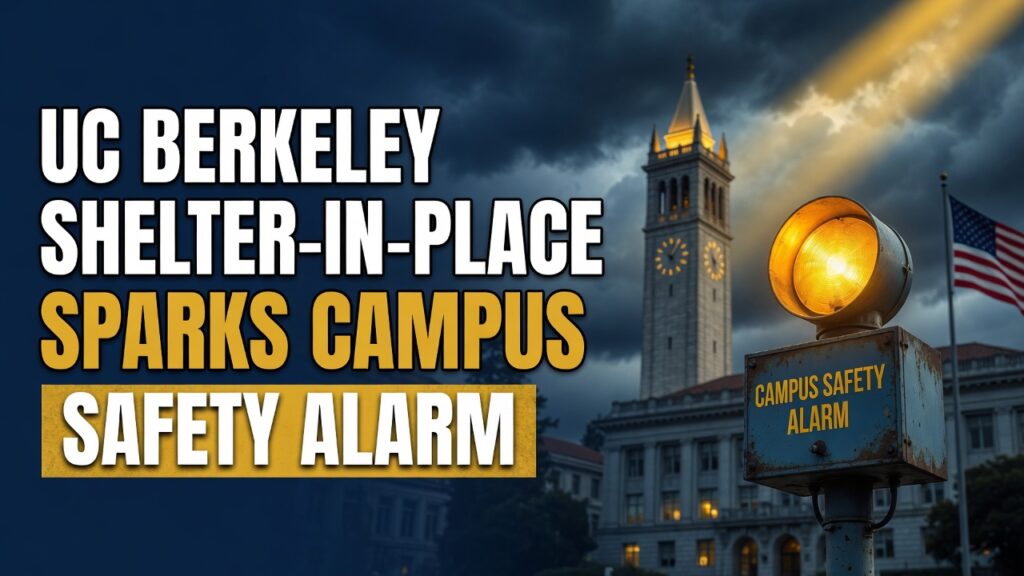
As UC Berkeley recovers from Tuesday’s armed-suspect scare at Haas School of Business, parents and taxpayers are asking the same question: who’s actually protecting the kids on this campus — and who answers for it when the system falls short?
A weapon on his hip. That single detail shut down a business school.
On Tuesday afternoon, UC Berkeley police locked down the Haas School of Business after multiple people reported a man carrying a weapon near the building. For nearly an hour, students, staff, and a room full of children in a summer program had no idea whether they were sheltering from a real threat or a false alarm. That uncertainty, more than the outcome, is the story parents and taxpayers should be asking about.
What Happened at Haas School of Business?
UC Berkeley police sent an initial alert shortly after 3 p.m. Tuesday warning the campus community to avoid the area around Haas, located at 2220 Piedmont Avenue on the east side of campus near Memorial Stadium. A follow-up “critical alert” arrived at 3:25 p.m., instructing anyone inside Cheit Hall and Chou Hall to secure in place immediately while officers searched the complex.
Officers swept Haas, Cheit Hall, Chou Hall, and surrounding buildings for close to an hour. Around 4:10 p.m., UCPD issued an all clear, reporting that no one matching the description had been found and that the buildings were safe to reoccupy. UCPD asked anyone with additional information to contact its dispatch line, a routine step that nonetheless underscores how much about this incident remains unresolved. If a search that thorough turns up nothing, does that mean the system worked — or that no one really knows what happened?
Support Independent Local Journalism
TheTownHall.News is a non-profit reader-supported journalism. Just $5 helps us hire local reporters, investigate important issues, and hold public officials accountable across Alameda County. If you believe our community deserves strong, independent journalism, please consider donating $5 today to support our work.Why Were Children Hiding Under Chairs During a Security Sweep?
Haas hosts more than classrooms. A summer program operating inside the building was caught in the middle of the search, and participants described children staying quiet and hiding under chairs while officers cleared the area. For parents who dropped their kids off that morning expecting a normal day of camp, the shelter-in-place order was not an abstraction. It was their children, on the floor, waiting to find out if the danger was real.
That is the uncomfortable core of this story. A university campus is not just a workplace for adults who chose to be there. It is also, in the summer months, a childcare site — and the institutions running those programs owe families a higher standard of both prevention and communication than a single WarnMe alert can deliver. <blockquote>If your child were the one hiding under a chair, would “we found nothing” be enough of an answer?</blockquote>
Key Questions This Incident Raises
- Why was a youth summer program operating inside a building with no dedicated lockdown protocol communicated to parents in real time?
- What obligation does UC Berkeley have to notify parents directly, rather than relying on students’ own university email accounts?
- How many similar scares have gone unreported because they were resolved before triggering a campus-wide alert?
What Do the Numbers Actually Tell Us?
66 minutes. That is roughly how long passed between the first alert near Haas and the all clear from UCPD [calculated from UCPD/Berkeley Scanner timeline]. The question no one has answered publicly: how many of those minutes were spent actually clearing rooms, and how many were spent waiting for information that never came?
UC Berkeley’s WarnMe system is built around three tiers — emergency notifications, timely warnings, and community advisories — governed by the federal Clery Act. Clery compliance is a legal minimum, not a guarantee of speed or clarity in the moment a parent’s phone lights up with a “critical alert.”
Why Did Police Have So Little to Go On?
UCPD Lt. Nicholas Hernandez told reporters the incident began with a report of a man near Haas carrying “a weapon on his hip.” No further details were shared with police about the type of weapon, or whether it was a firearm at all. “We would have liked to have more,” Hernandez said.
California law strictly limits the open carry of firearms in public [state law, general knowledge], which is precisely why a tip like this cannot simply be waved off. Multiple witnesses reported what they believed they saw, and officers were obligated to treat it as credible until proven otherwise. That is the system working as intended.
That distinction cuts both ways once the search actually begins. Officers searched four buildings for nearly an hour based on a single, vague description — and still can’t say what, if anything, was actually out there. Berkeley Fire staged nearby as a precaution, though UCPD did not request backup from Berkeley Police, and officers ultimately cleared the scene on their own. Whether that reflects appropriate restraint or a thin margin for error is a fair question to ask before the next call comes in.

Is UC Berkeley’s Alert System Actually Protecting Students?
California taxpayers and UC tuition payers fund a police department, an Office of Emergency Management, and a text-and-email alert network built specifically for moments like this one. On paper, the system performed as designed: an alert went out within minutes, buildings were secured, and an all clear followed once the search concluded.
But performance on paper is not the same as public confidence. Parents of children in the summer program were not campus email subscribers. They found out secondhand, if at all, while their kids sat quietly on a classroom floor. Shouldn’t a university that spends millions on emergency preparedness have a faster way to reach the parents of children on its own campus? That is not a radical question. It is the baseline expectation of any institution that accepts responsibility for other people’s kids.
What Do Defenders of Campus Security Protocols Actually Believe?
Supporters of UC Berkeley’s current approach make a reasonable case. They point out that officers responded within minutes, methodically cleared every building tied to the report, and issued a clear all clear once the search was complete — without a shot fired or an injury reported. In their view, a fast, thorough, uneventful response is exactly what good policing looks like, and second-guessing it after the fact risks punishing caution.
That argument has merit as far as it goes. Nobody was hurt, and officers followed established protocol. But protocol succeeding this time does not settle whether the underlying system — parent notification, summer-program lockdown planning, and public follow-up on what was or was not found — is actually built for the campus UC Berkeley has become. A response can be procedurally sound and still leave real gaps exposed.
Has UC Berkeley Reached Its Turning Point on Campus Safety?
Tuesday’s shelter-in-place did not end in tragedy, and that is worth acknowledging plainly. But it exposed real seams: a summer camp with no independent lockdown plan, parents left out of the loop, and a weapon report so thin that even the responding lieutenant admitted police wanted more information. None of that required a worst-case outcome to matter.
The final question is the one that lingers after the all clear: if this had gone differently, would anyone outside the police department be held accountable for how it was handled? The real question isn’t whether this will happen again — it’s whether anyone will fix the gaps before it does.
What do you think — should UC Berkeley overhaul how it alerts parents of children on campus? Still have questions? Stay informed — subscribe for daily coverage. Think other parents need to see this? Share the article. Want your voice to count? Contact the UC Berkeley Police Advisory Board or sign up directly for real-time alerts at warnme.berkeley.edu.