Former Monroe County Officer, Carlos Santillan, Arrested for Allegedly Burning Puppies Alive
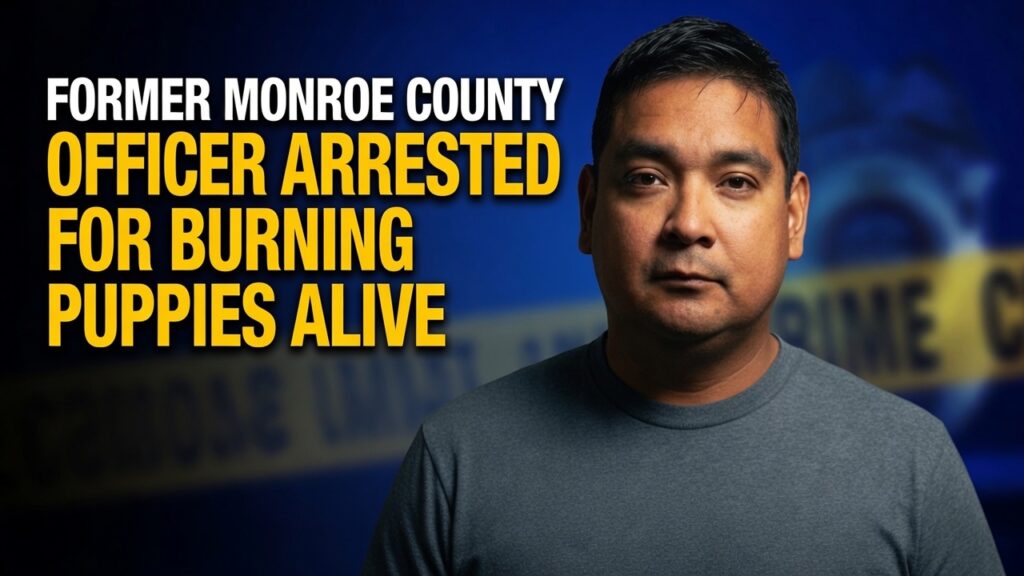
A Monroe County, Georgia, animal control officer allegedly placed four puppies into a shelter incinerator while they were still alive — and now residents are asking how a taxpayer-funded facility allowed it to happen, and who else knew.
Four puppies died inside a Georgia animal shelter’s incinerator.
The Monroe County Sheriff’s Office says former Animal Control Officer Carlos Santillan placed the puppies into the incinerator at the Monroe County Animal Shelter in Forsyth while they were “presumably alive.” The incident happened June 18, but the public did not learn about it until a citizen complaint reached investigators on July 6 — nearly three weeks later.
That gap matters. Santillan was fired and arrested the same day the complaint came in, and he now faces four felony counts of cruelty to animals. But the timeline raises a harder question for Monroe County taxpayers: if one complaint could crack this case open in a single day, why did it take three weeks for anyone in county government to notice on their own?
What Happened at the Monroe County Animal Shelter?
According to the sheriff’s office, investigators confirmed that Santillan placed four puppies into the shelter’s incinerator while they were presumably still alive. A sheriff’s office spokesperson, identified in local reporting as Watkins, told reporters, “I can confirm that it is true that the puppies were placed in the incinerator and they were presumably alive.” Santillan was taken into custody Monday, July 6, and booked into the Monroe County Jail. A magistrate judge set bond at $5,000, and Santillan posted it the same day. The Monroe County Board of Commissioners terminated his employment immediately following the arrest. Sheriff Brad Freeman confirmed the investigation began the moment the complaint arrived. “We received a citizen complaint that they had information that he had killed some puppies, and we immediately started an investigation,” Freeman said. That single sentence is worth sitting with. A functioning oversight system should not depend on a lone tip arriving weeks after the fact.
Support Independent Local Journalism
TheTownHall.News is a non-profit reader-supported journalism. Just $5 helps us hire local reporters, investigate important issues, and hold public officials accountable across Alameda County. If you believe our community deserves strong, independent journalism, please consider donating $5 today to support our work.Who Is Carlos Santillan, and Why Does His Role Matter?
Santillan was not a stranger to the shelter. He was a county-employed Animal Control Officer, entrusted with the routine, unglamorous work of caring for animals surrendered to or seized by Monroe County. That is precisely why this case cuts deeper than an ordinary cruelty complaint. When the person hired to protect vulnerable animals is accused of killing them, who exactly is protecting the public’s trust? This is not a story about a stranger breaking into a shelter. It is a story about a government employee, on the clock, inside a taxpayer-funded facility, doing something investigators say no reasonable oversight should have allowed.
No one should need a citizen’s tip to catch what happened inside that incinerator.
Why Did It Take Weeks for the Public to Learn the Truth?
Nineteen days passed between the alleged incineration on June 18 and the complaint that triggered Santillan’s arrest on July 6. Sheriff Freeman has also confirmed the investigation is not finished. “There was some other allegations that maybe he had been stealing time, and that aspect of the case is still under investigation,” Freeman said, adding that additional charges could follow.
Four felony counts. That’s what Santillan faces right now — and the question Monroe County residents deserve answered is whether four is the final number, or just the first.
Nineteen days passed before anyone outside Monroe County government learned what allegedly happened inside that incinerator. Monroe County’s animal control division has already drawn scrutiny once this year, after its director was separately fired following a drug distribution charge. Two senior-level departures tied to criminal allegations in the same small department, within months of each other, is not proof of a broader pattern on its own. But it is exactly the kind of coincidence that responsible local journalism — and responsible county government — cannot simply wave away.

What Does Georgia Law Say About Animal Cruelty?
Under Georgia’s animal cruelty statute, O.C.G.A. § 16-12-4, a standard first-offense cruelty charge is typically a misdemeanor. Prosecutors instead filed four felony counts against Santillan, consistent with Georgia’s aggravated cruelty provisions, which apply when a person knowingly and maliciously causes an animal’s death or serious physical harm. A felony conviction under that section carries one to five years in prison and fines of up to $15,000 per count [Georgia law, O.C.G.A. § 16-12-4]. Multiply that across four counts, and Santillan faces the possibility of decades behind bars if convicted on every charge. That is the law working as designed: proportionate, serious consequences for conduct serious enough to warrant them. Is that outcome guaranteed? No. Santillan has not been convicted of anything, and the investigation the sheriff’s office describes as ongoing could still reshape the case in either direction.
Key Questions This Case Raises
- Why did it take a citizen complaint, rather than internal county oversight, to uncover what allegedly happened on June 18?
- Is this an isolated act by one employee, or a symptom of weak supervision inside Monroe County’s animal control division?
- What safeguards, if any, will Monroe County put in place to make sure a shelter incinerator can never again be used this way?
What Do Defenders of Due Process Actually Believe?
Some readers will rightly push back on rushing to judgment before a trial. Santillan has been charged, not convicted, and under both Georgia law and basic fairness, he is entitled to the presumption of innocence and a chance to answer these allegations in court. Defenders of due process argue that public outrage, however justified it may feel, should never substitute for a jury’s verdict — and they have a legitimate point. Rule of law cuts both ways: it protects the accused from mob judgment just as surely as it demands consequences for proven wrongdoing. That principle deserves respect here.
At the same time, due process is not the same thing as institutional silence. Monroe County can respect Santillan’s right to a fair trial while still answering basic questions about how its shelter is supervised, who checks the work of animal control officers, and why an internal complaint system did not catch this sooner. Accountability for the government and fairness for the accused are not in conflict — they are both non-negotiable.
Where Does Monroe County Go From Here?
The Monroe County Sheriff’s Office says the investigation remains active and could expand. That means residents may not have final answers for weeks or months. In the meantime, the Board of Commissioners has a narrow window to show this was not business as usual. If a taxpayer-funded shelter can’t guarantee basic humane treatment, what exactly are residents paying for? Restoring public confidence will require more than one firing. It will require a public accounting of shelter protocols, supervision of incinerator use, and whatever internal reporting structure failed to flag a problem for nineteen days.
Is Monroe County’s Animal Cruelty Case Truly a Wake-Up Call?
Strip away the outrage, and one question remains at the center of this story: does Monroe County have a plan to make sure this cannot happen again? A felony prosecution can hold one man accountable. It cannot, on its own, fix a supervision gap that let a serious complaint sit unreported for nineteen days. That work falls to elected commissioners, not prosecutors. The real question isn’t whether Carlos Santillan will face consequences in court — it’s whether Monroe County will demand the same accountability from itself.
Support Independent Local Journalism
TheTownHall.News is a non-profit reader-supported journalism. Just $5 helps us hire local reporters, investigate important issues, and hold public officials accountable across Alameda County. If you believe our community deserves strong, independent journalism, please consider donating $5 today to support our work.What do you think — should counties like Monroe face independent audits of animal control operations after cases like this one? Share this article and let us know.
Still have questions about how this case develops? Stay informed — subscribe for daily coverage.
Think others need to see this? Share the article.
Want your voice to count? Monroe County Board of Commissioners meetings are open to the public, and contact information for both the Board and the Sheriff’s Office is available on the county’s official website — reaching out directly is one concrete way to ask how shelter oversight will change.