Carol Ammons Indictment: Wire Fraud, FBI Lies, and State Grants Explained
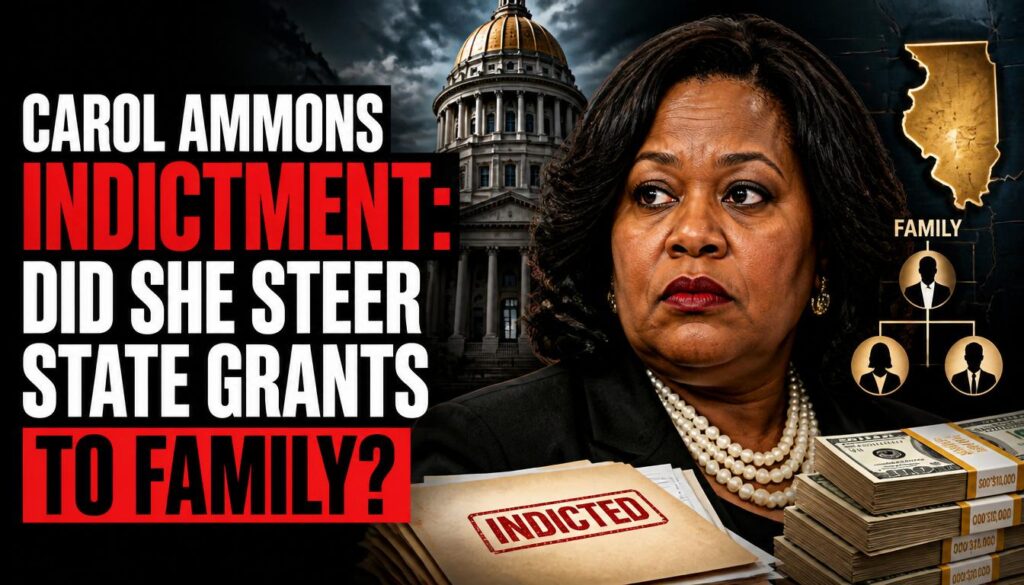
As a federal grand jury lays out an 11-count case against a six-term Illinois lawmaker, voters in Champaign County are left asking a simple question: how much of their tax money stayed in the family?
A veteran Illinois lawmaker now faces a federal grand jury’s judgment. On July 7, 2026, prosecutors indicted State Rep. Carol Ammons, D-Urbana, along with her husband, Champaign County Clerk Aaron Ammons, on charges including wire fraud, making a false statement to the FBI, and conspiracy to obstruct justice.
The timing matters. Ammons is currently unopposed for reelection in this year’s midterm — an election that, notably, falls under the administrative oversight of her own husband’s county clerk office. Her first court appearance is scheduled for July 16.
Support Independent Local Journalism
TheTownHall.News is a non-profit reader-supported journalism. Just $5 helps us hire local reporters, investigate important issues, and hold public officials accountable across Alameda County. If you believe our community deserves strong, independent journalism, please consider donating $5 today to support our work.What Does the Indictment Actually Allege?
Federal prosecutors say Ammons ran a scheme from 2017 through June 2025 to defraud the State of Illinois, its taxpayers, and her own campaign donors. The indictment accuses her of directing state grant money toward nonprofits that, in turn, employed her daughter, Titianna Ammons — while also funneling campaign donations toward personal use. Prosecutors allege Ammons and her daughter collected more than $100,000 through the scheme.
Carol Ammons faces eight counts of wire fraud and one count of making a false statement to a federal agent. Her husband faces a conspiracy to obstruct justice charge alongside her, plus a separate witness-tampering count of his own.
Where Did the Money Go?
According to NBC Chicago’s reporting on the indictment, prosecutors allege Ammons steered roughly $605,000 in state grants to a nonprofit called Hood Vote Neighborhood Transformation — an organization that employed her daughter. Two other groups, Bridgewater Sullivan Community Life Center and the Urbana-Champaign Independent Media Center, are also named.
The Independent Media Center alone received more than $1 million in state grants in 2021 and 2022, including a $700,000 allocation funded by the federal American Rescue Plan Act. During that period, Titianna Ammons was paid nearly $10,000 by the same organization as a “digital marketing coordinator” — while simultaneously working full-time as a program director at Bridgewater and part-time for the Illinois Secretary of State’s office.

$605,000. That’s the figure tied to a single nonprofit in this case — and the question Springfield hasn’t answered is who was supposed to be watching.
The indictment also alleges Ammons failed to report roughly $25,000 in campaign expenditures between January 2019 and November 2020, with a portion allegedly returned to her in cash. Between March 2021 and August 2022, prosecutors say she falsely claimed more than $15,000 was paid to a consulting firm when it actually went to an individual who kicked back part of it to Ammons directly.
Why Did Ammons Allegedly Lie to the FBI?
This is where the case moves from a conflict-of-interest dispute to a criminal one. Prosecutors allege that when an FBI agent asked Ammons in May 2024 about the arrangement between Hood Vote and her daughter, she claimed she had no knowledge of any conflict of interest — despite the indictment’s claim that state officials and the nonprofit had already discussed that exact conflict with her directly.
“Ammons knew full well that individuals from the State of Illinois and Hood Vote Neighborhood Transition had previously discussed the conflict of interest” with her — according to the federal indictment.
That single alleged false statement is now the basis of a federal charge. If a state grant recipient can allegedly mislead federal investigators and still keep drawing a legislative paycheck, what does accountability even mean in Springfield?
Is This Part of a Pattern in Springfield?
Ammons’ case doesn’t exist in isolation. It follows the resignation of State Rep. Harry Benton, D-Plainfield, last week after an inspector general investigation into separate ethics concerns. It also follows a June 2026 federal indictment of Titianna Ammons herself, who faces three counts of wire fraud for allegedly collecting COVID-era unemployment benefits while she was earning income elsewhere, including from her mother’s campaign committee.
Support Independent Local Journalism
TheTownHall.News is a non-profit reader-supported journalism. Just $5 helps us hire local reporters, investigate important issues, and hold public officials accountable across Alameda County. If you believe our community deserves strong, independent journalism, please consider donating $5 today to support our work.On her official website, Ammons has touted her role in passing the SAFE-T Act, the 2021 law that eliminated cash bail in Illinois — legislation she has presented as a signature achievement in criminal justice reform. Critics will likely note the irony: a lawmaker who championed sweeping changes to how the justice system treats the public now faces her own reckoning with federal prosecutors.
Who Is Holding Ammons Accountable — And Who Isn’t?
Illinois House Speaker Chris Welch has removed Ammons from House Democratic Caucus meetings, all committee assignments, and access to Speaker’s Office staff and resources. He has not called for her resignation, saying only that the allegations are “extremely serious” and that every person is entitled to due process.
Governor JB Pritzker’s office called the indictment “extremely concerning,” noting that the state had already flagged and halted one improper grant conflict before the indictment was filed — and pledged to review the other grants named in the case. House Republican Leader Tony McCombie went further, calling on Ammons to resign immediately and saying her own caucus would have acted faster.
Are Illinois Democrats protecting due process — or just protecting a seat? That’s the question hanging over Springfield as Ammons continues her unopposed reelection bid.
Key Questions This Case Raises
- Did state grant administrators have adequate safeguards to catch conflicts of interest before taxpayer money reached Ammons’ family — or only after the fact?
- Should Ammons be permitted to remain unopposed on a ballot her husband’s office oversees while under federal indictment?
- Will Illinois House leadership impose real consequences, or will “removal from committees” be the extent of the response?
What Do Ammons’ Defenders Actually Believe?
Ammons has not yet entered a public plea, and her office has not responded to multiple media requests for comment. Her defenders — and due process itself — deserve a fair hearing of the counterargument: an indictment is not a conviction, and prosecutors’ allegations must still be proven beyond a reasonable doubt in front of a jury.
It’s also true that nonprofits, not Ammons personally, received the state grants in question, and grant administration decisions in Illinois typically involve multiple layers of state review — meaning any conflict-of-interest failure may not rest with Ammons alone. Speaker Welch’s own statement stressed the presumption of innocence, and that principle applies here as much as anywhere.
But the specificity of the allegations — text messages, dates, dollar figures, and an alleged false statement to a federal agent — sets this case apart from a routine political dispute. Prosecutors don’t bring an 11-count federal indictment lightly, and the evidentiary bar they’ve laid out will now be tested in open court starting July 16.
The Question Illinois Voters Are Left With
Strip away the legal terminology, and the case against Carol Ammons boils down to one question: was public money used to fund a family enterprise, and did she lie about it when asked directly? A jury will ultimately decide guilt or innocence. But voters don’t have to wait for a verdict to ask whether their own representative has been straight with them.
The real question isn’t whether Carol Ammons broke the law — it’s whether Illinois will actually hold its own institutions accountable before the next election, or wait until it’s too late.
Still have questions about accountability in Springfield? Stay informed — subscribe for daily coverage.
Think other Illinois taxpayers need to see this? Share the article.
Want your voice heard? Contact your state representative and ask what safeguards exist to prevent grant money from benefiting officials’ own families — Illinois General Assembly contact directory.