McConnell Hospitalized Three Weeks: Senate Transparency and Elaine Chao’s Beijing Trip Raise Serious Questions
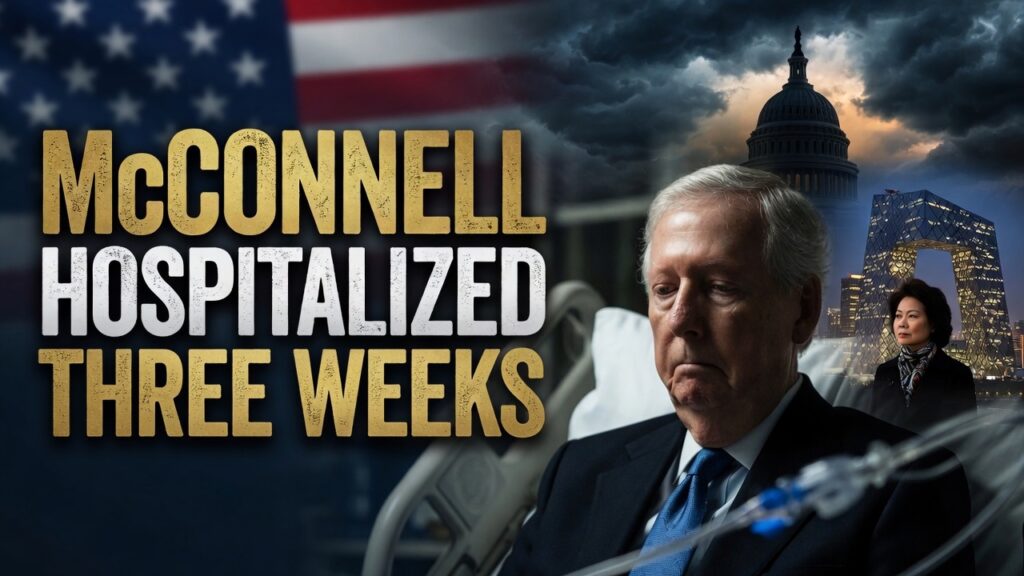
As Senator Mitch McConnell remains hospitalized following a cardiac emergency, his wife traveled to Beijing to meet with China’s vice president. Three weeks in, the Senate still has no answers for the American public.
Three weeks. That is how long Senator Mitch McConnell has been hospitalized — and Washington’s most powerful institution has said almost nothing about who is handling his office.
McConnell was hospitalized on June 14, 2026, after emergency responders were called to his Capitol Hill home, with dispatch audio capturing a scene in which CPR was reportedly in progress. For a senator who commanded the Senate Republican caucus for nearly two decades, the silence from his office has been striking. And it has grown harder to ignore given what happened just three days later, thousands of miles away in Beijing. The Gateway Pundit
Support Independent Local Journalism
TheTownHall.News is a non-profit reader-supported journalism. Just $5 helps us hire local reporters, investigate important issues, and hold public officials accountable across Alameda County. If you believe our community deserves strong, independent journalism, please consider donating $5 today to support our work.What Happened in Beijing on June 17?
Elaine Chao, former U.S. Transportation Secretary and McConnell’s wife of more than 30 years, traveled to Beijing and met with Chinese Vice President Han Zheng on June 17 — just three days after her husband’s hospitalization. Images of the meeting were published by Chinese state outlets, confirming the encounter. According to a statement released by the Chinese Embassy, Han urged further efforts to strengthen U.S.-China relations and referenced what he described as a shared vision of strategic stability agreed upon by the two countries’ leaders. BreitbartChinese Embassy in the US
Chao replied that stable relations serve the interests of both countries and pledged to promote practical cooperation and people-to-people exchanges. Chao holds no current official government position. She is a private citizen. And yet there she was — at a formal bilateral meeting with one of China’s most powerful officials — while her husband lay in a Washington hospital and his Senate office maintained near-total silence. The Gateway Pundit
When a sitting U.S. senator is incapacitated for weeks and his office refuses to provide basic transparency, voters deserve to know exactly who is making decisions — and in whose interest.
Is There a Transparency Gap in the U.S. Senate?
The American constitutional system has no formal mechanism to compel a senator to publicly disclose the nature or severity of a medical incapacitation. Unlike the executive branch, which has the 25th Amendment for presidential incapacity, Congress has no parallel provision. McConnell’s office has issued only vague statements saying he is “continuing his recovery” and remains “engaged with Senate and Kentucky matters through his staff.” That carefully worded language tells voters nothing about what he can or cannot do independently. Chronology

This is not a novel problem, but it is an urgent one. Senators vote on defense spending, intelligence authorization bills, treaty ratifications, and judicial confirmations. Their committee assignments carry real institutional weight. When a senator cannot perform those functions and no one is required to say so publicly, the people who elected him are left without representation — and without recourse.
“When an elected official is incapacitated for weeks and the Senate simply looks away, the real question isn’t whether it’s awkward — it’s whether accountability has a structural blind spot that nobody in Washington wants to fix.”
Senate Security Manuals establish that ultimate responsibility for ensuring employees comply with classified information safeguards lies with the employing senator. If the senator himself is hospitalized and unable to actively supervise his office, those oversight obligations do not disappear. They simply fall into a void that no one in the Senate leadership has been asked to explain. Amazon S3
What Do the Senate’s Own Rules Say About Classified Information?
As of recent reporting, the Senate has 637 staff members with active security clearances, including 284 with Top Secret/SCI-level access. Senators themselves hold access to classified information by virtue of their office, not by formal clearance application. Their staff, however, must obtain separate clearances and are bound by strict handling rules. The Senate Security Manual is explicit: classified material stays within secure facilities and cannot be removed or discussed outside authorized channels. Project On Government Oversight
None of that means a breach has occurred. To be direct: there is no public evidence that classified information has been mishandled in connection with McConnell’s hospitalization or Chao’s Beijing trip. Chao holds no security clearance in any current official capacity, and her meeting with Vice President Han addressed general bilateral relations, according to the Chinese Embassy’s own readout.
But here is the accountability question that no one in the Senate seems eager to answer: what formal safeguards activate when a senator is incapacitated, and who verifies they are working?
Support Independent Local Journalism
TheTownHall.News is a non-profit reader-supported journalism. Just $5 helps us hire local reporters, investigate important issues, and hold public officials accountable across Alameda County. If you believe our community deserves strong, independent journalism, please consider donating $5 today to support our work.- That is the number of Senate staffers with Top Secret/SCI clearances. Who is supervising them in offices where the senator himself cannot?
What Do Supporters of This Arrangement Actually Believe?
Defenders of the current system — and of McConnell’s office specifically — would argue that Senate offices are designed to function through senior staff when members are unavailable. Chiefs of staff, senior policy advisers, and legal counsels carry institutional knowledge and have their own clearances. They argue this is no different from a senator being on a foreign trip or in surgery for a day.
That argument has some validity, but it runs into a problem of scale and duration. Three weeks of hospitalization following a cardiac arrest is not a foreign trip. And the Senate’s self-reporting culture — where members police their own disclosures — depends entirely on good-faith compliance. There is no inspector general for a senator’s own office. There is no independent body that audits whether a senator’s staff is operating within proper boundaries when the senator is non-functional. The system assumes the senator is present. When he is not, it largely assumes nothing will go wrong.
That may be a reasonable assumption most of the time. It is not a substitute for a rule.
Who Is Elaine Chao, and Why Does This Trip Matter?
Elaine Chao was born in Taiwan and immigrated to the United States at age eight. Her father, James Chao, founded the Foremost Group, an American shipping company that operates primarily in international maritime commerce. She served as Secretary of Labor under President George W. Bush and as Secretary of Transportation in President Trump’s first term, resigning after January 6, 2021. Wikipedia
The Foremost Group has been described as having significant business ties to China, including dealings with Beijing-linked financial institutions. Chao has no formal affiliation with the company but has received millions of dollars in gifts from her father, who founded and previously ran it. During her tenure at the Transportation Department, ethics questions were raised about whether she was using her official position to benefit her family’s shipping interests, and a planned official trip to China was ultimately cancelled after State Department ethics officials raised concerns. NewsweekAmerican Oversight
None of that establishes wrongdoing in the June 2026 meeting. Chao is a private citizen entitled to travel. The Chinese Embassy’s own statement describes the meeting as focused on U.S.-China relations broadly. But context matters in accountability journalism. And the context here — a long-documented set of financial and business entanglements with Chinese commercial interests, combined with an informal high-level diplomatic meeting during a period of her husband’s incapacitation — raises legitimate questions that deserve a direct public answer.
If the roles were reversed and a Democratic senator’s spouse held these ties and made this trip, you know exactly how this story would be covered. The standard should not change based on party.
Are Our Institutions Built for This Moment?
The deeper issue this story surfaces is structural. American voters elect senators. They do not elect senators’ chiefs of staff. They do not elect spouses. And yet, when a senator goes down for weeks with no formal incapacity mechanism in place, governance does not pause — it continues through people the public never voted for, under rules that were not designed for prolonged absence.
McConnell announced he would not seek reelection in 2026. His current Senate term runs through January 2027. That means Kentucky voters are represented — at least formally — by a senator whose capacity to serve has not been publicly described by anyone with authority to assess it. Chronology
Senator Cory Booker has already called for greater transparency, with his office reportedly describing the situation as raising concerns. McConnell’s team has dismissed such calls, but dismissal is not an answer.
Key Questions This Article Raises:
- What formal Senate rule or mechanism governs the office operations of an incapacitated senator for an extended period, and who enforces it?
- Elaine Chao is a private citizen — but given her family’s documented business ties to China, was her June 17 meeting with the Chinese vice president disclosed to any U.S. government official in advance?
- Three weeks into the hospitalization, why has McConnell’s office not provided a basic medical status update that would allow Kentucky voters to assess whether their senator is capable of representing them?
The Senate was built on the assumption that its members show up. When they cannot, the institution has no real answer — just the hope that nothing important falls through the cracks.
The real question is not whether Mitch McConnell will recover. We hope he does. The question is whether an institution that demands accountability from the executive branch has ever demanded it from itself — and whether voters are willing to wait any longer to find out.
Think this story deserves more coverage? Share this article and tell us: what accountability reforms should Congress adopt for incapacitated members? Subscribe to The Town Hall News for daily coverage of the stories your other outlets won’t press.