US-Israel Military Integration in the NDAA: What American Sovereignty Is at Stake?
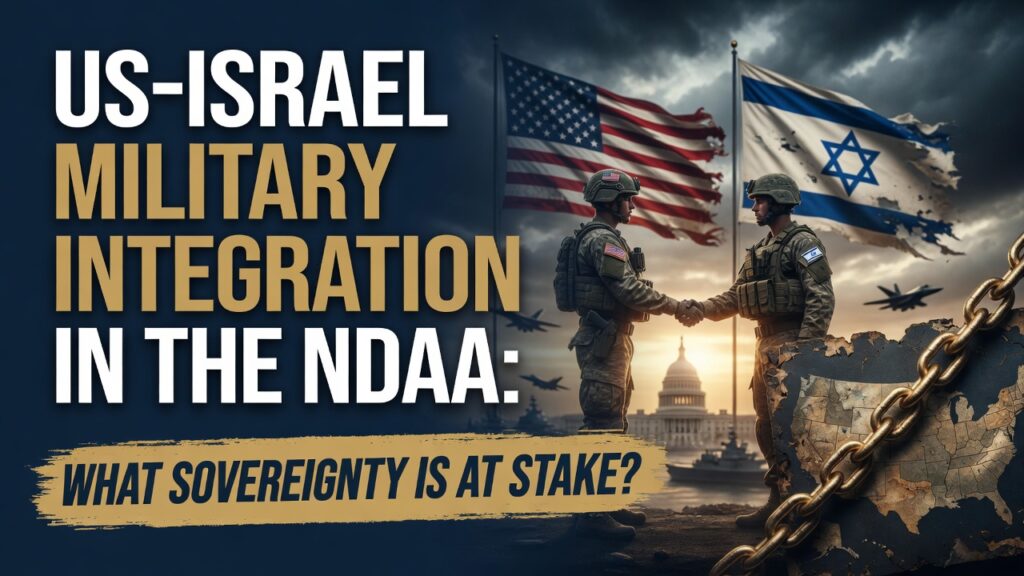
Two pieces of legislation — one buried in a defense bill, one tucked inside an intelligence authorization act — could permanently tie American military and intelligence power to a foreign government, with almost no public debate and no recorded vote.
Congress passed another National Defense Authorization Act. But buried inside the FY2027 version is a provision that a growing number of lawmakers — from both parties — say goes further than any defense partnership in American history. The question isn’t whether the United States should cooperate with allies. The question is whether Congress just quietly handed that decision to a foreign prime minister.
What Is Section 219 — and Why Did Leadership Kill the Vote?
Support Independent Local Journalism
TheTownHall.News is a non-profit reader-supported journalism. Just $5 helps us hire local reporters, investigate important issues, and hold public officials accountable across Alameda County. If you believe our community deserves strong, independent journalism, please consider donating $5 today to support our work.Section 219 of the House FY2027 NDAA would establish a “United States-Israel Defense Technology Cooperation Initiative” within the Department of Defense, creating an executive agent responsible for expanding defense technology cooperation between the two countries across a broad range of military programs. Military.com
The scope is sweeping. The initiative covers collaboration on artificial intelligence, quantum machine learning, autonomous systems, directed energy, advanced sensing, cyber defense, electronic warfare, biotechnology, biomanufacturing, network integration, and data fusion between both militaries. Wikipedia
A bipartisan pair of lawmakers — Rep. Thomas Massie (R-KY) and Rep. Ro Khanna (D-CA) — attempted to strip the provision from the bill before it reached the full House floor. They never got the chance. The House Rules Committee declined to make the amendment eligible for debate, ensuring it would not receive debate or a recorded vote before the House considered the broader defense bill. Military.com
“Section 219 of the NDAA is an unprecedented escalation of foreign involvement in our military,” Massie said. “This goes well beyond our pre-existing military relationships, such as with Five Eyes nations, or our more conventional defense partnerships with foreign militaries.” Military.com

Did a Foreign Government Help Write This Legislation?
The sovereignty concerns do not stop at the Pentagon. On June 1, 2026, Israeli Prime Minister Benjamin Netanyahu wrote a letter to Rep. Marlin Stutzman endorsing a bill facilitating a transition in the US-Israel relationship, stating: “The time has now arrived for us to move from aid recipient to partner.” Al Jazeera
Netanyahu’s language did not simply echo the NDAA provision — critics say it anticipated it. Rep. Khanna argued during committee debate that Section 224 “directly” follows Netanyahu’s language in that letter, describing a “new framework of joint defense cooperation, codevelopment, coproduction and mutual investment in areas including advanced missile defense, artificial intelligence, unmanned systems, and cybersecurity.” Al Jazeera
$750 million. That is the amount AIPAC says the FY2027 NDAA allocates for US-Israel cooperative programs — a $65 million increase over FY2026. [Source: AIPAC fact sheet, as reported by Wikipedia/FUTURES Act article.] The question taxpayers deserve answered: who decided this number, and who lobbied for it?
“If Section 219 is signed into law, the American people should see it as Congress fully capitulating our nation’s autonomy to foreign influence.” — Rep. Thomas Massie (R-KY)
Is This a Defense Partnership — or Something Permanent and Irreversible?
Support Independent Local Journalism
TheTownHall.News is a non-profit reader-supported journalism. Just $5 helps us hire local reporters, investigate important issues, and hold public officials accountable across Alameda County. If you believe our community deserves strong, independent journalism, please consider donating $5 today to support our work.The architects of Section 219 insist the provision is routine. Rep. Mike Rogers (R-AL), the House Armed Services Committee chairman, dismissed claims that the provision would compromise American sovereignty, calling any such narrative “categorically false and misleading” and arguing that Section 219 “actually improves oversight and accountability of these programs by designating a single official responsible for them.” Jewish Insider
Supporters point to tangible benefits. Rep. Don Bacon (R-NE) argued: “We have Silicon Valley, Israel has Tel Aviv — it’s like Silicon Valley number two. We have gained so much technology advantage from our partnership with Israel.” Responsible Statecraft
Those are legitimate arguments — and the US-Israel technology relationship has produced real defensive advances, including missile defense systems that protect both countries. But critics draw a distinction between cooperation and codification. As the Quincy Institute for Responsible Statecraft warned, “The measure risks tethering the US military to its Israeli counterpart technologically and making it difficult to uproot should conditions change. There may be no turning back if this provision becomes law.” Responsible Statecraft
Bold statement for civic clarity: Congress did not allow a single recorded floor vote on whether to debate whether the United States should permanently bind its defense infrastructure to a foreign nation’s military apparatus.
The Senate’s Intelligence Power Play
While the NDAA debate played out in the House, the Senate was quietly moving in the same direction — through a different bill entirely. The Senate Intelligence Committee’s Intelligence Authorization Act for FY2027 contains Section 622, titled “United States-Israel Intelligence Sharing Enhancement,” which would amend the National Security Act of 1947 itself by adding a section to govern intelligence sharing with Israel. Military.com
The constraints on executive authority in Section 622 are significant. The bill, put forward by Sen. Tom Cotton (R-AR), the chairman of the Senate Intelligence Committee, would prohibit any suspension, reduction, or limitation of intelligence sharing “except on the basis of a specific and identifiable national security concern determined by the President,” and any such exception would require a report to Congress within 15 days. Responsible Statecraft
The intelligence authorization act passed the committee by a 14-3 vote. That means a future president seeking to recalibrate the intelligence relationship with Israel — for any reason — would face a congressionally mandated reporting and justification process unlike that applied to any other foreign intelligence partner. The New American
Bold rhetorical question: If Congress would not impose the same legislative framework on the United Kingdom, Germany, Japan, or any NATO ally, why is one foreign nation receiving a category of its own inside US law?
What Do Supporters of This Policy Actually Believe?
Proponents make a coherent case rooted in shared strategic interests. Israel occupies a unique position in the Middle East as a technologically advanced democracy facing persistent threats from Iran, Hezbollah, and other hostile actors. The Senate intelligence bill argues that the partnership serves US national interests, citing terrorist threats, sanctions evasion, and state and non-state aggressors as shared global security concerns. Washington Examiner
On the defense technology side, the argument is frankly strong: joint development with Israel in missile defense, drone countermeasures, and cyber has historically benefited American warfighting capability, not just Israeli security. Rep. Ronny Jackson (R-TX) and Rep. Don Davis (D-NC), lead sponsors of the FUTURES Act on which the provision was modeled, emphasized that Section 219 requires public reporting on cooperative efforts, including how they benefit the United States. Jewish Insider
But the counterargument is not about whether cooperation is worthwhile — it is about whether it should be hardwired into law, removing executive flexibility, and structured in a way that uniquely disadvantages any future president who seeks to use the relationship as leverage. Critics argue that Congress has not created a comparable statutory framework requiring such broad and permanent defense integration with any other nation — not the United Kingdom, not France, not Germany, not Japan, not South Korea, not Australia. That is an extraordinary carve-out, and it demands an extraordinary explanation. Military.com
Are American Voters Even Part of This Conversation?
The procedural maneuvering around this debate is arguably as troubling as the substance. Ben Freeman noted at Responsible Statecraft that the Rules Committee made its decision to block the Massie-Khanna amendment “after no debate,” and that “by rejecting the Khanna and Massie amendment, the Rules Committee ensured the American public would not even get to see how their representatives would vote.” Common Dreams
That is not a minor process complaint. The NDAA is a must-pass bill. Provisions embedded in it are extraordinarily difficult to remove once codified. Former Rep. Marjorie Taylor Greene wrote that “once Section 224 passes, it will be next to impossible to be undone.” Whether or not one agrees with her broader politics, that specific observation reflects a basic legislative reality that all Americans — regardless of party — should find worth examining. Wikipedia
The issue now moves to the Senate floor and ultimately to a conference committee, where House and Senate versions of the NDAA must be reconciled. Although the House amendment was blocked, the issue remains alive, as any differences between the House and Senate bills must be resolved in a conference committee before legislation reaches the president’s desk. That conference process is, in practice, nearly invisible to the public. Military.com
Key Questions
- Should any foreign nation — ally or not — be given a permanent, statutory position inside US defense and intelligence law that no NATO partner currently holds?
- Who authorized the House Rules Committee to prevent a recorded vote on one of the most significant sovereignty questions in recent congressional history?
- If Section 219 and Section 622 become law, what leverage does the United States retain if its strategic interests ever diverge from Israel’s?
The real question at the center of this debate is not whether the United States and Israel should cooperate — they have for decades, and that relationship has produced genuine security benefits for both nations. The deeper question is whether this generation of lawmakers is permanently restructuring that relationship through must-pass legislation, with no floor debate, no recorded vote, and no explicit mandate from the American people who will pay for it and live with the consequences.
Congress works for the American public — not the other way around. Is anyone in Washington still acting like it?
What do you think — has Congress crossed the line from alliance to entanglement? Share this article and weigh in.
Still have questions? Stay informed — subscribe to The Town Hall News for daily coverage of federal policy and accountability journalism.
Think others need to hear this? Share the article and start the conversation.
Want to make your voice count? Contact your representative through house.gov/representatives/find-your-representative and ask them directly: did you support or oppose Section 219 of the FY2027 NDAA — and why?