California Voter ID Ballot Title: What Prop 39 Really Says
A Sacramento judge just let California’s attorney general rewrite how millions of voters will see a voter ID measure. Now Californians are asking: who gets to decide what “voting” even means?
Words matter on a ballot. Especially the first ones voters read.
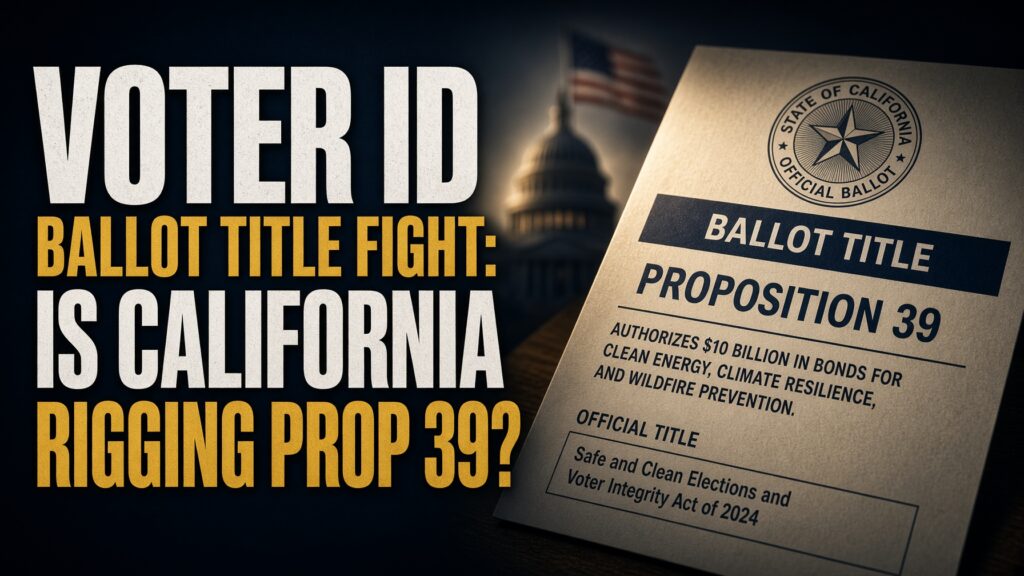
On August 6, a Sacramento County Superior Court judge sided with California Attorney General Rob Bonta in a dispute over how Proposition 39, the state’s voter ID initiative, will be described to voters this November. The ruling locks in a ballot title telling voters the measure “prohibits citizens from voting” — language the initiative’s own authors call misleading, and language every voter will read before November 3.
Support Independent Local Journalism
TheTownHall.News is a non-profit reader-supported journalism. Just $5 helps us hire local reporters, investigate important issues, and hold public officials accountable across Alameda County. If you believe our community deserves strong, independent journalism, please consider donating $5 today to support our work.Who Changed the Title, and Why Does It Matter?
Proposition 39 first appeared with the title “Establishes Additional Voter Identification and Citizenship Verification Requirements” on September 19, 2025, while organizers collected roughly 1.3 million signatures to qualify it for the ballot. That title stayed in place for ten months. After the measure qualified and Bonta’s office certified it on July 3, 2026, officials rewrote the title weeks later, on July 21, to read: “Prohibits Citizens From Voting Unless They Present Government-Issued Identification.”
The new language is narrowly accurate — the measure would bar officials from counting a ballot that fails its ID requirements. But there’s a meaningful difference between “additional identification requirements” and language telling voters the measure flatly prohibits them from voting. One is a description. The other is a warning.
Did the Judge Get This Right?
Judge Jennifer K. Rockwell denied the petition brought by Californians for Voter ID, Yes on 39, and a registered voter who challenged the rewritten title. Rockwell found the measure’s text does require ID to cast a ballot that counts, and ruled that “voting” reasonably includes having a ballot counted, not merely submitted. The attorney general, she wrote, acted within the “considerable latitude” state law grants his office in writing ballot titles.
That legal reasoning may hold up. California’s Elections Code gives the attorney general significant discretion here, and courts have historically deferred to it. But legal permissibility and fairness are not the same thing. A ballot title written by the official whose party opposes the measure isn’t impartial — even when a judge calls it technically legal.

What Does Proposition 39 Actually Do?
Strip away the framing fight, and the substance is straightforward. Prop 39 would amend the California Constitution to require in-person voters to present government-issued ID. Mail voters would write the last four digits of an ID number on their ballot envelope. The state would issue free voter ID cards on request. Election officials would be directed to verify voter citizenship and report results county by county, every year.
None of that is exotic. Versions of voter ID exist across much of the country, and polling has generally shown broad public support for identification requirements at the polls [polling data, multiple public surveys cited by proponents]. The dispute here isn’t really about whether voters should show ID. It’s about whether the state’s top law enforcement officer gets the final word on how a measure he personally opposes is described to the people voting on it.
Who Is Really Losing in This Fight?
The people who lose when a ballot title is engineered for persuasion, rather than clarity, are ordinary voters. Someone skimming the November ballot who reads “prohibits citizens from voting” in bold capitals is primed to react with alarm before reading the measure’s actual text — and that title is often the only thing most voters read before marking their choice.
If officials can rewrite a measure’s headline to sound like the opposite of what it does, what protects any initiative campaign? This is not hypothetical. Assemblymember Carl DeMaio, a co-author of the measure and chairman of Reform California, pointed to a similar fight over 2018’s gas tax repeal initiative as a precedent Bonta’s office may have drawn from.
A second ruling the same day compounds the problem for Prop 39’s backers. A separate Sacramento judge tentatively found several statements the Yes on 39 campaign submitted for its own ballot argument were themselves false or misleading — including a claim the measure would make voting easier — and ordered them revised before the state’s August 10 printing deadline [court filings, Courthouse News Service].
Support Independent Local Journalism
TheTownHall.News is a non-profit reader-supported journalism. Just $5 helps us hire local reporters, investigate important issues, and hold public officials accountable across Alameda County. If you believe our community deserves strong, independent journalism, please consider donating $5 today to support our work.What Do Supporters of This Policy Actually Believe?
It’s worth engaging honestly with the other side, because dismissing it outright would be lazy. Supporters of Bonta’s rewritten title argue that Prop 39, if passed, would function exactly as described: a ballot missing the required identification simply won’t be counted. To these supporters, that’s not spin — it’s a plain reading of the initiative’s own text, which states a voter “shall present government-issued identification” each time they cast a ballot in person.
Under this view, “prohibits voting” isn’t manipulative — it’s the honest consequence of noncompliance, and election officials nationwide already reject ballots that fail a state’s verification standards. That argument has merit and deserves a direct answer, not a dismissal. The flaw isn’t in describing the consequence — it’s in choosing which consequence to lead with, in bold capitals, after ten months of gentler language while signatures were being gathered. A description written to inform reads differently from one written to discourage.
What Do the Numbers Actually Tell Us?
1.3 million. That’s roughly how many signatures backed Proposition 39 onto the ballot under its original, milder title. The question no one at the attorney general’s office has answered: why did a measure with that level of grassroots support need its headline rewritten the moment it qualified?
“California politicians know that a supermajority of California voters support Prop 39’s bipartisan solution for Voter ID — so now they are corruptly trying to rig the election by putting a biased and dishonest title on this common-sense measure.”
That’s how DeMaio characterized the rewrite. While “corruptly” goes further than the court record supports, the underlying timing question — why the change came only after qualification — remains fair and unanswered.
Is This the Accountability Moment Voters Deserve?
The Yes on 39 campaign says it has no plans to appeal Rockwell’s ruling for now, choosing instead to focus on voter outreach ahead of November — a pragmatic call, given fixed printing deadlines and the cost of continued litigation.
But choosing not to fight in court doesn’t mean the underlying question disappears. Every voter deserves a ballot title meant to inform, not to nudge them toward a predetermined outcome — no matter which party writes it. Reform California and allied legislators have signaled they intend to raise the broader issue of attorney general discretion over ballot language in future sessions, regardless of how Proposition 39 fares.
Key Questions
- Why did the attorney general’s office wait until after Prop 39 qualified to rewrite its title, after ten months of milder language?
- Should any single elected official — from either party — have unilateral authority to write the headline voters see for a measure their office opposes?
- Will the contested framing meaningfully change how Californians vote on voter ID in November, or will underlying public support for identification requirements hold regardless?
What Happens When No One Challenges the Process?
If voters accept, without scrutiny, that an attorney general can reshape a measure’s framing after it qualifies, the precedent won’t stay confined to Proposition 39. Future fights — over taxation, parental rights, or public safety measures — will be fought as much in the wording of the title as in the substance of the policy. That should concern anyone who believes elections ought to be decided by informed voters rather than clever drafting.
The real issue was never only whether Proposition 39 should pass. It’s whether the process that decides how voters learn about it can be trusted — and whether anyone in Sacramento is held accountable if it can’t.
What do you think — is a ballot title written by an opposing official still a fair description, or has California crossed a line? Share this article and let us know.
Still have questions about how ballot measures get written and challenged in California? Stay informed — subscribe for daily coverage. Think other voters need to see this before November? Share the article. Want your voice to count? Contact your state legislator and the Secretary of State’s office about ballot title transparency before the next election cycle.