DOGE $110 Billion Savings Claim: What the GAO Audit Found
Can a government efficiency program survive an audit of its own efficiency numbers? That question is no longer hypothetical.
On August 6, 2026, the Government Accountability Office released a 52-page review of DOGE’s public “Wall of Receipts,” the website where the agency tallied its claimed taxpayer savings from canceled contracts, grants, and leases. DOGE was created in January 2025 with a mandate every fiscal conservative should welcome: find the waste, cut the fat, and show Americans exactly where their money went. It formally wound down on July 4, 2026. What comes next is a test of whether “efficiency” was a real accomplishment or a talking point dressed up as one. [federal data: GAO-26-108615]
What Did DOGE Actually Claim to Save?
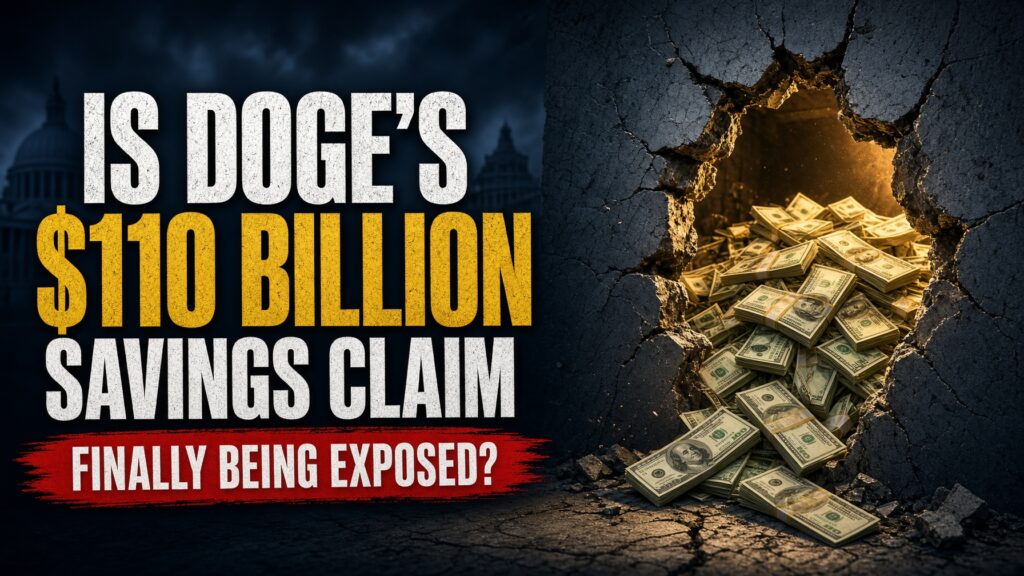
DOGE’s Wall of Receipts launched on February 17, 2025, and by July 7, 2026, it reported $110 billion in total savings across thousands of terminated contracts, grants, and leases. That number was repeated in press briefings, cable news hits, and social media posts as proof that the effort was working.
GAO’s job was simple: check the government’s homework. Auditors pulled records from the Federal Procurement Data System, USAspending.gov, and the General Services Administration’s lease tracker, and rebuilt DOGE’s numbers from the outside using the government’s own official data. [federal data: GAO-26-108615]
A $110 billion savings claim. The question taxpayers deserve answered: how much of it was actually real?
Did DOGE Even Cooperate With Its Own Audit?
Here’s where the story gets uncomfortable for anyone who values transparency. GAO said the U.S. DOGE Service did not respond to its requests for interviews or written clarification. Auditors sent DOGE a draft of the report for review and comment, the standard professional courtesy extended to any audited agency. DOGE let it go to publication without a response. [federal data: GAO-26-108615]
An agency built on the premise of holding government accountable to the taxpayer declined to answer basic questions from the taxpayer’s own investigative arm. That is not a partisan observation — it is what the report says happened.
Support Independent Local Journalism
TheTownHall.News is a non-profit reader-supported journalism. Just $5 helps us hire local reporters, investigate important issues, and hold public officials accountable across Alameda County. If you believe our community deserves strong, independent journalism, please consider donating $5 today to support our work.What Do the Numbers Actually Tell Us?
The specifics are where this story moves from allegation to documentation. GAO found that of the roughly $61 billion in claimed contract savings, about $34.6 billion came from contracts that were either never actually terminated or could not be corroborated as terminated using federal procurement records. Nearly 2,000 of the 13,476 contracts DOGE listed as canceled were still active, according to GAO’s review of the Federal Procurement Data System.
On leases, GAO reviewed all 264 properties DOGE listed as terminated and found that 108 of them — accounting for roughly $15.3 million of the reported $53.5 million in lease savings — were already in the process of being phased out before DOGE was ever established. In other words, DOGE took credit for cancellations that were already happening.
Grants fared worse under scrutiny. GAO said DOGE did not provide sufficient information to verify approximately 96.2 percent of its reported grant savings, a figure GAO calculated at roughly $47.3 billion. In one striking example, DOGE continued to list a $1.7 billion Defense Health Agency IT contract as a savings win months after Pentagon officials had already told DOGE the contract should not be terminated — and no action was ever taken on it. [federal data: GAO-26-108615]
Nearly one in five federal contracts DOGE claimed to cancel was never actually canceled. Is that efficiency, or is that spin?
Is This the Accountability Moment Fiscal Conservatives Should Want?
This is the section where the article could easily tip into either uncritical defense or reflexive attack. Neither serves readers who actually care about limited, honest government. The right question isn’t whether DOGE’s mission was worthwhile — cutting duplicative contracts and unused federal leases is a legitimate, overdue goal. The right question is whether the public was told the truth about what was accomplished.
A savings number that can’t survive an audit isn’t a victory for limited government. It’s a liability for everyone who wants smaller government to be taken seriously.
That standard cuts against both political tribes. Inflated numbers don’t help taxpayers, and they hand ammunition to anyone who wants to argue that spending cuts are inherently dishonest. A conservative case for smaller government depends on credibility. Numbers that don’t survive an audit undermine the entire argument.
Who Requested This Review — and Does That Change What It Found?
The review was requested by Senate Democrats Gary Peters of Michigan and Richard Blumenthal of Connecticut. Readers are right to ask whether that origin colors the findings. The honest answer: GAO is a nonpartisan legislative-branch agency that has audited federal programs under both parties for over a century, and its findings here are backed by line-item citations to federal procurement and grant databases that any citizen can check independently. The request came from one party. The methodology and the data did not.
What Do Supporters of This Policy Actually Believe?
Supporters of DOGE’s approach make a reasonable case worth engaging honestly: the federal government is enormous, notoriously resistant to reform, and has ignored efficiency recommendations from GAO itself for years — a separate GAO annual report found $100 billion in additional potential savings sitting unimplemented because Congress and agencies never acted. In that light, DOGE’s aggressive approach was a deliberate break from a broken status quo, and even an overstated number might still reflect real directional progress.
That argument has merit. But directional progress and verified savings are not the same thing. GAO’s review does not conclude DOGE accomplished nothing — it concludes the public tally cannot currently be trusted to say how much it accomplished, and that DOGE refused to help clarify the difference. Fiscal accountability means the numbers hold up whether they come from an agency you distrust or one you’re rooting for.

What Happens If No One Fixes This?
GAO’s recommendation was modest: prominently disclose the data limitations on the Wall of Receipts so the public isn’t misled by a headline number that can’t be substantiated. As of publication, DOGE’s former web presence has not been updated to reflect that.
If unverified savings claims go uncorrected, the practical cost isn’t just a bad number on a website. It’s a credibility cost that follows every future attempt to cut federal spending. The next administration, of either party, that tries to eliminate a wasteful contract or shutter a duplicative program will face a public primed to assume the savings are fake — because the last high-profile attempt to prove it couldn’t survive its own audit.
Key Questions This Report Raises
- How much of the $110 billion in claimed DOGE savings, if any, will ever be independently verified?
- Why did DOGE decline to respond to GAO’s basic requests for methodology and clarification?
- Will future administrations be more transparent about spending-cut claims, or will unverifiable “savings” become the new normal?
The Real Question Taxpayers Are Left With
Strip away the politics on both sides and one question remains: does the federal government tell the truth about its own spending, even when the truth is less impressive than the headline? DOGE was sold as a solution to exactly that problem — bureaucratic opacity about where tax dollars go. GAO’s audit suggests the solution inherited the same disease it was built to cure.
That doesn’t mean the underlying goal was wrong. Reducing federal waste, closing empty office leases, and canceling contracts nobody uses are all worth pursuing — carefully, and with verifiable numbers. What it means is that “trust us” is not an acceptable standard for any government program, no matter which administration runs it or which side of the aisle cheers it on.
What do you think — should Congress require independent verification before any agency publishes a taxpayer savings claim? Share this article and let us know.
Still have questions about how your tax dollars are tracked? Stay informed — subscribe for daily coverage. Think your neighbors need to see this? Share the article. Want your voice to count? Contact your member of Congress and ask whether they support independent, mandatory verification of any federal agency’s public savings claims.
The real question isn’t whether the government wastes money — it’s whether we’ll ever get a straight answer about how much, and from whom.