Crete Wildfire Arrest: Israeli Tourist Charged With Negligent Arson
As Greece battles one of its most punishing fire seasons in years, one arrest in a small Cretan village is raising a bigger question: when personal choices ignore public warnings, who should pay the price?
A lit match. A banned barbecue. A village suddenly under evacuation orders.
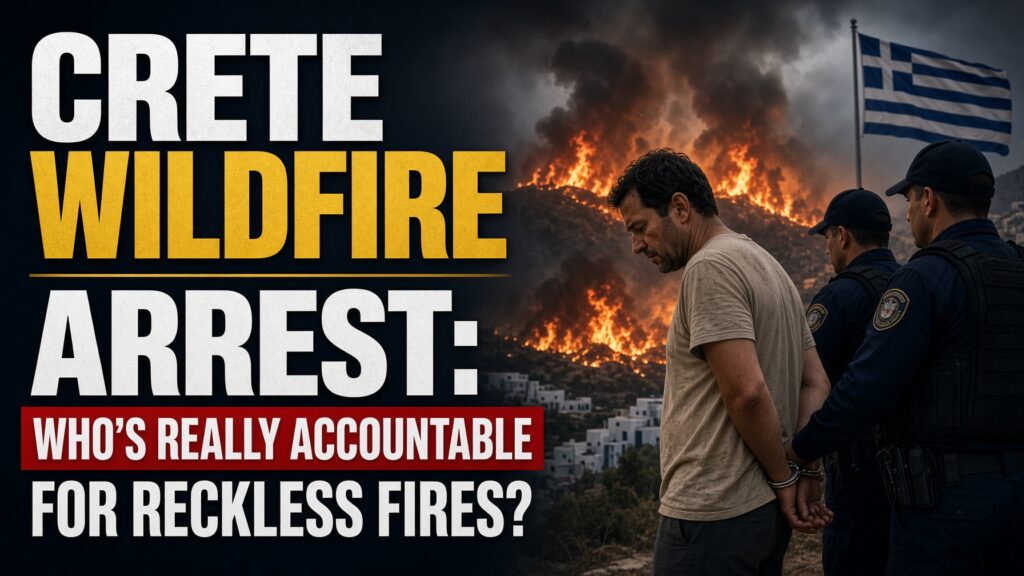
That is the story out of Sellia, a small village near the resort town of Plakias on Crete’s southern coast, where Greek authorities arrested a 35-year-old Israeli tourist over the weekend on suspicion of negligent arson. Investigators say he and a group of fellow travelers grilled at their rental villa despite an active fire ban — and despite being warned, in person and in writing, not to. The fire that followed forced two nearby communities to evacuate and required more than 60 firefighters to contain. It is a small story with a large lesson about personal responsibility, and it deserves a closer look.
What Actually Happened in Sellia?
The fire broke out around 7:10 p.m. on Friday, August 14, in the yard of a vacation villa in Sellia, within the municipality of Agios Vasileios in southern Rethymno. According to Greek media citing the Fire Service’s arson investigation unit, the blaze began after a group of Israeli tourists staying at the property lit a barbecue despite strong winds and an active high-risk fire warning.
The villa’s owner says he told the guests, both verbally and in writing, that grilling was strictly prohibited because of the elevated danger. They allegedly did it anyway. Strong evening winds carried embers into nearby dry brush, and the fire spread quickly enough that Greece’s 112 emergency alert system ordered precautionary evacuations in the nearby communities of Fotinari and Souda.
Why Was the Fire Ban in Place to Begin With?
This was not an obscure local ordinance nobody could reasonably know about. Crete has endured a brutal wildfire season, and Greek authorities have made open-flame restrictions during high-risk conditions a matter of public record and repeated warning — the kind of rule any responsible property owner, tenant, or short-term visitor is expected to follow without needing a government official standing over their shoulder.
That is the entire premise of a functioning fire-safety regime: clear rules, clearly communicated, followed voluntarily by people who understand the stakes. A written warning ignored isn’t bad luck — it’s a choice, and choices have consequences. The villa owner did his part. He posted the warning. He said it out loud. What happened next was not a failure of government. It was a failure of individual judgment.
Support Independent Local Journalism
TheTownHall.News is a non-profit reader-supported journalism. Just $5 helps us hire local reporters, investigate important issues, and hold public officials accountable across Alameda County. If you believe our community deserves strong, independent journalism, please consider donating $5 today to support our work.Who Pays When Personal Choices Become Public Disasters?
Here is where the story stops being about one barbecue and starts being about a much bigger principle. More than 60 firefighters, three specialized wildfire units, helicopters, and water tankers were dispatched to contain a blaze that, by the fire service’s own account, began with a single household decision. Olive groves were damaged. Two communities were forced into precautionary evacuation. None of that comes free.
297. That’s how many people Greek authorities have arrested for fire-related offenses since January 1, 2026 [regional press reports citing Greek Fire Service data] — 267 for negligence, 30 for deliberate arson. The question Greece’s tourism industry can no longer avoid: how many of those fires were entirely preventable?
Firefighting is not a limitless public resource. Every truck, every helicopter hour, every firefighter pulled off standby to chase down a preventable blaze is a cost borne by taxpayers and, ultimately, by the communities whose safety depends on those same resources being available for the next emergency. When a fire starts because someone decided a written warning didn’t apply to them, that is not a victimless mistake. It is a transfer of risk and cost from one individual onto an entire village.
“The warning was not informal. It was verbal, it was written, and it was ignored anyway.”
Is Greece’s Crackdown on Fire Negligence Actually Working?
Greece has not been shy about toughening enforcement. Officials confirmed that anyone found responsible for a wildfire — whether through negligence or intent — can face penalties as severe as 20 years in prison and fines up to €200,000. That is a serious deterrent on paper. Whether it changes behavior in practice is a fair question, and it’s one this case will help answer.
If a written fire ban isn’t enough to stop a backyard barbecue, what exactly would be? The man arrested in Sellia now faces a charge of negligent arson and was expected to appear before an investigating magistrate in Rethymno. A judge will ultimately decide whether formal charges proceed and whether he remains in custody or is released on conditions while the case continues. It is worth being precise here: he is accused, not convicted, and the presumption of innocence applies regardless of nationality or headline appeal.
Greek authorities deserve credit for treating this case exactly like any other. There has been no special leniency reported, no quiet dismissal, no suggestion that tourism revenue should buy a pass on fire safety. That is what rule of law is supposed to look like — the same standard applied to a foreign visitor as would apply to any local resident who ignored the same warning.
What Do Supporters of Lighter Tourist Enforcement Actually Believe?
Not everyone agrees that aggressive prosecution of tourists is the right approach, and that argument deserves a fair hearing. Some in Greece’s hospitality industry worry that high-profile arrests of foreign visitors — even in clearly negligent cases — generate bad press that could dent tourism revenue the local economy depends on. Others argue that if the fire was sparked by wind carrying embers rather than intentional misconduct, negligent-arson charges may be a disproportionate response to what was, at its core, an accident.
Those concerns are not unreasonable on their face. Tourism is a genuine economic lifeline for coastal Crete, and nobody benefits from turning every visitor mishap into an international incident. But an accident born of ignoring a written safety warning is still a choice with a victim — and the victims here were the residents of Sellia, not the tourists who lit the grill. Accidental does not mean blameless. Negligence, by legal definition, is precisely what happens when a reasonable warning is disregarded and harm follows. Softer enforcement might protect short-term tourism optics, but it would come at the cost of the deterrent effect that keeps the next visitor from making the same call.
Key Questions This Case Still Has to Answer
- Will the investigating magistrate formally proceed with the negligent arson charge, and what penalty will actually be sought?
- Does Greece’s steep legal exposure — up to 20 years and €200,000 in fines — meaningfully change tourist behavior, or is it simply a headline number?
- Should short-term rental platforms and villa owners bear any additional legal responsibility for ensuring guests understand and follow local fire restrictions?
A Lingering Question for Every Traveler
This case will move through the Greek legal system, and the facts — who knew what, who said what, who lit the match — will be tested in a Rethymno courtroom, not in a headline. But the broader principle at stake does not need a verdict to be true: rules posted for public safety only work if people follow them, and communities should not have to absorb the fallout when visitors decide otherwise.
Sellia’s residents did not choose to be evacuated from their homes on a Friday night. They did not choose to have olive groves burned or firefighting resources diverted to their village. Someone else made that choice for them. The real question isn’t whether Greek courts will hold one tourist accountable — it’s whether the rest of us are paying close enough attention to demand that kind of accountability everywhere personal recklessness threatens the public good.
What do you think — should countries impose even tougher penalties on tourists who ignore local safety laws, or does this case already go far enough? Share this article and let us know.
Still have questions about how this case unfolds? Stay informed — subscribe for daily coverage. Think others need to see how accountability actually works? Share this article. Want to make your voice count on wildfire policy and visitor accountability? Contact your local representative or tourism board about enforcement standards in high fire-risk areas.