ICE Conducts Largest DHS Raid Ever at Hyundai Georgia Plant — 475 Arrested
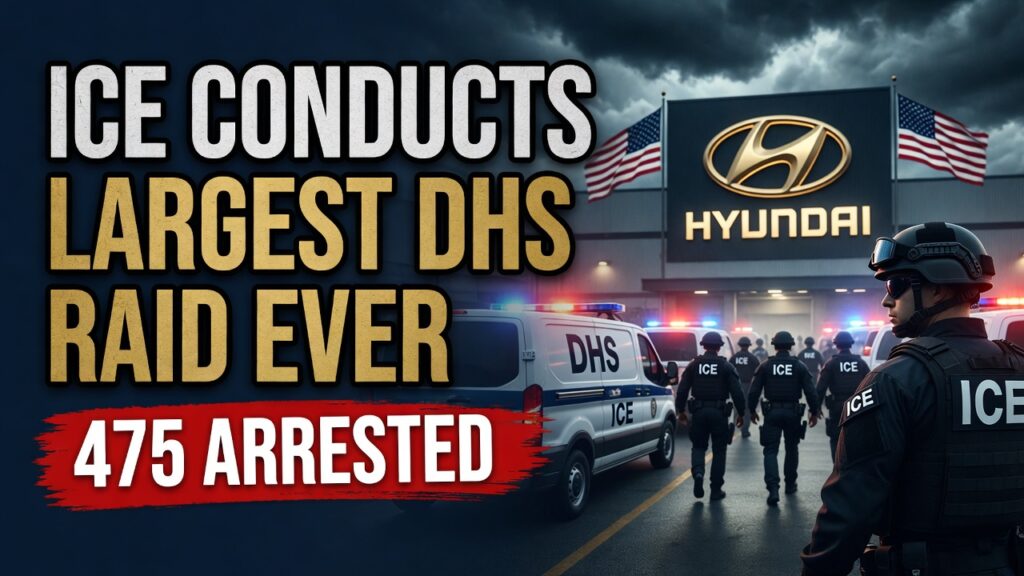
Federal agents descended on a Hyundai battery plant in rural Georgia, arresting 475 workers in what officials called the single largest worksite enforcement operation in the history of the Department of Homeland Security. The question now isn’t just who violated the law — it’s who enabled them to do it.
On the morning of September 4, 2025, hundreds of federal and state law enforcement officers flooded a 3,000-acre construction site in Ellabell, Georgia, thirty miles west of Savannah. What they found, officials say, was a workforce operating in systematic violation of U.S. immigration law — embedded inside one of the most high-profile foreign manufacturing investments on American soil.
The raid isn’t just a headline. It is a case study in what happens when corporations treat immigration compliance as optional — and what happens when the federal government decides to stop looking the other way.
Support Independent Local Journalism
TheTownHall.News is a non-profit reader-supported journalism. Just $5 helps us hire local reporters, investigate important issues, and hold public officials accountable across Alameda County. If you believe our community deserves strong, independent journalism, please consider donating $5 today to support our work.What Actually Happened at the Hyundai Plant?
Federal authorities raided the Hyundai facility as part of an ongoing criminal investigation into allegations of unlawful employment practices and other serious federal crimes, according to a statement from the Department of Homeland Security. The raid was authorized by a judge-issued search warrant following a monthslong investigation of the facility. ABC News
The operation was described by Homeland Security Investigations Special Agent in Charge Steve Schrank as the largest enforcement operation at a single site in the history of Homeland Security Investigations, a unit of U.S. Immigration and Customs Enforcement. Schrank said those detained had either entered the country illegally or had overstayed or violated visa terms. CBS News
The operation involved law enforcement agents from multiple federal agencies, including ICE, Border Patrol, the FBI, the Drug Enforcement Administration, the IRS and the Bureau of Alcohol, Tobacco, Firearms and Explosives — underscoring the government-wide nature of the enforcement action. CBS News
475 workers arrested in a single day. The question every American should be asking: how long had this been going on?

Who Were the Workers — and What Were They Doing There?
Roughly 300 of the 475 arrested were South Korean nationals. ICE alleged that many had either overstayed their visa waiver permits — known as ESTAs, which allow business visits of up to 90 days — or were holding B-1 business visas that did not permit them to perform manual labor. Democracy Now!CBS News
None of the Korean nationals worked directly for Hyundai. About 50 of them worked for LG Energy Solutions, while another 250 were employed by HL-GA Battery Company LLC, a joint venture entity operating under Hyundai and LG. CNN
The contractor model is important. By routing foreign laborers through subsidiary entities and subcontractors, the parent companies maintained a legal distance from the workforce actually building their facility. Hyundai said in a statement that it was committed to full compliance with all laws and that none of those detained was directly employed by Hyundai Motor Company — adding that it expects the same commitment from all its partners, suppliers, contractors, and subcontractors. CBS News
That disclaimer rings hollow when over 400 workers on your construction site are arrested in a single morning.
Is This What “Foreign Investment” in America Actually Looks Like?
If a foreign company can import hundreds of workers on tourist visas to build a billion-dollar factory on American soil, the entire legal immigration system is being treated as a suggestion — not a law.
The facility is a joint venture between Hyundai Motor and LG Energy Solution, representing a $4.3 billion investment, and is part of a 3,000-acre megasite that together employs about 1,200 people and was described as the largest industrial project in Georgia’s history. The promise was clear: jobs for Georgians, economic development for a region with a small and tight labor market. With local unemployment at just 2.9 percent and a metro population of only 400,000, Savannah may be unable to fill those positions — a practical challenge that experts acknowledged even before the raid. WikipediaCarnegie Endowment for International Peace
Support Independent Local Journalism
TheTownHall.News is a non-profit reader-supported journalism. Just $5 helps us hire local reporters, investigate important issues, and hold public officials accountable across Alameda County. If you believe our community deserves strong, independent journalism, please consider donating $5 today to support our work.That workforce reality doesn’t excuse legal violations. It explains why companies seek workarounds — and why those workarounds demand enforcement, not accommodation.
What Do Supporters of This Enforcement Actually Believe?
The administration’s defenders — and there are many — argue that worksite enforcement is exactly what immigration law requires. Schrank said the operation underscores the administration’s commitment to protecting jobs for Georgians and Americans, ensuring a level playing field for businesses that comply with the law, and safeguarding the integrity of the economy. CBS News
If a company can undercut American construction workers by importing visa-waiver labor to do the same job for less, that’s not free trade — that’s a rigged game.
The rule-of-law argument is simple: visa categories exist for a reason. A business visitor on a 90-day travel permit is not supposed to install battery manufacturing equipment. A tourist visa is not a construction permit. When companies allow or encourage that kind of misuse — through contractors, subcontractors, or willful ignorance — they are benefiting from the violation whether or not their name appears on the payroll.
What Do Critics of the Raid Believe?
It would be dishonest to ignore the complications this operation raised. A leaked document obtained by The Guardian showed that at least one detained worker held a valid B-1/B-2 visa and had not violated it, despite initial DHS statements to the contrary. That worker was ultimately offered voluntary departure. One immigration attorney alleged that ICE agents arrested workers who had not abused their visas and were eligible for the type of work for which they had been admitted. WikipediaBattery Technology
South Korea also announced an investigation into whether detained workers were read their rights during the arrest and reported that ICE agents made inappropriate remarks mocking North Korea during the operation. Wikipedia
These are legitimate concerns. Enforcement that sweeps in compliant workers alongside violators undermines the credibility of the operation — and gives critics ammunition to dismiss the entire effort. Precision matters. The goal of worksite enforcement is accountability, not spectacle.
What Are the Diplomatic and Economic Consequences?
The fallout extended well beyond Bryan County, Georgia. South Korean President Lee Jae Myung issued a stark warning: “As things stand now, our businesses will hesitate to make direct investments in the United States.” That is not an idle threat. South Korea had pledged $350 billion for investments in U.S. projects in July 2025 as part of a broader tariff deal. MS NOWWikipedia
$350 billion. The question every trade official in Washington should be answering: is one enforcement operation worth a generational realignment of allied investment?
Several South Korean firms pulled or prolonged a pause on investment in U.S. projects following the raid. Hyundai CEO José Muñoz confirmed the disruption would delay the battery plant’s opening by at least two to three months, a facility set to produce batteries for up to 500,000 hybrid and electric vehicles annually. The Washington PostBattery Technology
The Trump administration moved to limit the fallout, with top diplomat Christopher Landau expressing regret over the raid in meetings with South Korean counterparts and promising that detained workers would face no disadvantages upon reentry. Washington also agreed to establish a new visa working group with South Korea.
Is There a Legal Path That Works for Everyone?
Despite the controversy, Hyundai confirmed it would move forward with a $2.7 billion expansion of its Georgia plant, pledging to increase production capacity and create 3,000 new jobs. That’s an important signal. The investment wasn’t abandoned. The law was enforced. The relationship survived — barely. WAFB
The lesson from Ellabell isn’t that foreign companies shouldn’t invest in America. It’s that the legal infrastructure for bringing specialized workers into U.S. construction projects is broken, and corporations have been exploiting that gap for years. Washington has agreed to explore a separate visa working group for South Korean workers — a constructive step toward creating legal channels that don’t require companies to misuse tourist and business visas to staff major facilities.
The companies knew. The contractors knew. The question is whether Washington, for years before this raid, knew too — and chose not to look.
KEY QUESTIONS
- Who at Hyundai, LG, or their subcontractors signed off on bringing hundreds of workers to a U.S. construction site on tourist visas — and will any of them face charges?
- If the search warrant named only four individuals, what legal authority justified detaining 475 workers — including at least one confirmed to have had valid documentation?
- Will the new U.S.-South Korea visa working group create genuine legal pathways for skilled foreign workers, or serve as a diplomatic fig leaf that lets companies continue to game the system?
What Happens If No One Is Held Accountable at the Corporate Level?
Two months after the largest worksite raid in DHS history, no criminal charges have been filed against any employer, contractor, or corporate executive. The workers — most of them — went home. The plant is being rebuilt. The investment is continuing. Legal experts note that potential areas of inquiry include visa fraud or misrepresentation at the consular stage and conspiracy liability for contractors, subcontractors, or joint venture partners — but so far, the enforcement consequences have landed entirely on the workers themselves. Ballard Spahr
That asymmetry is the oldest story in American labor history. The people who actually profit from illegal labor arrangements rarely face consequences. The people doing the work bear all the risk. If the administration’s goal is genuine rule-of-law enforcement — not just headline-generating arrests — the next step has to involve the boardrooms, not just the construction site.
The real question isn’t whether 475 workers violated their visa terms. The question is who built the system that put them there — and whether anyone with a corner office will ever answer for it.
Still have questions? Stay informed — subscribe to The Town Hall News for daily accountability coverage.
Think others need to hear this? Share the article and tell us: should employers face criminal charges when their contractors hire unauthorized workers?
Want to make your voice count? Contact your U.S. representative and ask where the corporate accountability piece of this investigation stands: house.gov/representatives/find-your-representative