Alzheimer’s Nanoparticle Treatment Reverses Disease in Mice — What It Means for a Cure
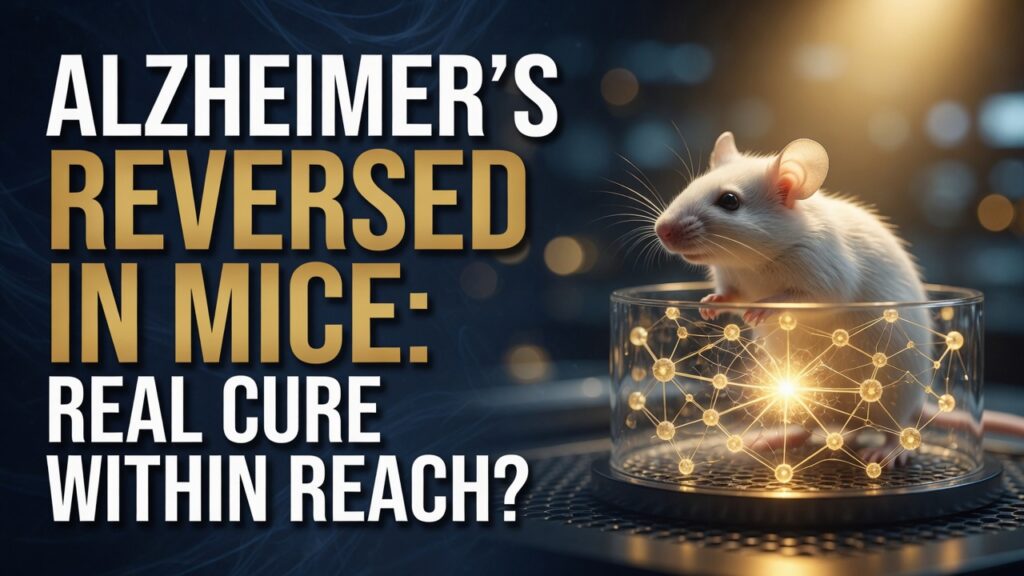
A landmark nanoparticle study has done what decades of failed drug trials could not — restore cognitive function in Alzheimer’s mice. Now every patient’s family is asking the same question: how long before this reaches people?
A new breakthrough in nanotechnology may have just rewritten the opening chapter of the most expensive disease in American history. In findings published in the peer-reviewed journal Signal Transduction and Targeted Therapy, an international research team demonstrated that specially engineered nanoparticles could reverse Alzheimer’s disease in mouse models — not slow it, not manage it, but reverse it — by restoring the brain’s own natural waste-clearance system.
This matters right now because the disease is not waiting. An estimated 7.4 million Americans age 65 and older are living with Alzheimer’s in 2026. The total economic burden of Alzheimer’s disease and related dementias in the United States reached $781 billion in 2025, a figure that includes direct care costs, unpaid family labor, lost wages, and the immeasurable collapse in quality of life. Against that backdrop, a study that achieves what no approved drug has ever achieved — cognitive reversal — commands serious attention. Alzheimer’s AssociationUSC Schaeffer
Support Independent Local Journalism
TheTownHall.News is a non-profit reader-supported journalism. Just $5 helps us hire local reporters, investigate important issues, and hold public officials accountable across Alameda County. If you believe our community deserves strong, independent journalism, please consider donating $5 today to support our work.How Did Scientists Actually Pull This Off?
Unlike traditional nanomedicine, which relies on nanoparticles as carriers for therapeutic molecules, this approach employs nanoparticles that are bioactive in their own right — “supramolecular drugs.” The distinction is significant. These are not delivery vehicles. They are the medicine itself. EurekAlert!
In Alzheimer’s disease, the main “waste” protein is amyloid-β (Aβ), whose accumulation impairs the normal functioning of neurons. Researchers used mouse models that are genetically programmed to produce larger amounts of Aβ protein and develop a significant cognitive decline mimicking Alzheimer’s pathology. They administered only three doses of the supramolecular drugs and afterward regularly monitored the evolution of the disease. MedicalXpress
The nanoparticles work by mimicking a receptor called LRP1 — the brain’s molecular gatekeeper. By mimicking the ligands of LRP1, they can bind to Aβ, cross the blood–brain barrier, and initiate the process of removing toxic species from the brain. In doing so, they help restore the vasculature’s natural role as a waste-clearing pathway and bring it back to proper function. Ibecbarcelona
The results were swift and dramatic.

What Did the Numbers Actually Show?
“Only one hour after the injection we observed a reduction of 50 to 60 percent in Aβ amount inside the brain,” explained Junyang Chen, first co-author of the study, researcher at the West China Hospital of Sichuan University and PhD student at University College London. Ibecbarcelona
50 to 60 percent. In one hour. The question that should keep neurologists awake at night: why has nothing else come close?
If a three-dose nanoparticle treatment can restore a mouse’s cognitive function to match that of a healthy animal, what does it say about every expensive, modestly effective drug approved before it? The contrast is not subtle. Current FDA-approved amyloid-targeting therapies slow decline at the margins. This approach reversed it.
Lead researcher Giuseppe Battaglia, ICREA Research Professor at the Institute for Bioengineering of Catalonia, explained the long-term effect: “When toxic species such as amyloid-beta accumulate, disease progresses. But once the vasculature is able to function again, it starts clearing Aβ and other harmful molecules, allowing the whole system to recover its balance. What’s remarkable is that our nanoparticles act as a drug and seem to activate a feedback mechanism that brings this clearance pathway back to normal levels.” Genengnews
“Our study demonstrated remarkable efficacy in achieving rapid Aβ clearance, restoring healthy function in the blood–brain barrier and leading to a striking reversal of Alzheimer’s pathology.” — Lorena Ruiz Perez, researcher, Institute for Bioengineering of Catalonia
Is This the Accountability Moment American Medicine Has Been Waiting For?
There is a fiscal dimension to this story that goes beyond the laboratory. More than two-thirds of the total cost of dementia care is paid for by Medicare ($106 billion) and Medicaid ($58 billion). These are taxpayer dollars — and they are funding an ever-expanding system of care management with no cure in sight. Every American who pays taxes, and every family rationing retirement savings around a parent’s memory care bill, has a direct stake in whether research like this receives the urgency it deserves. USC Schaeffer
Support Independent Local Journalism
TheTownHall.News is a non-profit reader-supported journalism. Just $5 helps us hire local reporters, investigate important issues, and hold public officials accountable across Alameda County. If you believe our community deserves strong, independent journalism, please consider donating $5 today to support our work.$781 billion. That is America’s annual dementia bill. The question Washington rarely asks: what would it cost to fund the research that eliminates it?
A generation of Alzheimer’s patients and their families didn’t fail themselves — the medical system failed to produce a cure, and taxpayers have been absorbing the cost ever since. The nanoparticle breakthrough is a reminder that the answers may exist, but they require investment, regulatory speed, and scientific courage to reach patients before it’s too late.
What Do Supporters of Existing Treatments Actually Believe?
Advocates of the current treatment landscape make a fair point: the pipeline for Alzheimer’s drugs has never been more active. Currently, there are 138 drugs being assessed in 182 clinical trials in the Alzheimer’s disease pipeline. Drugs like lecanemab (Leqembi) represent genuine progress — they target amyloid plaques, slow cognitive decline in early-stage patients, and offer families something they previously had none of: time. PubMed Central
Proponents also argue that mouse studies frequently fail to translate to human patients, and that enthusiasm should be tempered by the graveyard of promising preclinical results that never survived Phase 3 trials.
These are legitimate cautions. The history of Alzheimer’s research is littered with treatments that worked in mice and failed in people. The blood-brain barrier is far more complex in humans. Dosage, immune response, and long-term toxicity all require rigorous testing before any nanoparticle therapy reaches a clinic.
The responsible position, however, is not to dismiss the result — it is to fund its translation aggressively. As of early 2026, there are still no clinical trials of nanoparticles for the treatment of Alzheimer’s disease. That gap between a compelling preclinical result and a human trial is where promising science often dies. The question is whether regulators, policymakers, and research funders will treat this finding with the urgency the epidemic demands. PubMed Central
Why Are So Many Families Asking What Comes Next?
The human stakes are not abstract. Nearly 13 million Americans provide unpaid care for people with Alzheimer’s or other dementias. In 2025, unpaid caregivers provided more than 19 billion hours of care valued at more than $446 billion. These are adult children who left careers. Spouses who became full-time nurses. Parents who watched a parent disappear. Alzheimer’s Association
What obligation does a society have to the 13 million Americans quietly absorbing the caregiving burden that no drug has yet relieved? The nanoparticle study doesn’t answer that question. But it changes the terms of the debate.
The research team at IBEC has also extended the concept further, developing a companion system that pairs smart nanoparticles with biosensors capable of monitoring chemical changes in real time and flagging disease indicators before symptoms emerge. That early-warning capability — feeding data into an AI network to predict molecular disease patterns — could transform Alzheimer’s from a late-diagnosed catastrophe into a manageable, anticipatable condition. The potential is substantial. What’s needed now is the will to pursue it.
Key Questions This Story Raises
- Will regulatory agencies fast-track nanoparticle Alzheimer’s treatments into human trials, or will promising science spend years in bureaucratic limbo while millions lose cognitive function?
- Who decides how federal Alzheimer’s research dollars are allocated — and are the criteria serving patients or institutional inertia?
- If a three-dose treatment can reverse Alzheimer’s in an animal model, what does that demand of pharmaceutical companies, the NIH, and Congress in terms of accelerated investment?
The nanoparticle study does not promise a cure. It does something more important: it proves the mechanism works. The brain’s waste-clearance system is not permanently broken. It can be reactivated. What remains is the harder work of taking that proof from a Barcelona laboratory to the clinic floors where 7.4 million Americans — and their families — are waiting.
The real question isn’t whether a nanoparticle cure for Alzheimer’s is possible. It’s whether the institutions responsible for getting it there are moving fast enough to matter.
Think this story deserves wider attention? Share it. Still have questions about Alzheimer’s research? Subscribe to The Town Hall News for daily coverage of the science and policy decisions that affect your family. Want to push for faster NIH funding? Contact your representative at congress.gov and make your voice count.