Maine ICE Shooting: Self-Defense Or Media Rush to Judgment?
As Biddeford, Maine reels from a fatal encounter between federal agents and a local resident, a familiar pattern is emerging: outrage first, facts later. Who gets to decide what happened before the investigation is even finished?
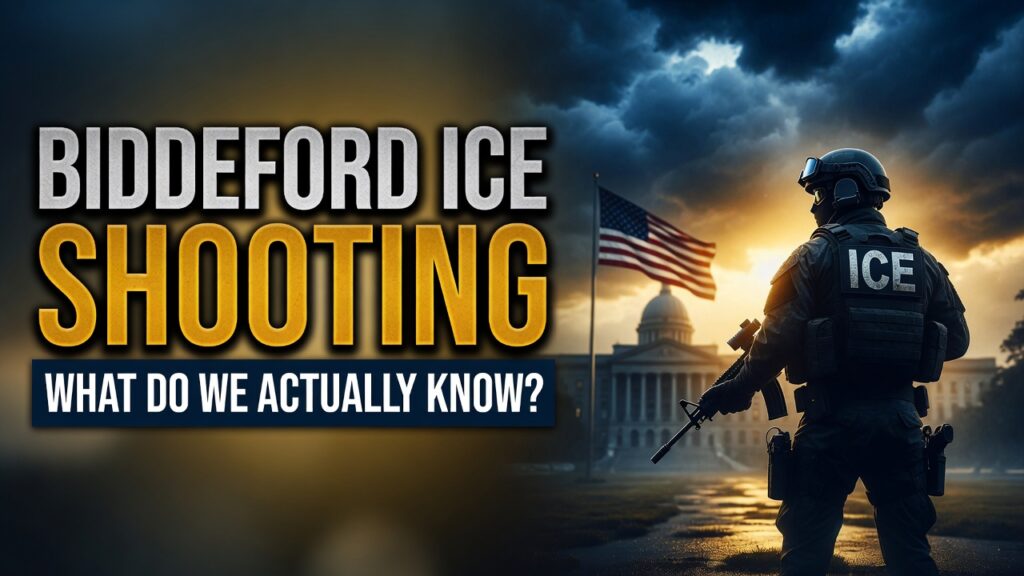
A man is dead in Biddeford. That much is confirmed. Everything else is still being sorted out — and that gap between confirmed fact and viral assumption is exactly where this story matters most right now, coming just six days after a nearly identical dispute over an ICE shooting in Houston.
What Actually Happened in Biddeford?
Here’s what’s solid. Maine House Speaker Ryan Fecteau confirmed Monday morning that a shooting occurred in Biddeford involving ICE personnel, and that one person was killed. State Police, the Department of Public Safety, and reportedly the FBI are investigating. Biddeford police responded to the scene but referred all questions to ICE, which had not released its own formal account of this specific incident as of Monday afternoon.
Support Independent Local Journalism
TheTownHall.News is a non-profit reader-supported journalism. Just $5 helps us hire local reporters, investigate important issues, and hold public officials accountable across Alameda County. If you believe our community deserves strong, independent journalism, please consider donating $5 today to support our work.Federal officials have not yet detailed what led to the shooting. Local reporting describes a chaotic scene: one resident says he heard sounds “like firecrackers” and saw an SUV collide with a smaller car more than once. None of that has been independently verified by investigators, and it shouldn’t be treated as settled fact — in either direction.
Why Is Everyone Comparing This to Houston?
Because the pattern is impossible to ignore. Six days earlier, an ICE agent in Houston fatally shot Lorenzo Salgado Araujo during a stop, after ICE said Araujo rammed an agency vehicle and tried to run over an officer. If federal agents are truly facing repeated attempts to run them down, shouldn’t that alarm every American who believes in law and order?
That question deserves a straight answer — but so does the one raised by witnesses in the Houston case, three of whom have disputed ICE’s version of events, according to their attorney. ICE has not released video or other evidence to support its account in either incident. That’s not proof the agency is wrong. It’s proof the public deserves more than a press release before drawing conclusions.
Are Politicians Judging This Before the Facts Are In?
Some already have. Rep. Chellie Pingree, who represents Biddeford, said she was “deeply disturbed and angry” and demanded to know why ICE agents were operating in Maine at all — before investigators had released a single confirmed detail about what triggered the shooting. That’s a legitimate question about federal enforcement priorities. It is not, on its own, evidence of wrongdoing by the agent involved.

This is the tension running through the entire story. Local leaders are entitled to ask hard questions about immigration enforcement in their communities. But an agent’s split-second decision to use force — in a moment authorities describe as an attempt to run him down — deserves the same presumption of good faith we’d expect for any officer defending his life, until facts prove otherwise.
What Do the Numbers Actually Tell Us?
70 arrests a day. [Reuters, citing internal ICE data] That’s the pace of ICE arrests in Maine as of early July — more than four times the rate from just a month earlier. The question no one in Augusta or Washington wants to answer plainly: was this surge properly coordinated with local law enforcement, or did it create the exact kind of high-tension encounter that ended in Biddeford?
That’s a fair accountability question regardless of your politics. Rapid increases in federal enforcement activity, without matching increases in transparency — body cameras, for instance, which were reportedly absent from the agents involved Monday — are the kind of policy choice that deserves scrutiny before, not after, someone dies.
“Why are you in Maine?” — the question a sitting congresswoman posed publicly, before the facts of the shooting were even known.
That’s a striking line. It’s also a reminder that outrage travels faster than evidence — and once released into a viral news cycle, it’s almost impossible to walk back even if the facts later complicate the narrative.
What Do Supporters of ICE’s Enforcement Approach Actually Believe?
Supporters of aggressive interior immigration enforcement make a specific, defensible argument: agents are enforcing laws passed by Congress, often in unpredictable field conditions where a vehicle can become a weapon in seconds. They point to the Houston case and now Biddeford as evidence that agents face real physical danger, and that split-second self-defense decisions shouldn’t be second-guessed by politicians or pundits who weren’t there.
Support Independent Local Journalism
TheTownHall.News is a non-profit reader-supported journalism. Just $5 helps us hire local reporters, investigate important issues, and hold public officials accountable across Alameda County. If you believe our community deserves strong, independent journalism, please consider donating $5 today to support our work.That argument has real merit — agents genuinely do face risk during enforcement stops, and the job doesn’t pause for a news cycle. But it doesn’t answer the transparency gap. If ICE’s use-of-force accounts are accurate, releasing available evidence — body camera footage, dashcam video, timestamps — would settle the dispute quickly and protect the agents themselves from unfounded accusations. The absence of that evidence, twice in six days, is itself becoming part of the story.
Key Questions This Story Raises
- Will investigators release evidence — footage, forensics, timestamps — before public opinion hardens around a narrative?
- Did the pace of ICE’s enforcement surge in Maine outstrip its coordination with local police and its own equipment standards, like body cameras?
- Are political leaders reacting to confirmed facts, or to the emotional shockwave of a death in their district?
Is This the Accountability Moment We’ve Been Waiting For?
Not yet — and that’s the point. Real accountability requires real facts, not the fastest tweet. A community is grieving a death it doesn’t yet fully understand — and that should make everyone slower to conclude, not faster. Whether this shooting proves to be a justified use of force or a tragic overreach, the answer will come from evidence, not from who posted first.
What’s clear already is that both federal enforcement agencies and the officials scrutinizing them owe Biddeford — and the rest of the country — a transparent, evidence-based accounting. If the roles were reversed and it was federal agents demanding answers from a private citizen, would “trust us” ever be an acceptable response?
The real question isn’t whether ICE acted in self-defense or overstepped — it’s whether we’re willing to wait for proof before deciding which one is true.
Still have questions? Stay informed — subscribe for daily coverage as this investigation develops. Think others need to see this reasoning before the narrative hardens? Share the article. Want your voice heard on how ICE enforcement is conducted in your community? Contact your congressional representative’s office directly and ask them to request the release of any body camera or dashcam footage from both the Biddeford and Houston incidents.