North Carolina Bodycam Footage Law: What the Nikac Case Means
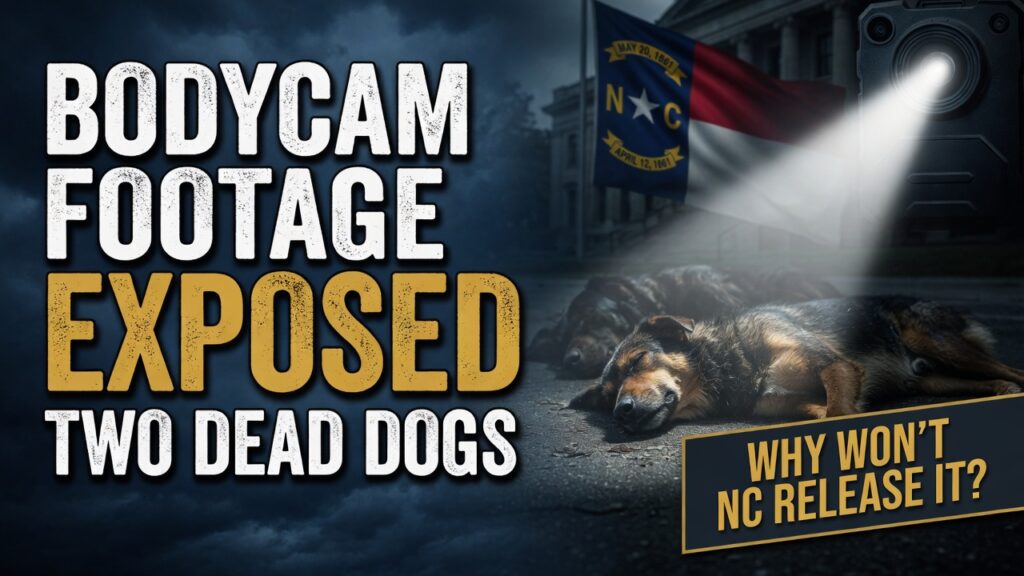
As a First Amendment case unfolds in the North Carolina Court of Appeals, one family is asking a question that applies to every citizen who’s ever faced a police officer: who gets to decide what the public sees?
North Carolina’s second-highest court is deciding whether a trial judge violated a dog trainer’s First Amendment rights by blocking her from sharing law enforcement bodycam footage. The case, Nikac v. Pitt County Sheriff, stems from an October 2024 incident in Washington, North Carolina, in which a state trooper fatally shot two dogs after their owner had already detained a car break-in suspect.
Lydia Nikac, who runs a dog training business, caught a man breaking into her car outside her home. She detained him with the help of her two trained Belgian Malinois, Bonnie and Clyde, and called 911. When a North Carolina State Highway Patrol trooper arrived alone and approached the property, Nikac asked him to keep his distance while she controlled her dogs. He did not. Moments later, both dogs were dead.
Support Independent Local Journalism
TheTownHall.News is a non-profit reader-supported journalism. Just $5 helps us hire local reporters, investigate important issues, and hold public officials accountable across Alameda County. If you believe our community deserves strong, independent journalism, please consider donating $5 today to support our work.Highway Patrol has said the trooper had the legal right to defend himself and felt shooting was his only option to protect himself from the dogs. The suspect Nikac detained, Kevin Toler, was arrested and charged with felony breaking and entering into a motor vehicle, attempted breaking or entering, and misdemeanor assault on a female — charges that remain pending in court.
That single, disputed decision by one trooper is not what is now before the North Carolina Court of Appeals. The appeal is about something bigger: whether a government agency can control what a citizen is allowed to say about her own encounter with the state.
Eighteen days after her dogs were killed, Nikac filed a petition demanding access to the trooper’s dashcam and bodycam recordings, along with footage from Pitt County deputies who responded afterward. In February 2025, Superior Court Judge Matthew Houston ordered the footage released to Nikac and her attorney, but only for use in preparing legal proceedings. He barred her from sharing it with anyone else, including the public.
Nikac appealed, arguing that Houston’s order amounts to a prior restraint on her speech. Her attorney, John Kirby, told the Court of Appeals that the First Amendment protects more than the right to talk — it protects the right to publish, post and share recordings and images. Kirby argued the trial court never explained, beyond reciting the statute, why Nikac’s speech needed to be restricted at all.

Should Citizens Have to Ask Permission to Speak?
That is the real question sitting underneath this case. North Carolina law treats police bodycam and dashcam recordings as confidential government records by default. A citizen who wants access — even footage of an encounter that happened on her own property — must petition a judge and accept whatever conditions the court imposes.
State attorneys defending the Highway Patrol argue the law gives judges wide latitude here. Confidential law enforcement recordings, they say, do not automatically become public property just because a citizen was involved in the incident. During oral arguments, the three-judge appellate panel appeared skeptical of Nikac’s position, noting that Houston’s order gave her exactly what her original petition requested: access for legal purposes.
That framing cuts to the center of the dispute. Nikac’s team says she is now being punished for not anticipating, back when she first filed for access, that she would also want to speak publicly about what happened to her dogs. Government agencies, meanwhile, are left holding broad discretion over whether footage of their own employees’ conduct ever reaches the public at all.
Who Actually Controls the Record of a Police Encounter?
Bodycams were sold to the public a decade ago as accountability tools: a neutral record of what happens when armed government agents interact with citizens. That promise only holds if citizens can eventually see the footage. When access depends on a judge’s discretion, the accountability tool becomes closer to an agency’s private archive.
This is not a partisan question. A citizen’s right to document and publicize her own dealings with government employees is a free speech principle that predates any single administration or party. It applies whether the footage would embarrass an agency or vindicate it.
Support Independent Local Journalism
TheTownHall.News is a non-profit reader-supported journalism. Just $5 helps us hire local reporters, investigate important issues, and hold public officials accountable across Alameda County. If you believe our community deserves strong, independent journalism, please consider donating $5 today to support our work.$23.2 million. That is what the Justice Department awarded in 2015 to launch the first nationwide push to equip police departments with body cameras. [DOJ Office of Public Affairs] The question few lawmakers want to answer a decade later: what good is a camera if the public can be blocked from ever seeing what it recorded?
“Under the First Amendment, speech is not just my ability to stand here and talk to you. Speech includes the right to publish and post videos and recordings and pictures.”
That argument, made by Nikac’s attorney before the Court of Appeals, is the crux of the case. If a citizen cannot legally publish footage of her own encounter with a police officer, how meaningful is her right to criticize that officer’s conduct at all?
Why Does This Case Matter Beyond One North Carolina Family?
If the government can decide who gets to see footage of its own employees at work, how accountable can it really be?
North Carolina’s public records statute on law enforcement recordings gives judges broad discretion to limit release, even to the person the footage is about. That discretion exists to protect ongoing investigations and third-party privacy. It was not designed, Nikac’s team argues, to let an agency shield its own employees from scrutiny simply because releasing footage might prove embarrassing.
A government agency should never get to grade its own homework on whether the public deserves to see how it operates.
Every citizen who has ever called 911, filed a police report, or had a run-in with a trooper has a stake in how this case resolves. If courts default to withholding footage from the people it depicts, transparency laws exist on paper only.
What Do Supporters of Confidentiality Rules Actually Believe?
Supporters of keeping law enforcement recordings tightly controlled make a reasonable argument. Bodycam footage often captures third parties, minors, and details of ongoing criminal investigations that have nothing to do with the person requesting access. Releasing that footage without limits could compromise prosecutions or violate the privacy of bystanders who never consented to being filmed.
State attorneys representing the Highway Patrol made exactly this case to the Court of Appeals, arguing confidentiality statutes exist so judges can weigh those competing interests case by case rather than releasing everything by default.
That concern is legitimate, and the statute does allow judges to redact footage or limit its use to protect third parties and active cases. But Nikac’s case does not involve a third party’s privacy or an ongoing investigation into the trooper’s conduct. It involves a citizen who wants to discuss her own encounter, on her own property, resulting in the deaths of her own dogs. The narrower question is whether a blanket restriction on public release, absent any specific finding of harm, goes further than the statute was written to allow.
Key Questions This Case Raises
- Does a citizen’s right to discuss her own encounter with police outweigh a state agency’s interest in controlling that footage?
- Should judges be required to explain specific harms before restricting a citizen’s ability to share footage of her own case?
- If this ruling favors the state, what precedent does it set for the next North Carolina resident who wants the public to see what happened to them?
Is This the Accountability Moment Transparency Advocates Have Been Waiting For?
The Court of Appeals has not yet issued a ruling. Whatever the three-judge panel decides will shape how North Carolina’s public records law applies to bodycam footage far beyond this one case. A ruling for Nikac would strengthen the presumption that citizens can speak publicly about their own encounters with law enforcement. A ruling against her would reinforce how much discretion trial judges retain to keep that footage under wraps.
Either outcome deserves scrutiny — not because of how sympathetic Bonnie and Clyde’s story is, but because the underlying principle applies to every resident who has ever wanted the public to see, and judge for itself, what happened when government showed up at their door.
The real question isn’t whether Lydia Nikac gets to tell her story. It’s whether any of us will be allowed to tell ours.
Still have questions about how this case turns out? Stay informed — subscribe for daily coverage of accountability stories like this one. Think your neighbors need to see this? Share the article. Want your voice to count on transparency laws in your state? Contact your North Carolina state legislator and ask where they stand on public access to police bodycam footage.