H-1B Visa Fee Ruling 2026: What Texas Employers Should Know
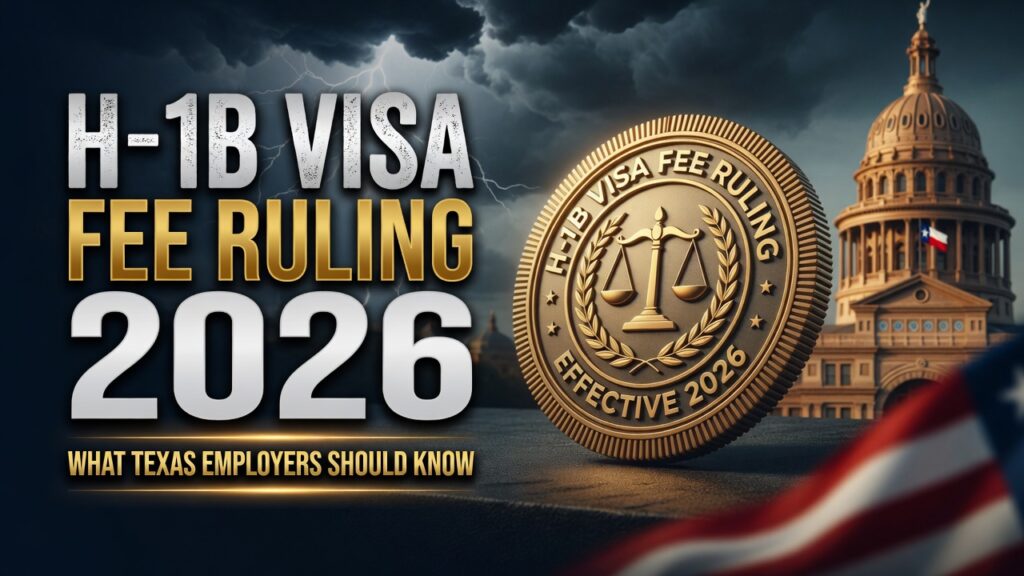
As federal courts issue conflicting rulings on a $100,000 fee for new H-1B petitions, Texas employers and workers are caught in the middle — and millions are asking who actually gets to decide who works in America, and at what price.
Can a president tax a work visa by proclamation? That question is now tearing through federal courts, and nobody agrees on the answer.
The stakes are not abstract. Texas currently ranks second in the nation for both H-1B visa approvals and active H-1B workers, and employers in the Dallas-Fort Worth metroplex alone received approval for 33,455 H-1B visas across fiscal years 2025 and 2026. Whatever happens in the courts over the next few months will directly shape hiring, wages, and housing pressure across North Texas. Daily Signal
Support Independent Local Journalism
TheTownHall.News is a non-profit reader-supported journalism. Just $5 helps us hire local reporters, investigate important issues, and hold public officials accountable across Alameda County. If you believe our community deserves strong, independent journalism, please consider donating $5 today to support our work.What Is the $100,000 H-1B Fee, and Why Does It Exist?
On September 19, 2025, President Trump issued Proclamation 10973, imposing a $100,000 fee on new H-1B visa petitions filed for workers located outside the United States. The fee took effect two days later and applies only to new petitions requiring consular processing abroad — not to renewals, extensions, or workers already inside the country changing status. OgletreeOgletree
The administration said the fee was meant to combat abuse of the H-1B program and protect American workers, particularly in science, technology, engineering, and math fields. Critics called it something else entirely: a backdoor tax dressed up as immigration policy, imposed without a single vote in Congress. Ogletree
If the executive branch can tax a work visa without Congress, what else could it tax by proclamation alone?
Who’s Actually Winning in Court Right Now?
The honest answer: it depends which courtroom you’re standing in. In December 2025, twenty state attorneys general led by California sued, arguing the fee exceeded presidential authority and violated the Administrative Procedure Act. On June 8, 2026, U.S. District Judge Leo Sorokin agreed, ruling the $100,000 charge functioned as an unauthorized tax that only Congress has the constitutional power to impose, and vacated the policy entirely. OgletreeClark Hill

That victory was short-lived. Four days later, the same judge issued an administrative stay of his own ruling after the administration filed an emergency appeal, effectively reinstating the fee while the First Circuit Court of Appeals reviews the case. As of this writing, USCIS remains permitted to collect the fee for qualifying H-1B petitions involving consular processing while that appeal plays out. KlaskolawVorys
Meanwhile, a separate court reached the opposite conclusion. In December 2025, the U.S. District Court for the District of Columbia upheld the fee in a lawsuit brought by the U.S. Chamber of Commerce and the Association of American Universities, ruling the fee fell within authority Congress delegated to the executive branch. That case is now on appeal before the D.C. Circuit, which held oral arguments in March 2026. With two federal circuits pointed in opposite directions, legal observers expect the Supreme Court will ultimately have to settle the question. Immigration Blog + 2
Why Should Texans Care Who Wins This Fight?
Because Texas isn’t a bystander — it’s one of the biggest players on the board. Beyond the DFW numbers, technology and consulting firms dominate H-1B approvals statewide, with companies like Cognizant Technology Solutions and Infosys among the top sponsors. Nationally, Texas ranked second among all states for new H-1B approvals in fiscal year 2025, trailing only California. The Dallas ExpressForbes
State leadership has already taken notice. Governor Greg Abbott ordered a freeze on new H-1B petitions across Texas state agencies and public universities, citing what he described as “recent reports of abuse in the federal H-1B visa program,” with the pause set to continue until the end of the Texas Legislature’s 90th Regular Session on May 31, 2027. Dallas Express
A $100,000 fee sounds like it targets big corporations. Does it actually protect the American workers it was designed to help — or does it just raise the cost of doing business without fixing the underlying problem?
Support Independent Local Journalism
TheTownHall.News is a non-profit reader-supported journalism. Just $5 helps us hire local reporters, investigate important issues, and hold public officials accountable across Alameda County. If you believe our community deserves strong, independent journalism, please consider donating $5 today to support our work.What Do the Numbers Actually Tell Us?
442,000. That’s roughly how many unique beneficiaries employers entered into the H-1B lottery in fiscal year 2025 — for a program capped at 85,000 slots a year. USCIS rejected more than 300,000 H-1B beneficiaries due to that annual limit, a cap that has been exhausted every single year since 2004. Forbes
The question no governor, court, or agency has fully answered: if demand for these visas outstrips supply by more than five to one, is a $100,000 fee actually solving a scarcity problem — or just deciding who can afford to skip the line?
The demographic concentration is just as striking. Roughly 72 percent of H-1B visas nationwide go to workers from India, with about 12 percent going to workers from China — a pattern visible in the visible workforce shifts many Texans have watched unfold in their own communities over the past decade. The Dallas Express
“The question isn’t whether America needs skilled workers. It’s whether the system deciding who gets in is accountable to anyone at all.”
What Do Supporters of This Policy Actually Believe?
Supporters of the fee, largely aligned with the administration, argue the H-1B program has drifted far from its original purpose. They point to companies like Infosys, which agreed in 2013 to pay $34 million to settle federal allegations of systemic visa fraud, and Cognizant, which faced a December 2025 federal ruling finding certain of its policies had a disparate impact on some U.S. workers. In this view, a steep fee filters out employers using the program to undercut American wages rather than fill genuine skill gaps. The Dallas Express
That argument deserves a fair hearing — but it runs into a real complication. Government wage data show H-1B holders in computer occupations earned an average salary of $136,000 in fiscal year 2024, well above the “cheap labor” narrative critics often invoke, and more than half of new H-1B petitions in 2025 went to employers with 15 or fewer approvals total — not the visa-mill giants the policy is aimed at. A blanket $100,000 fee doesn’t distinguish between a Fortune 500 outsourcing firm and a small Texas hospital trying to recruit one specialist. That’s precisely the argument the twenty suing states made in court — and it’s the tension the courts still haven’t resolved. Forbes
Key Questions This Fight Still Raises
- Who has the constitutional authority to tax a visa — the president alone, or Congress?
- Does a flat $100,000 fee actually target visa abuse, or does it just penalize every employer equally, abusers and honest hirers alike?
- What happens to Texas’s tech and healthcare hiring pipeline if this fee becomes permanent — or if it’s struck down for good?
Is This the Accountability Moment Texans Have Been Waiting For?
Whichever side of this fight you’re on, one thing is hard to dispute: for years, immigration policy this consequential has been set by proclamation, agency memo, and settled in courtrooms most Americans never hear about — not by open votes in Congress. That’s now colliding, in real time, with judges willing to say the executive branch overstepped.
The real question isn’t whether the $100,000 fee survives the appeals process. It’s whether Americans will keep watching closely enough to demand that whoever wins this fight — courts, Congress, or the White House — actually answers for the decision.
Still have questions about how this affects Texas jobs and communities? Stay informed — subscribe for daily coverage.
Think your neighbors need to see this? Share the article.
Want your voice heard? Contact your congressional representative and ask where they stand on who should have the authority to set immigration fees — Congress, or the executive branch alone.