Waze Israeli Law Terms Explained: What Drivers Actually Agreed To?
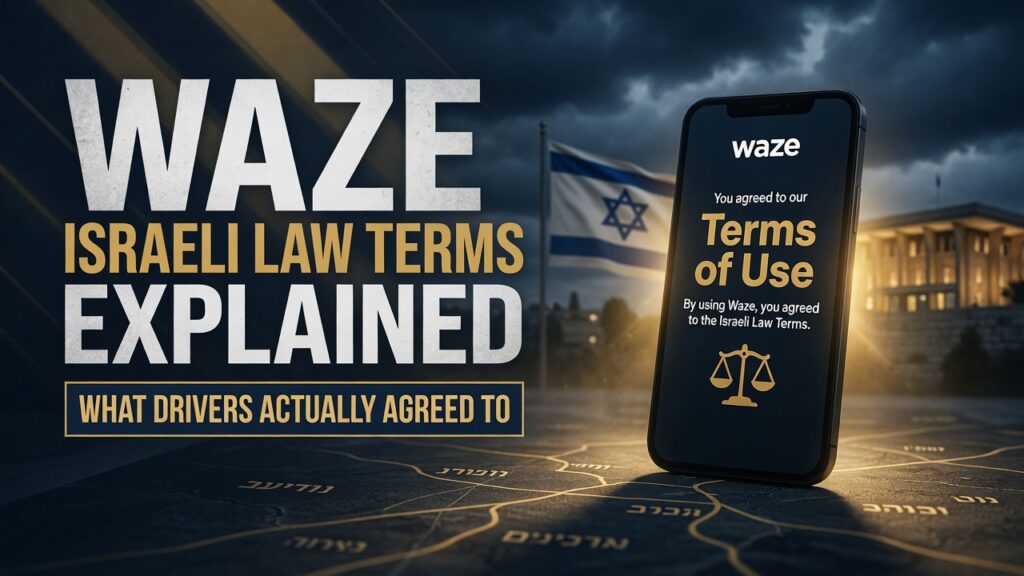
A viral video convinced millions that Waze hands their data to a foreign government. That claim is false — but the truth buried in the fine print raises a harder question: if Google’s navigation app wrongs you, why would you have to fly to Tel Aviv to do anything about it?
Thirty million American drivers signed a contract most of them never read.
That is the real story behind the Waze Israeli law controversy that exploded across TikTok and X this month — and it is not the story the viral videos are telling. On July 8, 2026, Waze updated its Terms of Use and Privacy Policy, and screenshots of the fine print spread within days. The panic version claims Israel now has “data rights” over American users. That claim does not survive contact with the actual document. But what the document does say should concern anyone who believes contracts between corporations and citizens ought to be enforceable by both sides.
What Does the Waze Fine Print Actually Say?
Start with what is verifiably true. Waze’s current Terms of Use identify the service provider as Waze Mobile Ltd., a company incorporated and operating under the laws of Israel, headquartered in Tel Aviv [Waze Terms of Use, posted on Google’s support site]. The terms state that the agreement is governed solely by Israeli law, that any dispute falls under the exclusive jurisdiction of courts in the Tel Aviv district, and that users must file any claim within one year of becoming aware of it — or waive it permanently.
None of that is a hoax. It is publicly posted, in plain English, on Google’s own support pages. And it applies to an app that handles some of the most sensitive data a phone can produce: real-time location, route history, home and work addresses, and voice commands.
If a company can track every mile you drive, shouldn’t you at least be able to sue it in your own country?
Support Independent Local Journalism
TheTownHall.News is a non-profit reader-supported journalism. Just $5 helps us hire local reporters, investigate important issues, and hold public officials accountable across Alameda County. If you believe our community deserves strong, independent journalism, please consider donating $5 today to support our work.Is the Viral Surveillance Claim Actually True?
No — and getting this right matters. The video circulating this month claims the privacy policy proves “Israel has data rights” over your information, and that this only surfaced because U.S. privacy laws “now require transparency.” Neither claim holds up.
A governing-law clause is a contract term, not a surveillance grant. It determines which country’s courts hear disputes and which legal code interprets the agreement. It does not give any government — Israeli or American — a key to your phone. Security analysts reviewing the July update made exactly this point: the policy does not say a foreign agency can watch your commute, and pretending otherwise makes people worse, not better, at protecting themselves.
The “new transparency law” claim fares no worse only because it fares just as badly. Terms-tracking services that monitor the document found the recent changes largely restated and formalized existing boilerplate rather than granting anyone new rights. The Israeli jurisdiction language is not new at all — tech press flagged it as far back as 2013, the year Google bought the company. The viral video also claims Google paid $1.1 billion; contemporaneous reporting put the figure at roughly $1.15 to $1.3 billion [2013 acquisition reporting].
Recycled facts, wrong numbers, invented legal claims. This is how disinformation works: it wraps a real document in a false story, and the correction never travels as far as the panic.
So Why Should Americans Still Be Asking Questions?
Because the accurate story is arguably worse for consumers than the fake one — it just requires reading past the headline.
Consider what suing Waze would actually demand of an ordinary American user. You would litigate in Tel Aviv, because the terms give that district exclusive jurisdiction. You would argue under Israeli law, which means retaining Israeli counsel. You would file within one year — while typical American statutes of limitations for consumer claims run two to six years, depending on the state. And the class action, the one tool that lets consumers with small individual harms band together against a two-trillion-dollar corporation, does not travel with you.
A legal right that costs more to exercise than you could ever recover is not a right. It is decoration.
If Google Maps answers to California courts, why does Waze — owned by the same company, tracking the same drivers — answer only to a courtroom in Tel Aviv?
That double standard is the detail the viral videos missed. Google’s own U.S. Terms of Service designate California law and Santa Clara County venue. Waze, thirteen years after Google acquired it, still routes every dispute overseas. Same parent company. Same American users. Radically different access to justice.
What Do the Numbers Actually Tell Us?
Between 0.05 and 0.22 percent.
That is the share of consumers who ever open the terms and conditions, according to research cited in the Columbia Business Law Review [academic research]. The question practically asks itself: can a “agreement” that fewer than one in four hundred people reads honestly be called consent?
The timing sharpens the stakes. On or around July 1, 2026, the Supreme Court ruled 6–3 in the Chatrie case that geofence warrants — where police compel a company to identify every device near a crime scene — are searches requiring probable cause [Supreme Court ruling, per SCOTUSblog and NBC News coverage]. Google alone received more than 11,500 such warrants in 2020. Chatrie was a genuine win for the Fourth Amendment. But it is also a map of that amendment’s limits: it constrains American police under the American Constitution. It says nothing about location data held by a foreign-incorporated entity under foreign law.
We spent a decade litigating what our own government can do with your location data. Almost no one asked what happens when the data sits beyond American law entirely.

What Do Supporters of These Terms Actually Believe?
The defense deserves a fair hearing, because parts of it are correct. Jurisdiction clauses are standard practice; terms-monitoring services find Tel Aviv-style venue provisions across hundreds of platforms, and thousands of companies worldwide designate a single legal home. Waze’s engineering talent genuinely is in Israel — the app began there as FreeMapIsrael in 2006 before its founders renamed it — and keeping the operating entity where the operations are is ordinary corporate structuring, not a scheme. Google, for its part, publicly states it reviews government data requests, narrows overbroad demands, and provides no backdoor access [Google transparency policy].
All true. And all beside the point. The question is not whether foreign incorporation is legal or common. It is whether a mass-market consumer product — preinstalled in American cars, partnered with American cities — should be able to combine exclusive foreign jurisdiction, a one-year claim bar, and no class-action path for tens of millions of Americans who never read a word of it. “Everyone does it” has never been an argument for whether something is right. It is an argument for how big the problem is.
Key Questions
- Why does Google hold Waze to a different legal standard than Google Maps — and who benefits from the difference?
- If fewer than 1 in 400 users reads the terms, is click-through “consent” meaningful — or is it a legal fiction overdue for reform?
- Should Congress require consumer apps operating at national scale to offer American users an American venue for disputes?
What Happens If No One Speaks Up?
The viral panic will fade, as panics do. Most people who deleted Waze this month will reinstall it by Labor Day. But the fine print will remain — and so will the precedent that a corporation can enjoy full access to the American market while placing itself functionally beyond the reach of American consumers.
This is not an argument against Israel, against Google, or against Waze, which remains a genuinely useful product built by talented engineers. It is an argument for a principle conservatives have defended for generations: contracts require two enforceable sides, and the rule of law means little if exercising your rights costs more than the rights are worth. Limited government does not mean no accountability. It means accountability that actually works — in courts citizens can actually reach.
The real question isn’t whether you’ll keep using the app — it’s whether you’ll keep signing contracts no one expects you to read, enforceable in courts no one expects you to reach.
What do you think — is fine-print jurisdiction a fair trade for a free app, or a loophole overdue for closing? Share this article and let us know.
Still have questions? Subscribe to The Town Hall News for daily accountability coverage. Think others need to hear this? Share it. Want your voice to count? Contact your U.S. representative and ask where they stand on requiring American dispute venues for consumer apps at national scale — the House and Senate Commerce Committees oversee exactly this.