Trump’s Record-Breaking 2026 State of the Union: America First, Accountability Always
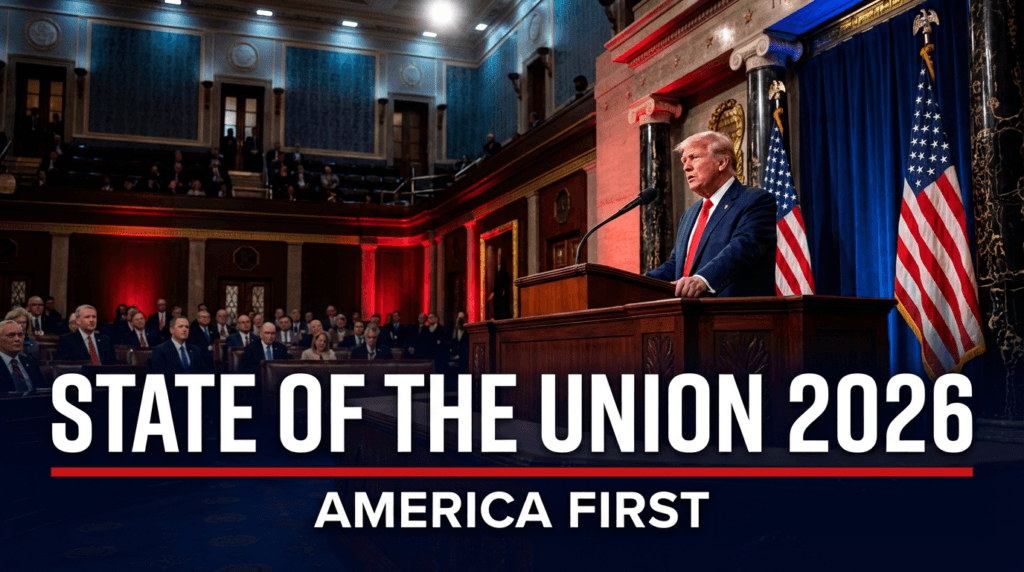
On the evening of February 24, 2026, President Donald Trump stood before a joint session of Congress and delivered the longest State of the Union address in American history — one hour and 48 minutes of unapologetic, America-first leadership. It was not a speech for the faint of heart, and it wasn’t meant to be. It was a declaration: that the era of apology, retreat, and government overreach is over, and that a new chapter defined by strength, accountability, and renewed national pride has begun.
Love him or loathe him, Trump delivered a speech that forced Washington — and the country — to pay attention.
A Roaring Economy: Cutting Through the Noise
The first hour of the address was devoted to the economy, and Trump made no bones about his assessment: America is winning. He cited falling gasoline costs, lower mortgage rates, reduced prescription drug prices, and a rising stock market as evidence that his administration’s policies are working for everyday Americans. “The roaring economy is roaring like never before,” he declared, and for millions of working families who have watched their grocery bills and energy costs begin to stabilize, those words carry real weight.
Support Independent Local Journalism
TheTownHall.News is a non-profit reader-supported journalism. Just $5 helps us hire local reporters, investigate important issues, and hold public officials accountable across Alameda County. If you believe our community deserves strong, independent journalism, please consider donating $5 today to support our work.Critics were quick to point out that an AP-NORC poll in February showed only 39% of Americans approved of his economic handling. But polling captures a snapshot, not a trend. Real economic progress — the kind that flows from deregulation, energy independence, and sound fiscal policy — takes time to reach kitchen tables. What conservatives understand, and what Trump articulated forcefully, is that the path to genuine affordability runs through free markets and limited government intervention, not through more federal spending and more bureaucratic control.
Trump also pointed the finger squarely where it belongs: at the Democratic policies that drove up health care premiums, failed to protect Social Security, and created the affordability crunch that squeezed American families for years. “You caused that problem,” he told Democrats seated before him. It was blunt. It was uncomfortable. And it was largely accurate.
Tariffs, the Supreme Court, and Fiscal Accountability
One of the most striking moments of the evening came when Trump addressed the Supreme Court’s recent 6-3 decision to strike down the bulk of his sweeping tariff program — ruling that the International Emergency Economic Powers Act did not grant him the authority to impose such levies. Trump called the ruling “unfortunate,” a measured response given his earlier, sharper criticism that the justices involved were “an embarrassment to their families.”
To be clear: the judicial branch has a role to play, and its independence must be respected. But the broader debate over tariffs touches on a fundamental conservative principle — that America must not be held hostage to exploitative trade relationships that hollow out domestic manufacturing and ship jobs overseas. Trump announced his administration would impose new 10% global tariffs under the 1974 Trade Act, later raised to 15%, signaling that the fight for fair trade is far from over.

His suggestion that tariff revenues could “substantially replace the modern day system of income tax” is bold and constitutionally complex — the 16th Amendment and Congress’s exclusive role in revenue collection make a full income tax replacement through tariffs a long road. But the underlying instinct — that Americans deserve relief from a tax burden that punishes work and productivity — is one that resonates deeply with conservatives who believe in fiscal restraint and putting more money back in the pockets of working families.
In a genuinely bipartisan moment, Trump also endorsed a ban on congressional stock trading, calling out the insider trading culture that has enriched lawmakers at the expense of the American people. “Let’s ensure that members of Congress cannot corruptly profit from using insider information,” he said. This is the kind of government accountability that crosses party lines — and it’s long overdue.
Confronting Iran: Strength, Diplomacy, and the Red Line
Perhaps the most sobering portion of the evening came when Trump turned to Iran. Speaking plainly and without diplomatic hedging, he laid out what is at stake: a theocratic regime that has, by his account, killed at least 32,000 of its own citizens for protesting, that has funded terrorism and proxy warfare across the Middle East, and that is actively developing ballistic missiles capable of reaching Europe — and soon, potentially, the United States.
“My preference is to solve this problem through diplomacy,” Trump said. “But one thing is certain — I will never allow the world’s number one sponsor of terror to have a nuclear weapon.”
This is not saber-rattling for its own sake. A nuclear-armed Iran represents an existential threat not just to Israel and the broader Middle East, but to the stability of the entire Western world. Trump has already assembled the largest U.S. military presence in the Middle East in decades — a clear signal that American strength is back, and that the era of strategic ambiguity that allowed Iran to advance its nuclear program under previous administrations is over. Conservative foreign policy has always held that peace is best secured through strength. That doctrine is on full display.
Support Independent Local Journalism
TheTownHall.News is a non-profit reader-supported journalism. Just $5 helps us hire local reporters, investigate important issues, and hold public officials accountable across Alameda County. If you believe our community deserves strong, independent journalism, please consider donating $5 today to support our work.Democrats in Disarray — and Defiance
The Democratic response to Trump’s address ranged from stony silence to outright disruption. Rep. Rashida Tlaib shouted “You’re killing Americans” during Trump’s remarks on immigration enforcement. Rep. Al Green was escorted from the chamber — for the second consecutive year — for holding up a protest sign. Several Democrats boycotted the speech entirely.
https://www.instagram.com/reel/DVKp_I0jhfe
This is the opposition party in 2026: no coherent policy alternative, no compelling vision for America’s future, only disruption, grievance, and contempt for the democratic process they claim to champion. Virginia Gov. Abigail Spanberger delivered the Democratic rebuttal, questioning whether Americans truly feel a “golden age” — but offering little in the way of solutions beyond implicit trust in more government.
Meanwhile, Trump honored genuine American heroes: a 100-year-old Navy aviator and Korean War veteran, Capt. Royce Williams, who received the Medal of Honor from First Lady Melania Trump. He recognized National Guard members wounded near the White House. He saluted a Coast Guard swimmer who rescued 164 girls during Texas floods. These are the people who make America great — and they deserved every moment of recognition they received.
Law, Order, and the Integrity of Elections
Trump also revisited the issue of election integrity, calling for Congress to pass a national voter photo ID requirement. “Cheating is rampant in our elections,” he warned. Voter ID is not a suppression tool — it is a basic common-sense safeguard that the vast majority of Americans across party lines support, and that virtually every other functioning democracy in the world already requires. Protecting the integrity of the ballot box is not partisan; it is foundational.
On immigration, Trump reprised his commitment to law and order at the border — even as he avoided dwelling on the most contentious enforcement incidents earlier in the year. The message was clear: the rule of law is not optional, borders exist for a reason, and an America that cannot control who enters its territory cannot remain sovereign.
The Bottom Line: Leadership That Demands Accountability
Trump’s 2026 State of the Union was long, combative, and at times raw. It did not shy away from the fights that define this political moment. And that, frankly, is precisely what the moment demands. A country facing genuine economic pressures, a rising nuclear threat from Iran, activist courts, and a disorganized opposition does not need a president who speaks in careful, focus-grouped platitudes. It needs a president who leads.
Whether you agree with every policy position or not, Tuesday night’s address made one thing unmistakably clear: Donald Trump came to the State of the Union not to manage expectations, but to set an agenda — for America’s economy, its security, its sovereignty, and its soul.
The state of the union, if we have the courage to protect it, is strong.
📣 Stay Informed. Stay Engaged. Stay American.
America’s future is shaped by informed, engaged citizens — people like you. Stay informed. Read widely, question critically, and don’t let the noise of partisan media drown out the facts. Share this article with someone who wants to cut through the spin and understand what Tuesday night really meant. And if you believe in limited government, fiscal accountability, and an America that leads from strength — get involved in your local community, your school board, your precinct. Democracy is not a spectator sport.
The Town Hall — delivering news and opinion that cuts through the noise.