Nancy Guthrie Disappearance Exposes Law Enforcement Failures and Raises Urgent Questions About Protecting the Vulnerable
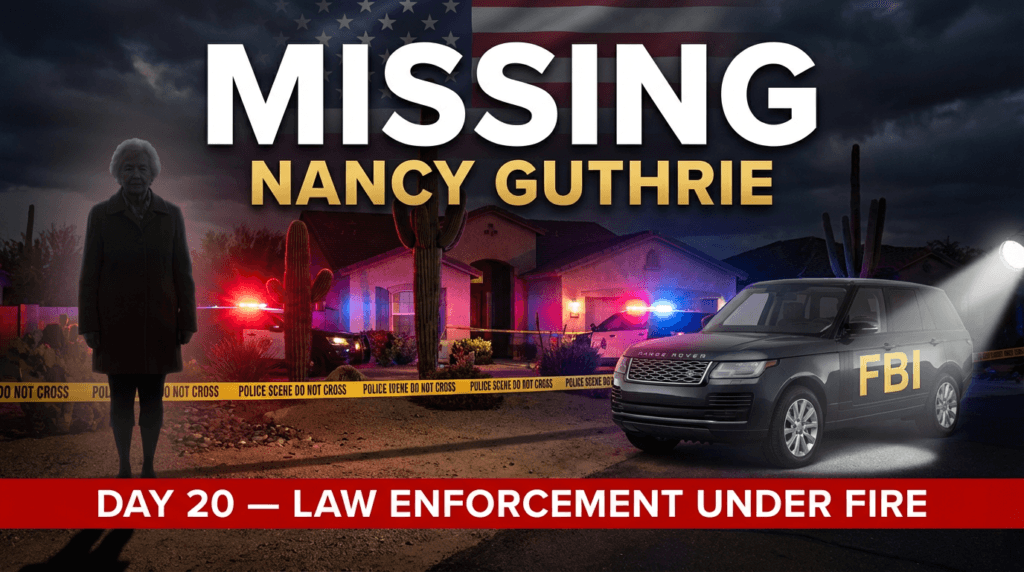
An 84-year-old woman is taken from her home in the dead of night. Her blood is found on the front porch. A masked, armed man is captured on camera. And within 24 hours, the crime scene is released — opened to reporters, delivery drivers, and passersby who walk through the evidence as if it were a public sidewalk.
Twenty days later, Nancy Guthrie is still missing.
The disappearance of Nancy Guthrie — the mother of NBC “Today” show anchor Savannah Guthrie — from her Tucson-area home has gripped the nation. But beyond the heartbreak of a family searching for answers, this case has become a sobering illustration of what happens when institutions entrusted with public safety stumble at the most critical moments. It is a story about law and order, personal accountability, and whether our systems are truly built to protect the most vulnerable among us.
Support Independent Local Journalism
TheTownHall.News is a non-profit reader-supported journalism. Just $5 helps us hire local reporters, investigate important issues, and hold public officials accountable across Alameda County. If you believe our community deserves strong, independent journalism, please consider donating $5 today to support our work.A Methodical Crime Meets a Chaotic Response
The facts, as confirmed by the Pima County Sheriff’s Department and the FBI, paint a chilling picture. Nancy Guthrie was last seen the evening of January 31, 2026, when her son-in-law dropped her off at her home in the Catalina Foothills near Tucson, Arizona. Her garage door closed at approximately 9:50 p.m.
Sometime after midnight on February 1, a masked man approached Guthrie’s front door. Doorbell camera footage — later released by the FBI — shows the suspect carrying a handgun holster and a backpack, attempting to obscure the camera with foliage. By 1:50 a.m., the home’s Nest camera was disconnected. Minutes before 2:30 a.m., Nancy’s pacemaker lost its connection to her phone.
She was reported missing later that day when she failed to appear for her regular church stream with a friend. Deputies found blood on the front porch. By February 2, the story was national news, and a local television station had received a ransom note demanding millions of dollars in Bitcoin — complete with specific details about what Nancy had been wearing.
The Range Rover and the Investigation’s Biggest Leads
On the evening of February 13, the investigation produced what appeared to be a major development. A SWAT operation unfolded roughly two miles from Guthrie’s home, and the FBI and Pima County deputies descended on a Culver’s restaurant parking lot, where they seized a late-model gray Range Rover.

Agents were photographed processing the vehicle’s interior and trunk, at one point unfurling a sheet to shield the trunk’s contents from public view. Three individuals were detained at the scene. The Range Rover was towed under a search warrant, and DNA evidence was sent for analysis. The three detained individuals were later released without charges, and authorities have declined to identify the vehicle’s owner or confirm how it connects to the case.
Separately, DNA recovered from a black glove found two miles from Guthrie’s home — a glove the FBI confirmed appears to match those worn by the suspect on camera — was submitted to the national CODIS database. It returned no match. Investigators are now pursuing genetic genealogy as an alternative avenue.
A System That Failed at the Starting Line
It is the investigative missteps — not just the leads — that have sparked the loudest public outcry.
The Pima County Sheriff’s Department released Guthrie’s home as a crime scene just one day after she was reported missing. What followed was a contamination disaster. Reporters walked to the front door. An Amazon delivery driver wandered onto the property. Blood drops remained visible on the porch — all while the scene sat unguarded.
The crime scene was eventually re-secured so the FBI could conduct its own search, but the damage was done. Sheriff Chris Nanos acknowledged the error: “Monday morning quarterback. Absolutely. I probably could have held off on that.” But acknowledgment is not the same as accountability.
Support Independent Local Journalism
TheTownHall.News is a non-profit reader-supported journalism. Just $5 helps us hire local reporters, investigate important issues, and hold public officials accountable across Alameda County. If you believe our community deserves strong, independent journalism, please consider donating $5 today to support our work.Adam Bercovici, a former supervisor with the LAPD’s special investigations unit, did not mince words. “It is a debacle,” he told the Los Angeles Times. “This kidnapping is one of the worst cases of incompetence I have seen.”
Critics also flagged that the department sent critical evidence to an out-of-state lab — reportedly because the testing was offered for free — rather than utilizing faster options. Nanos was spotted at a college basketball game during a weekend when a ransom deadline was still active. And the initial public handling of ransom communications — openly confirming their existence rather than managing them quietly — may have compromised investigators’ leverage.
These are not partisan observations. They are questions of competence, protocol, and the fundamental expectation that when a citizen’s life hangs in the balance, those in authority will execute their duties with precision.
The Ransom Trail and an Expanding Investigation
The case has also exposed the dark intersection of crime and cryptocurrency. The first ransom note, sent to a local TV station on February 2, demanded roughly $6 million in Bitcoin. On February 11, new activity was detected in the cryptocurrency wallet tied to that note — someone sent approximately 1 Bitcoin (about $70,000) to the address, though it remains unclear who or why.
TMZ later received what it described as a “highly sophisticated” second ransom demand, this one involving a different cryptocurrency and graphic threats. The outlet forwarded it to the FBI. Whether these communications are from the actual abductors — or opportunists exploiting a high-profile tragedy — remains under investigation.
The FBI has fielded between 40,000 and 50,000 calls to its tip lines. The 911 communications center has been so overwhelmed that officials publicly pleaded with people to stop calling with “thoughts and opinions” and to reserve the lines for actionable information. The investigation has also gone international, with the FBI reaching out to Mexican authorities.
What This Case Demands of Us
Nancy Guthrie’s disappearance is, at its core, a story about an elderly woman who should have been safe in her own home. She is 84 years old, relies on daily medication, has a pacemaker, and has a history of heart problems. Whoever took her committed an act of profound cruelty against one of the most vulnerable members of a community.
This case should prompt serious questions — not just about who committed this crime, but about the systems that allowed the investigation’s early hours to devolve into chaos. A crime scene should never be released prematurely. Evidence should never be routed based on cost rather than speed. And a sheriff leading a kidnapping investigation should project nothing less than total, focused command.
Law and order is not simply a slogan. It is a covenant between citizens and the institutions they fund and trust to keep them safe. When that covenant is broken — through negligence, poor judgment, or misplaced priorities — it is the public’s right and duty to demand better. We fund these agencies. We entrust them with the safety of our parents, our grandparents, our neighbors. That trust must be earned every single day, and especially in the moments that matter most.
The Guthrie family has shown extraordinary grace. Savannah Guthrie spoke directly to whoever holds her mother: “It’s never too late to do the right thing.” Sheriff Nanos issued his own plea: “Just let her go. Take her to a park. Take her to the hospital. Just let her go.”
The reward for information now exceeds $200,000 — $100,000 from the FBI and over $100,000 from anonymous donors and community contributions.
How You Can Help
If you have any information about the disappearance of Nancy Guthrie, contact the FBI’s hotline at 1-800-CALL-FBI or submit a tip at tips.fbi.gov. The Pima County Sheriff’s Department also maintains a dedicated tip line for this case.
Beyond the tip lines, this case is a reminder: demand accountability from the institutions we entrust with public safety. Support law enforcement — but hold them to the highest standard. Stay informed. Share this story. And never accept the premise that “good enough” is acceptable when a life is on the line.
Twenty days is too long. Nancy Guthrie deserves to come home.