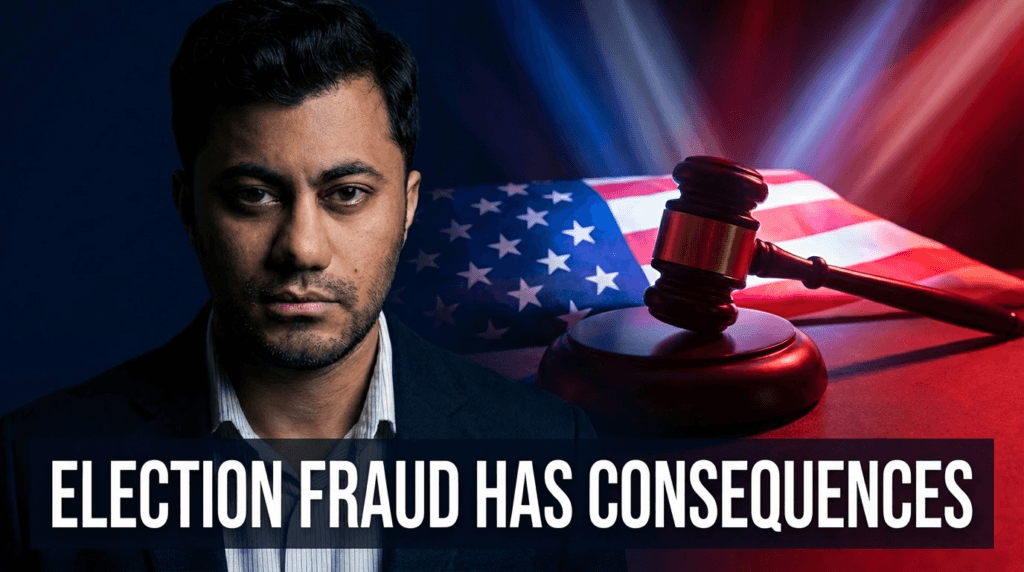
Election Fraud Has Consequences: The Shakir Khan Verdict Is a Win for Democracy
When a Public Servant Betrays the Ballot Box
There is no act more corrosive to a free society than the deliberate manipulation of an election. Democracy does not run on goodwill alone — it runs on trust. When an elected official — someone sworn to uphold that system — deliberately undermines it, the damage is not just legal. It is moral, civic, and deeply personal to every citizen who played by the rules.
On March 2, 2026, that principle was reaffirmed in a San Joaquin County courtroom. Former Lodi City Councilman Shakir Khan was sentenced to three years in county jail after pleading no contest to 77 felony and misdemeanor charges, including election fraud and money laundering. Judge Richard Mallett denied Khan’s last-minute motion to withdraw his plea, and District Attorney Ron Freitas made clear exactly what was at stake: “Today’s sentence shows the seriousness with which we take efforts to tamper with the electoral process in San Joaquin County.”
This case is about far more than one California councilman. It is a case study in why law and order, personal responsibility, and the integrity of our democratic institutions must be defended — loudly, consistently, and without apology.
Support Independent Local Journalism
TheTownHall.News is a non-profit reader-supported journalism. Just $5 helps us hire local reporters, investigate important issues, and hold public officials accountable across Alameda County. If you believe our community deserves strong, independent journalism, please consider donating $5 today to support our work.What Shakir Khan Actually Did
Let’s be clear about the facts, because they are damning.
According to investigators and court records, Khan — while serving as an elected official on the Lodi City Council — stashed 41 ballots at his home during the 2020 election. He also registered 23 individuals at his personal address, and his email address and phone number were used to register an additional 47 voters — voters whose identities and intentions were manipulated for his benefit.
In total, Khan’s scheme sought to put his thumb on the scale of an election that was supposed to reflect the will of the people. He originally faced a possible 40-year state prison sentence. Through a no-contest plea deal reached in January 2024, that was reduced: he will serve two years in county jail, with a third year suspended under mandatory supervision — and an eight-year state prison term held in reserve should he violate the terms of that supervision.
And the wrongdoing did not stop at the ballot box. In February 2025, Khan was also implicated in illegal gambling while serving as a public servant. He admitted to those allegations and was required to forfeit approximately $77,000 in cash and $383,000 in property assets, paid into the general funds of San Joaquin County.

This is not a case of a minor technicality or a bureaucratic slip. This is a pattern of deliberate, calculated abuse of public office.
The Conservative Case for Election Integrity
Conservatives have long understood something the political left has too often been reluctant to acknowledge: election integrity is not a partisan issue — it is a foundational one. The legitimacy of every law passed, every tax levied, every regulation imposed depends on the credibility of the process that put those lawmakers into office.
When votes are manufactured, harvested illegally, or manipulated by insiders, the entire architecture of self-governance collapses. It doesn’t matter whether the culprit leans left or right. What matters is that the rules — the same rules every ordinary citizen must follow — are enforced without fear or favoritism.
This is exactly what conservatives mean when they speak of the rule of law — not a slogan, but a principle: no person, regardless of title or political affiliation, stands above their legal and moral obligations. Shakir Khan was given power by the people of Lodi. He was trusted to represent them. Instead, he treated that trust as a resource to be exploited.
Personal Responsibility Starts at the Top
One of the defining values of conservative thought is personal responsibility — the belief that individuals must own the consequences of their choices. That principle carries special weight for those in public office. Elected officials are not just citizens; they are stewards. They hold power that belongs, in the most fundamental sense, to the people who elected them.
Support Independent Local Journalism
TheTownHall.News is a non-profit reader-supported journalism. Just $5 helps us hire local reporters, investigate important issues, and hold public officials accountable across Alameda County. If you believe our community deserves strong, independent journalism, please consider donating $5 today to support our work.When Khan attempted to withdraw his no-contest plea before sentencing — a motion the court rightly denied — he demonstrated once more a reluctance to own his actions. His effort to reverse course at the final hour was not a legal technicality; it was a continuation of the same evasion that characterized his conduct throughout. The court’s rejection was the right call. Accountability is not negotiable — not for ordinary citizens, and certainly not for public officials.
What This Says About Government Accountability
The Shakir Khan case also speaks to a deeper concern conservatives have raised for years: the dangers of unchecked local government power. At the city council level, where races are decided by small margins and public scrutiny is often limited, the temptation and opportunity for abuse can be significant. Khan’s scheme targeted a local election — the kind of race where a few dozen manipulated ballots can change an outcome entirely.
This is precisely why fiscal accountability and transparency in local government matter so much. Voters who are engaged in local civic life are the most powerful deterrent against this kind of corruption. A community that shows up — at city council meetings, at the polls, and in the public square — is a community far harder to deceive.
It is also worth noting that the San Joaquin County Sheriff’s Office and the Registrar of Voters — two institutions conservatives have long championed — worked alongside the District Attorney to bring this case to justice. When law enforcement is allowed to function without interference, the system works. That is something worth defending.
Justice Delayed, But Not Denied
It took years to bring this case to its conclusion. Khan’s fraud occurred in 2020. His no-contest plea came in January 2024. His sentencing was handed down in March 2026. For the citizens of Lodi who trusted their elected official and had that trust violated, that is a long time to wait.
But the outcome matters. District Attorney Freitas’s message was unambiguous: “Accountability includes honoring the plea and fulfilling the terms of supervision. If Mr. Khan fails to comply, the full consequences of his sentence will be enforced.” That is the language of a justice system that takes its responsibilities seriously — and exactly what Americans should demand from every prosecutor, judge, and elected official.
A Warning to Would-Be Fraudsters
Khan’s post-sentencing statement claimed he was ready to move forward “with integrity.” One can only hope. But the more important message from this case is not directed at Shakir Khan — it is directed at anyone else who might look at a ballot box and see an opportunity rather than a duty.
The message is simple: we are watching, and there are consequences. Elections are not games to be won by whoever bends the rules hardest. They are the mechanism by which a free people governs itself. And as the Shakir Khan case demonstrates, the law will catch up with you.
Conclusion: Guard the Ballot Box Like Your Freedom Depends on It
Because it does.
The sentencing of Shakir Khan is a victory — not for any party or ideology, but for the principle that elections must be free, fair, and above reproach. It is a reminder that when law enforcement does its job, when prosecutors stand firm, and when courts hold the line, justice is possible. But justice in a democracy is never passive. It requires an informed citizenry that refuses to look the other way — voters who show up not just on Election Day, but every day, demanding accountability from those who represent them.
The ballot box is the cornerstone of American freedom. Let’s defend it like it is.