California AB 1607: How a $100 Speeding Ticket Quietly Becomes a $480 Fine
California lawmakers just passed a bill that quietly extends a penalty surcharge stacked on top of your traffic tickets — and most drivers won’t know it’s coming until they open the envelope.
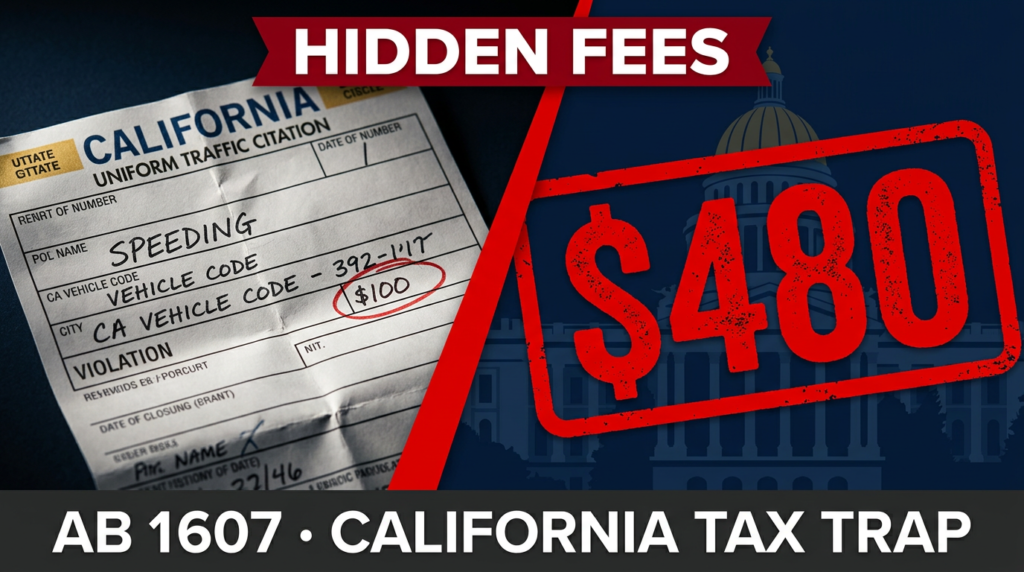
You got a speeding ticket. The officer hands you a citation with a $100 base fine. You wince, but it’s manageable. Then the bill arrives in the mail — and it’s $480.
That’s not a mistake. That’s California government working exactly as its architects designed it. And a bill quietly moving through the state legislature right now is making sure it stays that way.
Support Independent Local Journalism
TheTownHall.News is a non-profit reader-supported journalism. Just $5 helps us hire local reporters, investigate important issues, and hold public officials accountable across Alameda County. If you believe our community deserves strong, independent journalism, please consider donating $5 today to support our work.Assembly Bill 1607, authored by Assemblymember Mark González, passed the California Assembly on April 20, 2026, and has been sent to the Senate. The bill extends — to January 1, 2037, and potentially indefinitely — a county-level penalty surcharge that adds $2 for every $10 in traffic fines, penalties, and forfeitures. That money flows into the Maddy Emergency Medical Services (EMS) Fund, a county-administered pool for emergency care reimbursement. On its face, it sounds benign. But AB 1607 doesn’t exist in a vacuum. It is the latest chapter in California’s long-running practice of using traffic tickets as a stealth revenue machine — one that has been audited, criticized, and repeatedly ignored by the same lawmakers now extending it.
How a $100 Fine Becomes $480: The Fee Stacking No One Talks About
The base fine on a California traffic ticket is only the beginning. Over the past two decades, the state legislature has quietly layered nearly a dozen separate fees and surcharges onto every citation. These are not transparent line items explained to drivers at the roadside. They appear on a bill that arrives weeks later — often quadrupling the original fine.
The list includes state and county penalty assessments, court operations fees, emergency medical services surcharges, DNA identification fund charges, and — remarkably — a Fish and Game Preservation Fund levy that has absolutely nothing to do with driving. Each fee is authorized through separate legislation, buried in budget bills or policy extensions, and rarely debated in public with the full cost impact disclosed.
CBS News California investigated the practice and documented exactly this phenomenon: a driver who ran a red light in 2025 received a citation with a $100 bail amount. Her total bill: $486.

This is not an accident. It is a feature.
A State Audit Demanded Reform. Sacramento Did Nothing.
Here is the part of the story that should anger every California taxpayer regardless of political affiliation.
California’s own Joint Legislative Audit Committee commissioned a formal state audit of the traffic fine and fee structure. The auditor’s conclusions were damning. The fees were described as “seemingly arbitrary” and “not directly connected to the offense.” The audit found no clear evidence the fee amounts were based on actual program needs. Most critically, the auditor explicitly urged lawmakers to “reconsider the entire penalty and fee structure.”
That audit was completed nearly a decade ago.
The legislature’s response? Extend the fees. Renew the surcharges. Add new ones. And now, with AB 1607, push the sunset date out another decade.
Support Independent Local Journalism
TheTownHall.News is a non-profit reader-supported journalism. Just $5 helps us hire local reporters, investigate important issues, and hold public officials accountable across Alameda County. If you believe our community deserves strong, independent journalism, please consider donating $5 today to support our work.Sacramento was told its fee structure was broken and chose to preserve it anyway.
That is not negligent governance. That is deliberate governance — designed to extract maximum revenue from residents while minimizing political accountability.
Who Gets Hurt the Most
Defenders of California’s fee-stacking model often argue these charges fund essential services. The EMS fund, for instance, does support emergency care delivery and, per the bill’s language, directs 15% of collected funds toward pediatric trauma centers. These are legitimate public needs.
But the mechanism for funding them is deeply flawed — and not just politically.
The Western Center on Law and Poverty, a nonpartisan advocacy organization, has pointed directly to the state audit’s finding that traffic fines frequently go unpaid because they impose a significant financial burden on low-income Californians. A $480 bill for a minor speeding infraction is not a manageable inconvenience for a family earning $40,000 a year. It can trigger license suspension, collection action, and a cascade of financial consequences that compound over months.
The people least able to absorb a hidden, fourfold multiplication of their ticket are precisely the ones being asked to fund the state’s revenue shortfalls. That is not law enforcement. It is regressive taxation wearing a traffic citation as a disguise.
The Accountability Gap: When Elected Officials Won’t Answer
San Diego Republican Carl DeMaio brought AB 1607 into public view on April 23, 2026, posting a video on social media calling out the bill’s fee implications. His framing was direct: California Democrats just passed a bill turning a $100 speeding ticket into a $480 fine.
The reaction from supporters of the bill was telling. Rather than offer a detailed, transparent defense of the fee structure — explaining exactly which charges apply, in what amounts, and why — the response leaned toward dismissal.
That pattern is worth naming. When elected officials are confronted with the real-world cost of their legislation and respond with deflection rather than data, it is a signal that the policy cannot survive public scrutiny. Laws that work in the public interest tend to hold up under direct questioning. Laws designed primarily to generate revenue without accountability typically do not.
If the fee structure is fair and justified, lawmakers should be able to explain every dollar of it in plain English. The fact that few can is the story.
What the Other Side Gets Right — and Wrong
To be fair: the Maddy EMS Fund does serve a real purpose. California’s emergency medical system is underfunded in many counties, and hospitals and trauma centers that treat uninsured patients need dedicated revenue streams to stay operational. The California Hospital Association and other healthcare stakeholders formally supported AB 1607 in exactly these terms.
That argument deserves serious engagement. Emergency services are a core function of government. Funding them is a legitimate priority.
But the question is not whether to fund EMS. The question is how. Using traffic fines as a hidden tax engine — stacking fees that multiplied a $100 citation to nearly $500 — is not a defensible funding model. It is opaque, regressive, and specifically designed to avoid the transparency that would come with a direct appropriation or a publicly debated tax increase.
If California’s EMS system needs more money, the legislature should request it openly, vote on it transparently, and let taxpayers weigh in. What it should not do is bury the charge in a traffic ticket and hope no one does the math.
The Bottom Line: This Is a Transparency Problem First
AB 1607 is not the largest bill moving through Sacramento this session. In isolation, the EMS fund surcharge extension is narrow in scope. But it is a precise and revealing example of a broader governing philosophy: when the state needs revenue, find a mechanism that generates it quietly, attach it to something the public already accepts — like traffic enforcement — and renew it before anyone notices.
California drivers already pay some of the highest gas taxes in the nation, some of the highest vehicle registration fees in the country, and some of the highest income taxes anywhere in the developed world. They now also face a traffic citation system in which the number printed on the ticket bears almost no relationship to the bill they’ll actually receive.
The state’s own auditors said the system was broken. The legislature extended it anyway.
That is the story of AB 1607. And it is a story worth sharing.
Take Action
Stay informed. Track AB 1607’s progress through the California Senate at leginfo.legislature.ca.gov. Contact your state senator and make your voice heard before this bill becomes law.
Share this article. Most Californians have no idea their traffic fines are being quietly multiplied by fees they never consented to. Changing that starts with awareness.
Support independent journalism. Stories like this one don’t get told without reporters willing to follow the money. Subscribe, share, and engage — because accountability journalism only works when readers are part of it.
Based on California legislative records, the CalMatters Digital Democracy database, CBS News California investigative reporting, and official Assembly bill analysis documents.