Trump Cancels Pakistan Trip as Iran Peace Talks Stall — And Tehran Blinked First
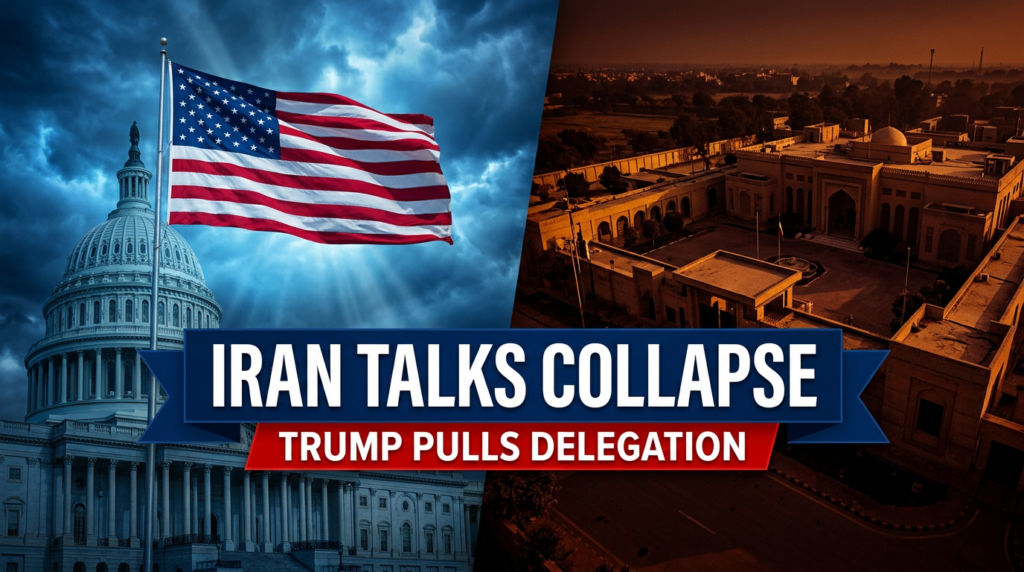
With Iran’s foreign minister already heading home and no deal in sight, Trump’s last-minute cancellation of the Islamabad talks signals a bold shift in America’s negotiating posture — and it may be working.
The scene played out like something straight from a high-stakes poker table. American envoys Jared Kushner and Steve Witkoff were packed and ready to board an 18-hour flight to Islamabad, Pakistan — only to be waved off at the last minute by the President of the United States. The reason? Iran’s foreign minister had already left the building.
Within ten minutes of Trump cancelling the trip, according to the president himself, Iran submitted what he described as a “much better paper.” Whatever was in that document, the message from Washington couldn’t have been clearer: America does not chase deals. Deals come to America.
Support Independent Local Journalism
TheTownHall.News is a non-profit reader-supported journalism. Just $5 helps us hire local reporters, investigate important issues, and hold public officials accountable across Alameda County. If you believe our community deserves strong, independent journalism, please consider donating $5 today to support our work.A War That Was Never Supposed to Happen — and a Peace That Keeps Slipping Away
To understand why Saturday’s diplomatic collapse matters, you have to go back to how we got here.
The 2026 Iran war didn’t emerge from nowhere. It was the direct consequence of years of failed diplomacy — most notably the collapse of the 2015 Joint Comprehensive Plan of Action (JCPOA), which Iran repeatedly violated and which was never backed by the enforcement mechanisms needed to mean anything. After the 12-Day War in June 2025, in which U.S. and Israeli forces struck Iranian nuclear infrastructure, and following a brutal Iranian government crackdown in January 2026 that killed an estimated 30,000 of its own citizens, the region’s tensions had reached a boiling point.
Operation Epic Fury launched on February 28, 2026. Nearly 900 strikes in 12 hours dismantled Iran’s military command structure and killed Supreme Leader Ali Khamenei. What followed was weeks of retaliatory missile and drone strikes across the Gulf region, displacement of over a million people in Lebanon, and oil prices surging from $70 to over $100 per barrel. Commercial traffic through the Strait of Hormuz — through which roughly 20% of global oil passes — dropped more than 90%.
A fragile two-week ceasefire, brokered by Pakistan with Chinese influence, was announced on April 7–8. It did not end the war. It barely paused it.

The Islamabad Talks: 21 Hours, Zero Results
The first formal round of US-Iran negotiations took place in Islamabad on April 11–12, with Vice President JD Vance leading the American delegation and Iranian parliament speaker Mohammad Bagher Ghalibaf representing Tehran. After 21 hours of marathon talks, the two sides left with nothing to show for it.
When talks collapsed, the U.S. Navy began a blockade of the Strait of Hormuz on April 13 — a move that made clear America still holds enormous economic leverage. The ceasefire was later extended indefinitely, pending a new Iranian proposal.
That proposal apparently wasn’t good enough. And that brings us to Saturday.
Iran Left Before America Arrived — That’s the Real Story
Here is the core of what happened on April 25, and why it matters: Iran’s Foreign Minister Abbas Araghchi flew to Islamabad, met with Pakistani Army Chief Field Marshal Asim Munir and Prime Minister Shehbaz Sharif, and then departed for the airport — before any American negotiators had arrived.
Iranian state media and a senior Iranian security official, Ebrahim Azizi, made clear that Araghchi had “no assignment related to nuclear talks” and was there “only for discussions on bilateral relations.” Iran’s state broadcaster described Pakistan’s role as a mere “bridge” for shuttle diplomacy, not a venue for direct negotiation.
Support Independent Local Journalism
TheTownHall.News is a non-profit reader-supported journalism. Just $5 helps us hire local reporters, investigate important issues, and hold public officials accountable across Alameda County. If you believe our community deserves strong, independent journalism, please consider donating $5 today to support our work.Meanwhile, White House Press Secretary Karoline Leavitt had publicly stated that Kushner and Witkoff were heading to Pakistan for “direct talks intermediated by the Pakistanis” with Iran. The two sides couldn’t even agree on what kind of meeting they were having.
Trump’s response was swift and characteristically blunt: “I’ve told my people a little while ago they were getting ready to leave, and I said, ‘Nope, you’re not making an 18-hour flight to go there. We have all the cards.'”
When the other side won’t sit at the table, sending your team halfway around the world isn’t diplomacy — it’s theater.
What Critics Get Wrong About Trump’s Approach
Critics will argue that Trump’s cancellation was impulsive, that diplomacy requires patience, and that abandoning negotiations — however frustrating — risks escalation. These concerns deserve engagement, not dismissal.
But the facts complicate the narrative of American recklessness. The ceasefire, however imperfect, has held since April 8. The blockade of the Strait of Hormuz, widely criticized as provocative, gave the United States enormous economic leverage at the negotiating table. And the very fact that Iran submitted a revised proposal within minutes of Trump’s cancellation suggests that the American position — patient, costly diplomacy — had been interpreted in Tehran as weakness, not good faith.
There is also the matter of fiscal accountability. Trump was direct about the cost calculus: “Traveling takes too long, too expensive. I’m a very cost-conscious person.” In an era of ballooning federal expenditure, using presidential leverage to force the other side to pick up the diplomatic burden is not reckless — it’s rational.
The Confusion Inside Tehran Is a Factor, Not an Excuse
Trump also cited “tremendous infighting and confusion within their ‘leadership'” as a reason for his decision. This is not a throwaway line — it reflects a genuine strategic reality.
Since the killing of Supreme Leader Khamenei in February, Iran has cycled through leadership figures under extraordinary military and economic pressure. De facto authority has shifted multiple times. On the one hand, this internal chaos makes negotiating a final agreement harder; on the other, it makes Iran’s calculus more unpredictable — and more dangerous.
For American policymakers, the lesson is this: you cannot negotiate a durable peace with an institution that doesn’t know its own mind. Any agreement signed today could be repudiated tomorrow by a different faction inside Tehran’s shattered power structure. Recognizing this fragility is not defeatism — it is strategic clarity.
What Comes Next — and Why Americans Should Pay Attention
The stakes here are not abstract. Oil prices remain elevated. U.S. military assets remain deployed at enormous cost across the Middle East. The Strait of Hormuz, a chokepoint for global energy markets, remains contested. Every week without a durable deal is a week of economic strain rippling through gas prices, supply chains, and household budgets at home.
This is not a distant geopolitical chess match. It is a live crisis with direct consequences for American families and the American economy.
Trump’s decision to force Iran to come to the table — rather than flying American envoys 18 hours to be stood up — reflects a negotiating philosophy grounded in strength over accommodation. Whether that approach produces a lasting deal or a deeper impasse will define not just this presidency’s foreign policy legacy, but the stability of a region the world depends on.
If Iran wants peace, as its mediators insist, it knows how to pick up the phone.
🔑 Key Takeaway
The second round of US-Iran peace talks collapsed on April 25, 2026, after Iran’s delegation left Islamabad before American envoys arrived. President Trump cancelled the trip and within minutes received what he called a “much better” Iranian proposal. The episode underscores a core principle: leverage, not accommodation, moves adversaries. The world is watching to see whether Tehran responds with substance — or silence.
Stay informed on this developing story. If you found this article valuable, share it with your network — independent journalism depends on engaged, informed readers like you. Subscribe to our newsletter and never miss a critical update.