Senate Passes ICE and Border Patrol Budget Reconciliation in 50-48 Vote — But the DHS Shutdown Isn’t Over Yet
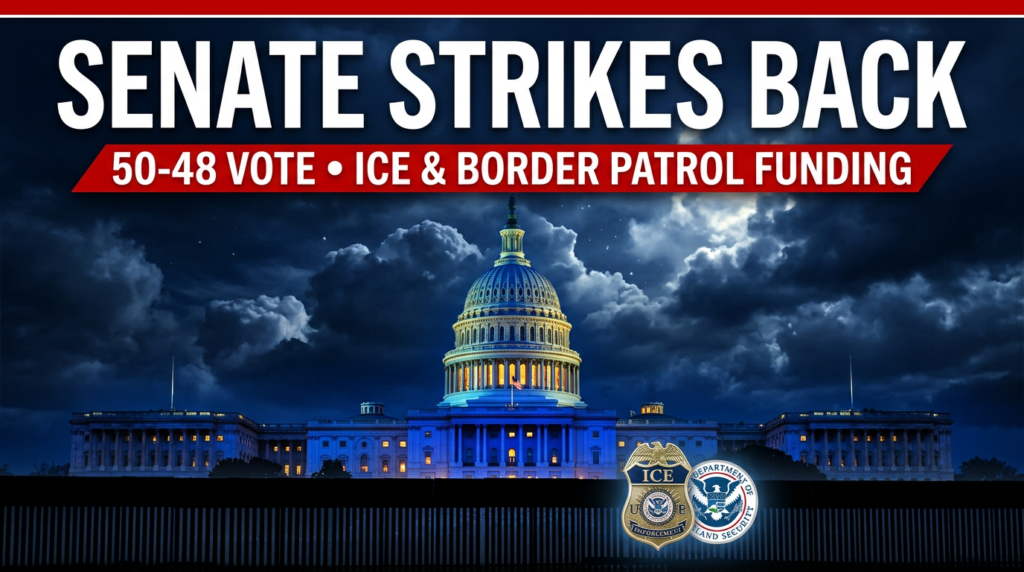
After 68 days of a partial DHS shutdown and months of collapsed bipartisan negotiations, Senate Republicans have cleared a critical procedural hurdle to fund America’s immigration enforcement agencies — bypassing Democratic obstruction through a historic budget reconciliation move. But the finish line is still ahead.
At 3:30 in the morning on Thursday, April 23, 2026, the United States Senate passed a budget resolution by a 50-48 vote — setting in motion a process to deliver $70 billion to Immigration and Customs Enforcement and Customs and Border Protection. The vote came after an exhausting overnight “vote-a-rama,” a marathon session of procedural amendments unique to the budget reconciliation process.
For 68 days prior, a partial Department of Homeland Security shutdown had left two of America’s most critical law enforcement agencies in bureaucratic limbo. Border communities, immigration courts, and the men and women on the front lines of enforcement operated under the shadow of a funding impasse driven, in large part, by Democratic demands to curtail immigration operations — demands that followed the deaths of two American citizens in Minneapolis involving federal immigration enforcement agents.
Support Independent Local Journalism
TheTownHall.News is a non-profit reader-supported journalism. Just $5 helps us hire local reporters, investigate important issues, and hold public officials accountable across Alameda County. If you believe our community deserves strong, independent journalism, please consider donating $5 today to support our work.For the first time in months, a path forward exists. But calling the battle won would be premature.
What the Senate Actually Voted On — And Why It Matters
Let’s be precise about what Thursday’s vote was and wasn’t.
The Senate did not pass a spending bill. Republicans approved a budget resolution — a non-binding procedural document that instructs Senate committees to begin drafting filibuster-proof legislation to fund ICE and Border Patrol. That bill, when written, would move through the budget reconciliation process, requiring only a simple majority — 51 votes — rather than the 60 votes needed to overcome a Democratic filibuster.
This distinction matters enormously. For months, Democrats wielded the filibuster as a political shield, blocking Republican attempts to fund the agencies while attaching operationally disruptive demands — including restrictions on where ICE agents could conduct enforcement and requirements that would expose agent identities during active raids. Republicans refused. Bipartisan negotiations collapsed entirely.

By moving to reconciliation, the GOP has found a constitutional path around the blockade. Senate Majority Leader John Thune (R-SD) put it plainly: “At the end, Republicans will have helped ensure that America’s borders are secure and prevented Democrats from defunding these important agencies.”
68 Days: The Real Cost of the DHS Funding Standoff
Sixty-eight days is a long time for the agencies responsible for securing America’s borders to operate without a clear funding mandate.
The partial DHS shutdown didn’t simply create administrative headaches. It sent a signal — to agents in the field, to communities along the southern border, and to those watching from abroad — that America’s commitment to law enforcement could be held hostage by political brinkmanship. Those who believe in the rule of law understand that a functioning immigration enforcement system is not optional. It is the backbone of national sovereignty.
When ICE and CBP lack reliable funding, criminal networks notice. Trafficking operations notice. The border is not a metaphor — it is a physical line that requires consistent, well-resourced enforcement.
The DHS shutdown was not a principled policy disagreement. It was a political weapon deployed against the agencies that stand between order and chaos.
Support Independent Local Journalism
TheTownHall.News is a non-profit reader-supported journalism. Just $5 helps us hire local reporters, investigate important issues, and hold public officials accountable across Alameda County. If you believe our community deserves strong, independent journalism, please consider donating $5 today to support our work.Thursday’s vote begins to dismantle that weapon.
Republican Fractures — And What They Signal
The 50-48 vote was not without dissent. Two Republican senators broke ranks.
Sen. Rand Paul (R-KY) opposed the resolution on fiscal grounds, raising concerns about authorizing another $70 billion in new spending at a time of significant national debt. His objection is principled and worth acknowledging — fiscal discipline is not a partisan issue, it is a constitutional one. A government that spends without restraint undermines the very economic foundation that makes all other functions of governance possible.
Sen. Lisa Murkowski (R-AK) also voted against the resolution. These defections carry real forward-looking weight. Republicans will need to hold 50 of their 53 caucus members to pass the actual funding legislation when it emerges from committee. That means leadership can absorb virtually no further defections.
The overnight vote-a-rama also revealed fault lines on other issues. Democratic amendments targeting healthcare costs drew notable crossover votes from Sens. Susan Collins (R-ME) and Dan Sullivan (R-AK) on one amendment, and an additional break from Sen. Josh Hawley (R-MO) on a separate measure. The Republican majority is achievable — but it is not guaranteed. Every vote will matter.
What Democrats Got Wrong — And What This Vote Exposes
Democrats framed their opposition as a matter of civil liberties and agency accountability. Senate Minority Leader Chuck Schumer took to the floor to denounce ICE and Border Patrol as “two unchecked rogue agencies,” and argued Republicans were prioritizing immigration enforcement over healthcare costs, housing, and grocery prices.
It is a politically crafted message. It is also a false choice.
Funding immigration enforcement does not preclude addressing the cost of living. What it does prevent is the systematic hamstringing of agencies that Congress itself created and that federal courts have consistently upheld as lawful. The Democratic position effectively demanded that ICE expose agent identities during operations — a requirement that experienced law enforcement officials have warned would endanger lives and compromise active cases.
More fundamentally, the Democratic argument conflates accountability with defunding. They are not the same. Real accountability requires oversight, transparency, and the rule of law — not operational restrictions engineered to prevent enforcement from functioning. Republicans now have a clear opportunity to demonstrate that distinction by ensuring the final reconciliation bill includes meaningful oversight language without crossing into political sabotage.
What Comes Next — The Road to Full DHS Funding
Thursday’s vote is step one of a multi-step process.
The budget resolution now travels to the House of Representatives for approval. If the House passes it, Senate committees will begin drafting the actual $70 billion ICE and CBP funding bill under reconciliation rules. That legislation will then require another Senate vote — one that must clear 50 Republican votes to succeed.
Simultaneously, House Republican leaders have signaled they may now move forward with the separately negotiated, bipartisan Senate-passed bill that would fund the rest of DHS — the departments and agencies not covered under the reconciliation framework. If that happens, the 68-day partial shutdown could effectively end even before the ICE and CBP reconciliation bill reaches a final vote.
The path is clear. The political will is largely present. What remains to be seen is whether Republican leadership can hold its coalition intact through what promises to be another bruising legislative stretch.
The Case Against — And Why It Falls Short
Critics will argue that bypassing bipartisan negotiations in favor of a party-line reconciliation process is poor governance — a short-term political win that deepens Washington’s institutional dysfunction.
It is a concern worth taking seriously. Bipartisan appropriations are genuinely preferable when they are genuinely achievable. But the record here is unambiguous: months of negotiations collapsed not because Republicans refused to fund DHS, but because Democrats attached conditions specifically designed to limit immigration enforcement — not improve it. When one side uses the legislative process to undermine law enforcement rather than oversee it, the other side is left with limited options.
Budget reconciliation is a constitutional instrument. Using it to fund agencies that protect the nation’s borders is not a procedural abuse — it is a measured response to one.
A Win — But Not the Last Battle
Thursday’s 50-48 vote is a genuine milestone. After 68 days of a grinding partial DHS shutdown and the collapse of bipartisan talks, Senate Republicans have secured a viable path to fund the agencies that enforce America’s immigration laws and secure its borders.
But it is a first step, not a finish line. The budget resolution needs House approval. The actual funding bill must be written, debated, and passed with a coalition that has already shown cracks. Democratic pressure — both in the chamber and in the press — will not relent.
What is not in question is the principle at stake: a functioning government must be able to fund its law enforcement agencies without being held hostage to demands designed to hamper those agencies from doing their jobs. That principle survived the night on Thursday.
The question is whether it survives the weeks ahead.
Key Takeaway
The Senate’s 50-48 vote on April 23, 2026, is a significant procedural victory for Republicans pursuing full ICE and Border Patrol funding — but the DHS shutdown continues, the House must act next, and the final bill is still being written. The most consequential vote hasn’t happened yet.
Stay Informed. Get Involved.
This story is moving fast and the implications are real — for border security, the rule of law, and the integrity of the federal budget process. Share this article with anyone who believes government should fund its enforcement agencies without political strings attached. Subscribe to stay ahead of every development as this fight moves to the House. Independent journalism depends on engaged readers — be one.