Somalia TPS Ruling 2026: What the Burroughs Order Means
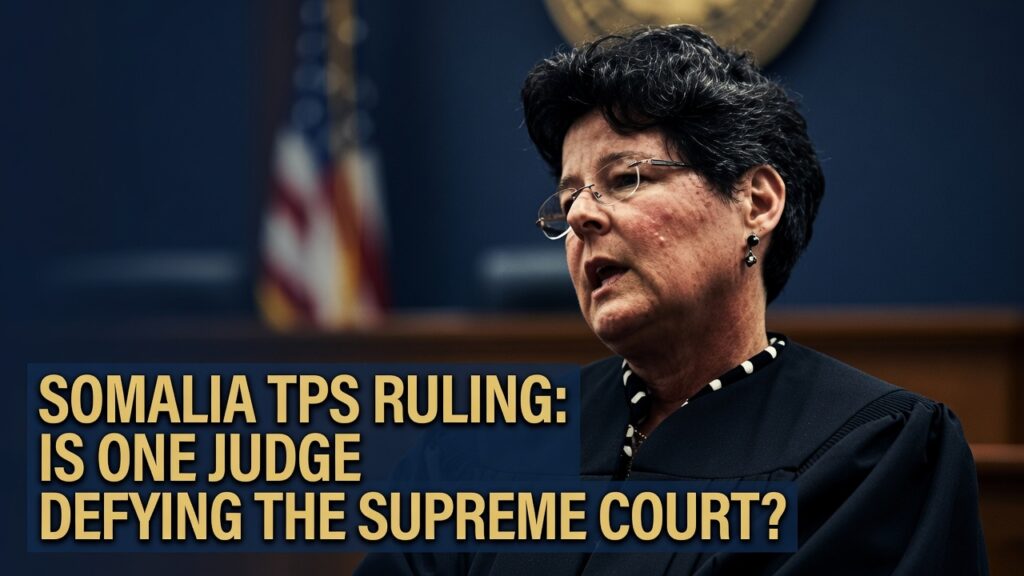
As the Trump administration presses ahead with ending Temporary Protected Status nationwide, a Boston judge keeps hitting pause on Somalia’s case. The question millions are now asking: who actually gets the final word on immigration policy?
A federal judge in Boston just blocked the Trump administration from ending deportation protections for Somali nationals. Again. It is the second time in five months Judge Allison Burroughs has stopped the termination of Somalia’s Temporary Protected Status designation, and it comes just weeks after the Supreme Court ruled on a related question.
That timing is exactly why this case matters right now. On June 25, the Supreme Court ruled 6-3 that federal courts generally cannot second-guess a Homeland Security Secretary’s decision to end TPS for a country, clearing the way for the administration to strip protections from more than 350,000 Haitians and 6,000 Syrians [Supreme Court opinion]. Five weeks later, a different federal judge extended a block on Somalia’s TPS anyway.
Support Independent Local Journalism
TheTownHall.News is a non-profit reader-supported journalism. Just $5 helps us hire local reporters, investigate important issues, and hold public officials accountable across Alameda County. If you believe our community deserves strong, independent journalism, please consider donating $5 today to support our work.Who Is Judge Allison Burroughs?
Burroughs is a U.S. District Judge in Massachusetts, appointed by President Obama in 2014. She has presided over several high-profile disputes with the Trump administration, including a 2025 order temporarily blocking DHS from revoking Harvard University’s ability to enroll international students [court record].
In March, Burroughs issued an emergency administrative stay just days before Somalia’s TPS designation was set to expire, ruling the termination “null, void, and of no legal effect” while litigation proceeded. On July 31, after plaintiffs filed an amended complaint and a new emergency motion, she issued another stay. DHS has not minced words about it. A department spokesperson previously called an earlier Burroughs order “the latest example of judicial activists trying to prevent President Trump from restoring integrity to America’s legal immigration system.” If unelected judges can keep overriding a cabinet secretary’s statutory authority, who is actually running immigration policy?
Does the Supreme Court’s Ruling Actually Cover Somalia?
Here is where the story gets more complicated than the headlines suggest. The Supreme Court’s June ruling addressed two specific cases involving Haiti and Syria, not Somalia [Supreme Court opinion, Mullin v. Doe]. The justices held that TPS termination decisions are generally shielded from judicial review under the governing statute, but the Somalia lawsuit is a separate case built on an amended complaint with its own procedural posture.
That distinction matters legally, even if it feels like a technicality to frustrated observers. Immigration attorneys who track TPS litigation widely expect the Supreme Court’s reasoning to eventually doom challenges like Somalia’s, Ethiopia’s, and Venezuela’s as those cases work through the courts [immigration law analysis, AILA practice alert]. But “eventually” is not “already.” Is a five-week gap between a Supreme Court ruling and a lower court order really open defiance, or is it a legal system still catching up to a fast-moving precedent?

What Do the Numbers Actually Tell Us?
More than 100,000 Somali nationals live in the United States, with thousands holding or pending TPS applications tied to Somalia’s decades of civil conflict [DHS-adjacent reporting; exact eligible-population figures vary by source]. That status was first granted in 1991 and has been renewed repeatedly since. One judge’s order now determines whether a population larger than many American towns keeps its legal work authorization. Where is the accountability for the people whose lives hinge on a single docket?
Why Does This Keep Happening?
Somalia is not an isolated case. A separate federal judge, Brian Murphy, indefinitely extended a block on ending TPS for Ethiopians last month, prompting a DHS official to accuse district judges of “mutiny against the Supreme Court” [DHS official statement]. Taken together, these rulings suggest a pattern: district courts entertaining new legal theories and amended complaints to keep TPS terminations frozen even after the Supreme Court weighed in on the underlying legal question.
“Is a five-week gap between a Supreme Court ruling and a lower court order really open defiance, or is it a legal system still catching up to a fast-moving precedent?”
Supporters of strict immigration enforcement see this as exactly the kind of judicial overreach that erodes public trust in elections and executive authority. When voters elect a president who campaigns on ending abuse of humanitarian parole programs, and courts repeatedly intervene through procedural maneuvers, it raises a legitimate question about who voters can actually hold accountable.
What Do Supporters of the Somalia Stay Actually Believe?
Advocates for the Somali plaintiffs argue this is not defiance at all but ordinary due process. They point out that Burroughs did not rule TPS terminations unconstitutional; she granted a temporary administrative stay so the court could review a newly amended complaint — the kind of procedural pause available in any federal case. Plaintiffs’ representatives have said publicly they are “heartened” by interim protection while acknowledging “many battles lie ahead” [plaintiffs’ counsel statement].
That argument deserves a fair hearing. Federal courts routinely grant short administrative stays to review new filings without deciding the merits. But the pattern across Somalia, Ethiopia, and other pending cases suggests something beyond routine housekeeping: a coordinated legal strategy to keep terminations frozen indefinitely, one amended complaint at a time, even as the Supreme Court’s guidance grows clearer with each ruling. Process matters, but so does an executive branch’s ability to actually execute the policies voters elected it to carry out.
Support Independent Local Journalism
TheTownHall.News is a non-profit reader-supported journalism. Just $5 helps us hire local reporters, investigate important issues, and hold public officials accountable across Alameda County. If you believe our community deserves strong, independent journalism, please consider donating $5 today to support our work.356,000. That is roughly how many Haitians and Syrians alone are now expected to lose protected status following the Supreme Court’s ruling [legal reporting estimate]. The question no one in Washington wants to answer: why does one country’s caseload move forward while another, with a similar legal posture, keeps getting paused?
Key Questions This Case Raises
- Does a Supreme Court ruling on TPS for one country legally bind lower courts handling TPS cases for other countries?
- How many more amended complaints can plaintiffs file before a “temporary” administrative stay becomes a permanent block in practice?
- Who is ultimately accountable to voters when courts, not elected officials, control the pace of immigration enforcement?
Is This the Accountability Moment We’ve Been Waiting For?
Congress created TPS in 1990 as short-term humanitarian relief, not a permanent status. The Supreme Court’s June ruling reaffirmed that termination decisions belong to the executive branch, not the courts. If the law says the decision belongs to the Secretary of Homeland Security, why is a single district judge still making it instead?
That is the tension at the heart of the Somalia case. It is not yet legally resolved, and casting it as flat defiance of the Supreme Court oversimplifies a case built on new claims still working through the system. But the pattern of repeated stays, amended complaints, and DHS’s increasingly blunt public statements suggests a courtroom fight over who truly controls immigration policy in this country.
The real question is not whether the Supreme Court will eventually settle Somalia’s case the way it settled Haiti’s and Syria’s. It is whether anyone will be held accountable for how long that process takes.
Still have questions about how this case unfolds? Stay informed — subscribe for daily coverage of the courts shaping immigration policy. Think others need to see this? Share the article. Want your voice to count? Contact your congressional representatives and urge them to clarify TPS judicial review standards through legislation rather than leaving it to case-by-case litigation.