California Mileage Tax: Democrats Block Ban and Leave Drivers Facing $900-a-Year Double Tax
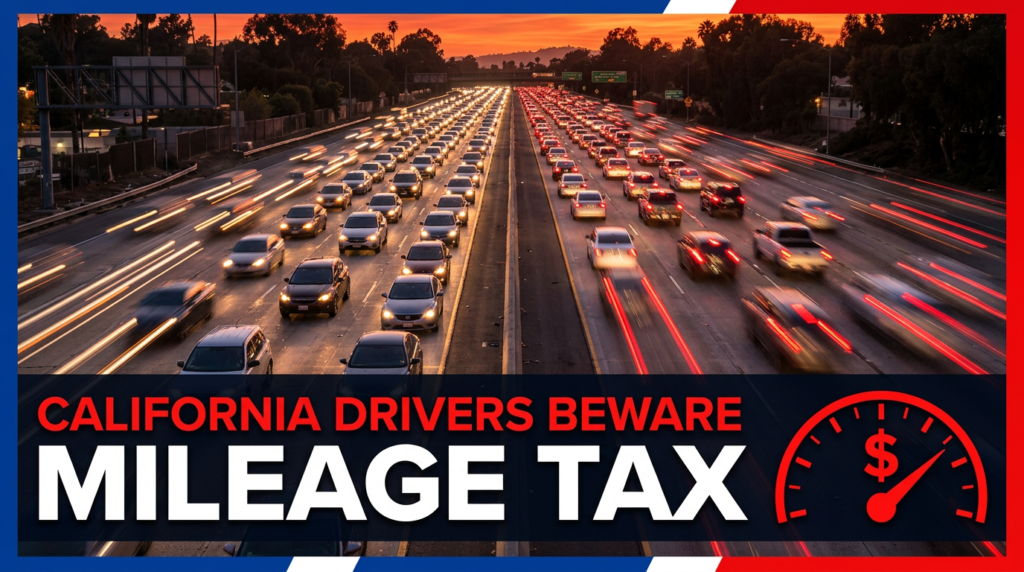
Sacramento lawmakers just voted down a constitutional guardrail that would have protected California drivers from being charged twice just to get to work. Here’s what they don’t want you to know.
Every morning, millions of Californians climb into their cars to drive to work, drop off their kids, or run a small business. They already pay the highest gas tax in the nation — and now Sacramento Democrats are laying the groundwork to charge them again, by the mile.
In a move that has ignited outrage across the state, California Assembly Democrats voted in early February 2026 to block a proposed constitutional amendment that would have barred a new per-mile driving tax from being stacked on top of the gas tax drivers already pay. The vote wasn’t close. It wasn’t subtle. And it sent a clear message: Sacramento politicians believe your wallet is their resource.
Support Independent Local Journalism
TheTownHall.News is a non-profit reader-supported journalism. Just $5 helps us hire local reporters, investigate important issues, and hold public officials accountable across Alameda County. If you believe our community deserves strong, independent journalism, please consider donating $5 today to support our work.What Just Happened in Sacramento
The controversy centers on Assembly Bill 1421, passed by the California Assembly on January 29, 2026. Authored by Democratic Assemblymember Lori Wilson, the bill directs the California Transportation Commission to deepen its study of a Vehicle Miles Traveled (VMT) fee — a charge assessed on drivers for every mile they drive — as a potential replacement for the state’s gas tax.
Republicans immediately moved to put guardrails around any future implementation. ACA 12, authored by Assemblymember Wallis, would have enshrined taxpayer protections directly into the California Constitution — specifically prohibiting a mileage tax from being imposed on top of the existing gas tax and requiring any per-mile charge to be fair and uniform.
Democrats voted it down on February 2, 2026.
That vote matters enormously. By refusing to write those protections into the Constitution, Democrats left the door wide open to a scenario where Californians pay both a gas tax and a mileage tax simultaneously — a genuine double taxation of the act of driving.

The Numbers Don’t Lie: $900 More Per Driver, Per Year
The cost projections are not hypothetical. California has already run a pilot program using a 6-cent-per-mile road charge rate. Do the math: the average California driver logs approximately 15,000 miles per year. At six cents a mile, that’s $900 annually — on top of gas taxes that already add up to between $300 and $600 per year for most drivers.
For a working family with two cars, that’s potentially $1,800 in new annual costs layered onto fuel taxes, registration fees, and the general cost of living in a state that already ranks among the most expensive in the country.
“This is the last thing we should be thinking about — creative ways to tax Californians who already pay among the highest taxes while having the highest cost-of-living in the country.” — Assemblymember Heath Flora (R)
These are not abstract policy numbers. For a nurse driving 45 minutes to a hospital, a contractor hauling equipment across the county, or a parent shuttling children between school and activities, this is real money disappearing from real family budgets.
Why This Issue Matters Right Now
California’s transportation funding situation is genuinely complex. The state faces a projected $215 billion transportation funding gap over the next decade, driven in part by declining gas tax revenue as more drivers switch to electric and hybrid vehicles. Electric vehicle owners currently pay as little as $117 per year toward road maintenance through registration fees, while gas-powered vehicle owners contribute $300 to $600 annually through fuel taxes. That imbalance is a legitimate policy problem.
But here’s where fiscal accountability must enter the conversation: the answer to a funding gap is not always a new tax. It is first a serious audit of how existing revenue is being spent.
Support Independent Local Journalism
TheTownHall.News is a non-profit reader-supported journalism. Just $5 helps us hire local reporters, investigate important issues, and hold public officials accountable across Alameda County. If you believe our community deserves strong, independent journalism, please consider donating $5 today to support our work.California has one of the largest state budgets in the world — larger than most countries. Before asking drivers to pay more, Sacramento owes taxpayers a transparent accounting of where transportation dollars have gone, why infrastructure remains underfunded despite decades of gas tax collections, and whether the state’s spending priorities are actually aligned with the public’s needs.
The mileage tax debate is arriving at a moment when California voters are already stretched thin, already skeptical of Sacramento’s fiscal management, and already watching their purchasing power erode. The timing is not coincidental — it is politically tone-deaf.
What Critics of the Opposition Get Wrong
Supporters of AB 1421 argue the bill does nothing more than mandate a study. Assemblymember Wilson has been explicit: “What this bill does is bring together all the work that’s already been done — by universities, state agencies, and pilot programs — and ask for a complete report back to the Legislature.”
That argument deserves a fair hearing — and it’s true that AB 1421 does not, by itself, create a new tax. Studies are not laws.
But the refusal to attach constitutional protections to that study is where the “it’s just research” defense collapses. If the intent is purely to study a VMT fee as a replacement for the gas tax, there should be no objection to writing that replacement requirement into the Constitution. The fact that Democrats blocked ACA 12 — which would have done exactly that — suggests the “replacement, not addition” framing may be more aspirational than binding.
Voters are right to read the fine print. Policy studies have a well-documented history of becoming policy reality, especially when the fiscal incentives for government are strong.
The Surveillance Question Nobody Is Asking Loudly Enough
Beyond the dollars, there is a civil liberties dimension to the mileage tax conversation that deserves serious public debate.
A per-mile driving charge requires tracking how far you drive. That means some mechanism — whether odometer reporting, GPS monitoring, or a connected device — must record your vehicle’s movement. For a state government to bill you by the mile, it must first know how many miles you drove.
California residents have legitimate questions about what data would be collected, how it would be stored, who could access it, and how long it would be retained. These are not fringe concerns. They are the kinds of questions a free society should ask before authorizing any government program that creates a database of citizen movement.
The mileage tax is not just a fiscal issue. It is a question of how much of your daily life you are willing to hand over to a government agency in exchange for the privilege of driving on roads your taxes already built.
How This Affects Families and Communities
The burden of a mileage tax would not fall evenly. Urban residents with access to public transit, remote workers who rarely commute, and higher-income households that can absorb new costs would fare far better than working-class families in suburban and rural California who have no alternative to driving.
A farmworker in the Central Valley. A home health aide in the Inland Empire. A small business owner making multiple deliveries per day. These are the people for whom a 6-cent-per-mile charge is not an inconvenience — it is a genuine financial hardship.
Policies that disproportionately burden lower and middle-income workers while being designed and voted on by legislators who face no such constraints represent exactly the kind of governing-class disconnect that erodes public trust in democratic institutions.
Key Takeaway
California Democrats had an opportunity to show voters they take the threat of double taxation seriously. They declined. By blocking ACA 12, they chose to preserve maximum flexibility for a future mileage tax — and left drivers with no constitutional protection against being charged at the pump and by the mile.
Governor Newsom’s office has indicated he would not sign a mileage tax in its current form. But governors change, political priorities shift, and studies have a way of becoming legislation. The time to draw the line is before the infrastructure for a new tax is fully built — not after.
Conclusion: Your Car. Your Wallet. Your Vote.
The California mileage tax debate is about more than transportation funding. It is about whether government has a responsibility to live within its means before reaching further into the pockets of working families. It is about whether civil liberties matter even when the policy justification sounds reasonable. And it is about whether voters in California — and across the country — are paying attention.
Sacramento is counting on you not to be.
The vote on ACA 12 was a test of political will. Democrats failed it. Now the question is what California voters will do with that information in November.
Stay informed. Share this article. Engage your elected officials. Democracy works best when citizens are watching.