SPLC Indicted on Federal Fraud Charges: What the DOJ’s 11-Count Case Against the Southern Poverty Law Center Really Means
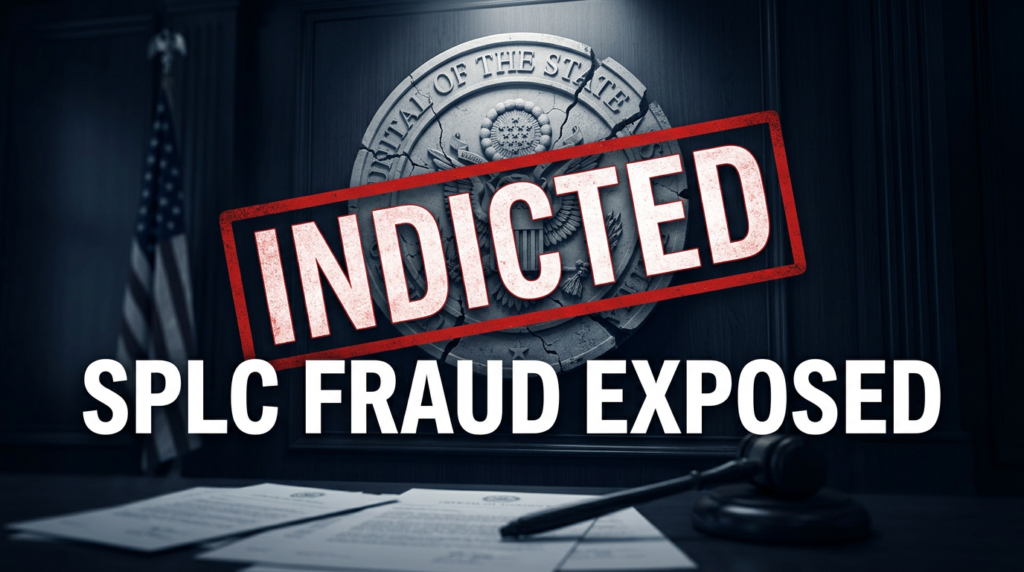
A federal grand jury has charged the Southern Poverty Law Center with 11 counts of wire fraud, false statements, and money laundering conspiracy — alleging the organization secretly funneled more than $3 million in donor dollars to members of the very extremist groups it claimed to oppose.
For decades, the Southern Poverty Law Center operated as one of America’s most powerful — and most profitable — moral authorities. Its “hate group” designations shaped federal law enforcement priorities, influenced major tech platforms, and unlocked hundreds of millions in charitable donations from Americans who believed they were funding the fight against bigotry. On April 21, 2026, that carefully constructed image cracked wide open.
A federal grand jury in Montgomery, Alabama, returned an 11-count indictment against the SPLC, alleging that between 2014 and 2023, the organization secretly funneled more than $3 million in donor funds to individuals affiliated with some of the nation’s most notorious violent extremist groups — the very organizations the SPLC publicly claimed to be dismantling. Acting Attorney General Todd Blanche and FBI Director Kash Patel announced the charges jointly, calling it one of the most consequential nonprofit fraud prosecutions in recent memory.
Support Independent Local Journalism
TheTownHall.News is a non-profit reader-supported journalism. Just $5 helps us hire local reporters, investigate important issues, and hold public officials accountable across Alameda County. If you believe our community deserves strong, independent journalism, please consider donating $5 today to support our work.What the Federal Indictment Actually Charges
The 11-count indictment includes six counts of wire fraud, four counts of making false statements to a federally insured bank, and one count of conspiracy to commit concealment money laundering. Federal prosecutors also filed two separate forfeiture actions to recover alleged proceeds of the scheme.
According to the Department of Justice, the SPLC operated a covert network of “field sources” — individuals either embedded within or actively recruited into extremist organizations. The groups named in the indictment include the Ku Klux Klan, the United Klans of America, the National Alliance, the National Socialist Movement, Unite the Right, the Aryan Nations-affiliated Sadistic Souls Motorcycle Club, the American Nazi Party, and the American Front.
To conceal the payments, prosecutors allege the SPLC opened bank accounts connected to fictitious entities — shell companies designed to disguise the true nature, source, and control of the money. The organization then allegedly made false statements to banks to maintain those accounts and keep the operation hidden from public view.
“The SPLC is manufacturing racism to justify its existence. Using donor money to allegedly profit off Klansmen cannot go unchecked.” — Acting AG Todd Blanche

A Fundamental Betrayal of Donor Trust
At the core of the DOJ’s case is a straightforward allegation: the SPLC raised money by telling donors it was fighting extremism while simultaneously paying the leaders of extremist groups with those same donated dollars.
That is not a bookkeeping error. If proven, it represents a fundamental betrayal of every American who wrote a check believing their generosity was being used to combat hatred. Acting U.S. Attorney Kevin Davidson put it plainly: “Donors gave their money believing they were supporting the fight against violent extremism. As alleged, the SPLC instead diverted a portion of those funds to benefit individuals and groups they claimed to oppose. That kind of deception undermines public trust and social cohesion.”
The financial stakes are significant. According to the SPLC’s own audited financial statements, the organization reported over $786 million in net assets for fiscal year 2024, with total assets exceeding $822 million and $129 million in annual revenue. The question now before a federal court is whether that empire was built, at least in part, on fraud.
The Investigation That Was Shut Down — Then Revived
One of the most politically significant details in this case is its recent history. Acting AG Blanche confirmed that the federal investigation into the SPLC had been shut down during the Biden administration before being revived under President Trump’s second term.
That admission raises serious questions. If investigators had sufficient grounds to build an 11-count federal indictment, why was the case halted for years? Was the decision driven by prosecutorial judgment — or by the SPLC’s political alignment with the previous administration’s priorities?
Support Independent Local Journalism
TheTownHall.News is a non-profit reader-supported journalism. Just $5 helps us hire local reporters, investigate important issues, and hold public officials accountable across Alameda County. If you believe our community deserves strong, independent journalism, please consider donating $5 today to support our work.These are not partisan talking points. They are the kinds of questions that Americans across the political spectrum should be asking about equal justice under law. A small business owner who misrepresents how he spends client funds faces immediate legal consequences. The same standard must apply to an organization of this size and influence — regardless of how many powerful friends it has in Washington.
Why This Case Reaches Far Beyond the Courtroom
The SPLC’s “hate group” designations have had consequences that extend well beyond fundraising brochures. For years, federal agencies, major technology platforms, financial institutions, and newsrooms have cited SPLC designations to justify deplatforming, defunding, and discrediting organizations — including mainstream conservative advocacy groups, Christian ministries, and civic associations that have never engaged in violence of any kind.
Families who support faith-based charities, veterans’ organizations, and traditional civic groups have watched those institutions labeled “extremist” by an organization that — if the DOJ’s charges are proven — was paying actual extremists with those same donor dollars.
If the SPLC was writing checks to Klansmen while labeling Christian organizations as hate groups, the credibility of its entire designation apparatus must now be seriously reconsidered.
This is a question of institutional accountability — the same accountability that citizens committed to limited government, fiscal transparency, and free expression have demanded of public institutions for generations.
What the SPLC Says — and Where the Argument Falls Short
The SPLC is not staying silent. Interim CEO Bryan Fair called the allegations “false” and accused the Trump administration of targeting the organization. He argued that the sources paid by the SPLC were legitimate confidential informants who “risked their lives to infiltrate and inform on” violent extremist groups, and that the intelligence they provided was shared with the FBI and “saved lives.”
That counterargument deserves a fair hearing. Confidential informant programs are a legitimate and long-established law enforcement tool. If the SPLC was running a properly structured intelligence operation in genuine coordination with federal authorities, that context matters enormously — and the courts will weigh it carefully.
But the argument runs into a significant problem: the DOJ alleges that the SPLC used fictitious shell companies and made false statements to federally insured banks to conceal these payments. Legitimate, above-board informant programs do not typically require concealment money laundering charges. The organization also allegedly failed to disclose these payments to its own donors — the people whose trust and generosity funded the entire operation.
Transparency is not optional when you are asking the public for money. That gap between what donors were told and what allegedly happened is the heart of this case.
The Principle That Cannot Be Compromised
Americans who believe in personal responsibility, fiscal accountability, and equal justice have long argued that powerful institutions must be held to the same standards as everyone else. That principle is on trial here as much as the SPLC itself.
The indictment does not guarantee a conviction. The SPLC is presumed innocent until proven guilty, and the case will be decided in a federal courtroom — as it must be. But the charges demand a broader reckoning: with how much unchecked power this organization accumulated, how little scrutiny it received, and what it means for the thousands of Americans whose reputations were damaged by its designations.
Equal justice under law is not a slogan. It is the foundation of a functioning republic. No institution — regardless of its branding, its endowment, or its political connections — is above the law.
Key Takeaway
The SPLC indictment is not just a legal story. It is a story about accountability, donor trust, and the cost of allowing powerful institutions to operate for decades without meaningful scrutiny. Whatever the verdict, the questions this case raises will not disappear when the courtroom doors close.
Stay Informed. Stay Engaged.
Stories like this one don’t always get the coverage they deserve. Independent journalism exists to make sure you get the full picture — not the curated version. If this story matters to you, share it with someone who needs to read it. Subscribe to our newsletter to stay ahead of the news cycle. Civic engagement starts with being informed.
The Town Hall News is committed to fact-based reporting and editorial independence. This article is based on verified DOJ court filings, official press statements, and publicly available financial disclosures.